Vigilo

Guy Patrick
Gregson

Major-General, Royal Horse Artillery
CB · CBE · DSO & Bar · MC
1906 — 1988
A Private Family Archive

Contents

IThe Sudan Years1937–1941
IITwo Brothers in the Desert1942
IIIThe Desert Rats1942–1943
IVThe Day After Wittmann13–15 June 1944
V37,818 ShellsKorea, 1952–1953
VIA Lighter, More Mobile Force1954–1959
VIIThe Retirement That Wasn’t1960–1988
VIIIThe Loose ReinA Son’s Portrait
Chapter One

The Sudan Years

1937–1941

In the mountains above Keren, in February 1941, the Italian bombers came through low. Guy Gregson’s gun troop — four 3.7-inch pack howitzers crewed by Sudanese cavalrymen who had never seen an artillery piece eight months earlier — was dug in next to a British regular battery. The ground shook. Men were hit on both sides of the line. And then his soldiers turned to him and asked a question that, forty years later, he could still hear.

“They said to me, ‘is that the way to behave?’ Pointing to the British battery, who hadn’t batted an eye, and was steady as rocks. ‘Oh, yes, of course,’ scared stiff myself. But you know, ‘yes, that’s quite the way to behave.’ And from then on, they never moved at all.”

— Guy Gregson, IWM Sound 4424, recorded 21 May 1979

The Battle of Keren was the largest set-piece engagement of the East Africa campaign — two Indian divisions, a Free French brigade, and elements of the Sudan Defence Force thrown against an Italian garrison of twenty-three thousand men dug into a natural mountain fortress. General Platt told his officers before the assault: “It is going to be a bloody battle, against both the enemy and the gruelling, gruesome ground.” He was right. The fighting ground on for nearly two months.

But the question that matters here is not how the battle was won. It is how a troop of Sudanese horsemen came to be firing pack howitzers in the Eritrean mountains at all. To answer that, you have to go back two years, to a cavalry compound on the Nile, and a thirty-one-year-old captain who was broke.

“A More Lucrative Station”

Guy Patrick Gregson had spent eleven years as a subaltern doing what subalterns of his generation did when the Empire was quiet and money was theoretical: he played polo and he raced. He was good at both. He was terrible with money. By the time promotion to captain arrived in the summer of 1937, he was facing a choice that the army offered to officers in his position — India, where the polo was better and the bills were somebody else’s problem, or somewhere, as he put it with the gift for understatement that ran through everything he said, “more lucrative.”

He chose Sudan. The money was extraordinary by the standards of the late 1930s — fifty pounds a month, clear of tax — and the living was austere enough that there was nothing to spend it on. A friend named Willie Newell, already stationed at Shendi, had a word with the selection board. Guy, with a candour that his generation rarely permitted itself, called it what it was: “a certain degree of nepotism.”

Within weeks of his appointment, he was on a boat across the Channel, a train across France, a second boat from Toulon to Egypt, and a third train south along the Nile into Sudan — the Sudan Railways having bought their coaches, inexplicably, from a cancelled Russian contract, so that Guy crossed the desert in carriages built for Siberia. At the end of the line was one of the last outposts of mounted soldiering in the British Empire.

Shendi

The Sudan Horse was a cavalry unit of three mounted squadrons, recruited from riverain Arabs with facial scarification — “three cups on their faces” — who rode hard across distances that European armies would have covered by rail. Only about seventy British officers served in the whole of Sudan. There were no British other ranks. Officers held Turkish military titles: Guy was a bimbashi, wearing the crown and star that in the British Army denoted a colonel. The effect was both magnificent and faintly absurd — a thirty-one-year-old captain from Woolwich addressed as if he commanded a regiment, living in a mud-walled bungalow without electricity, running water, or fans, in heat that routinely reached a hundred and eighteen degrees in the shade.

The compound at Shendi sat on the Nile, a hundred and twenty-five miles north of Khartoum. It was irrigated into an improbable garden — lawns, flowers, “beautiful flowers,” Guy remembered — carved from the surrounding desert. Officers slept on the roof. The only ventilation came from a punkah boy who pulled a rope with his toe, and whose reliability was measured by the simplest possible diagnostic.
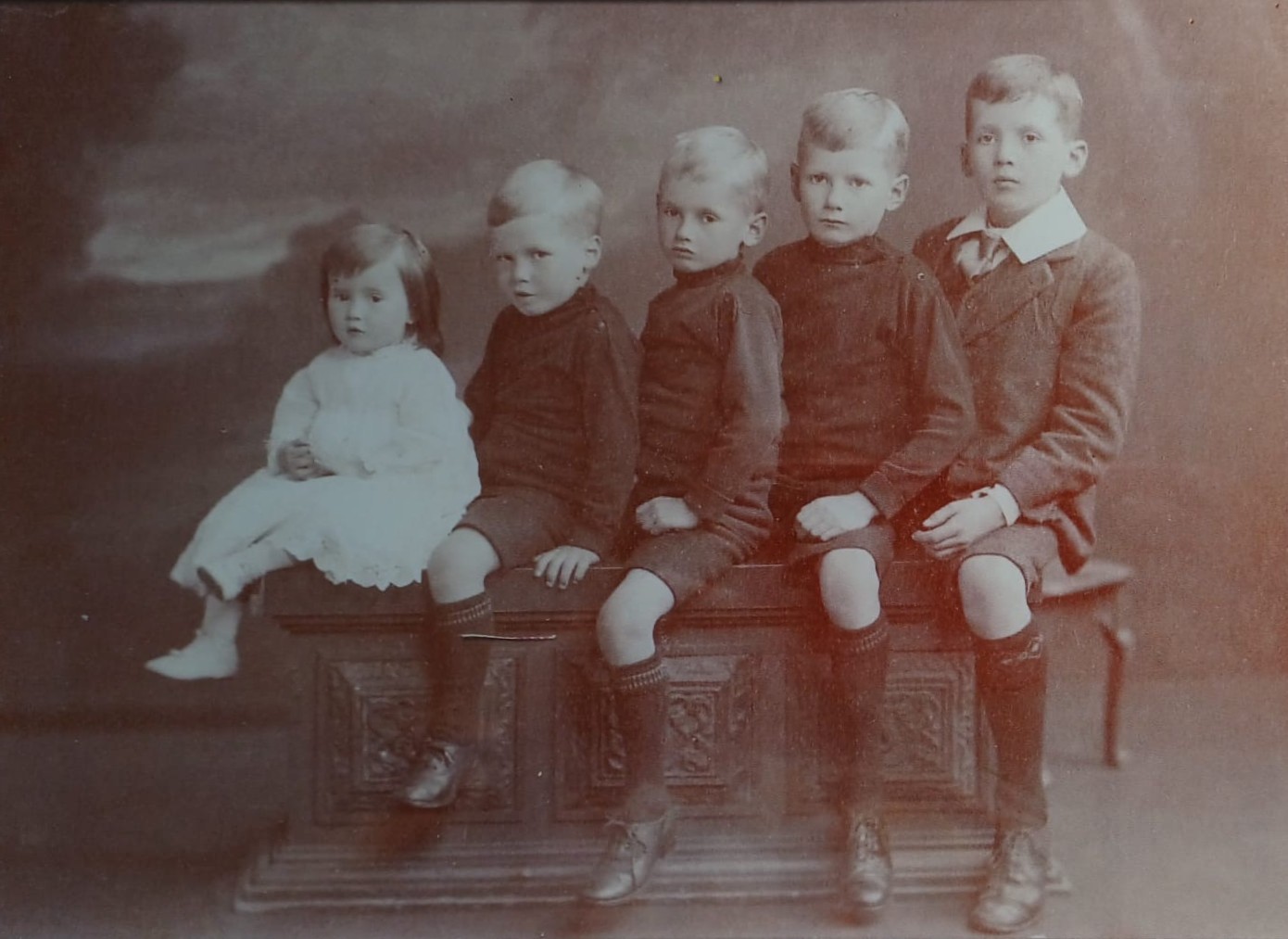
The five Gregson children, c. 1913-16
The five Gregson children, c. 1913–16. Guy the eldest on the right; Mark third from left. The only photograph of all five siblings together. — Source: A04, Family Holdings

“You knew directly he went to sleep because he started pouring with sweat again.”

— Guy on the punkah boy at Shendi, where temperatures reached 118°F

The routine was shaped entirely by the heat. Up at five. Training until half past nine, when the sun made further work impossible. Breakfast, then squadron office — charges, offences, paperwork. No work in the hot afternoons. Polo at five. Darkness fell, Guy said, “with a bang” at six or seven. In the cool season, officers took their entire squadron trekking for six weeks at a time, covering enormous stretches of country, visiting sheikhs, training on the move. What Shendi lacked in comfort it made up for in a kind of freedom that the peacetime army at home could never have offered — independent command, vast territory, and the society of men who had chosen to be there.

And there was a personal servant named Ahmed — “very trustworthy and reliable” — who chose his own subordinate staff, maintained his own quarters, kept his own family in a world that Guy understood was not his to see. “That was quite a private world.” It is a small remark, but it says something about the man who made it: a recognition, unusual for its time and class, that the people who served him had lives that were not his business.

The Graves at Jakdul Wells

During a holiday week, Guy took camels seventy miles across the Bayuda Desert to a watering point called Jakdul Wells — known to anyone who had read Winston Churchill’s The River War as a staging post on the doomed 1884 march to relieve General Gordon at Khartoum. The local game warden said there was nothing out there. Guy went anyway, and shot what he called “a very good” ibex.

What he found at the wells was something else entirely. The graves of the British soldiers who had marched through half a century earlier — the Redcoats of the Desert Column, men of the Camel Corps who had struggled across a hundred and seventy-six miles of waterless desert under Brigadier-General Herbert Stewart — were still there, perfectly preserved. The dry air had stopped time. Bully beef tins lay among the rocks. The headstones, if they had them, stood in the sand exactly where they had been placed in 1885.

It is one of those details that tells you more about a landscape than any amount of description. The desert preserved everything and forgot nothing. The men who had died on that march — of thirst, exhaustion, disease — were still waiting in the howling wilderness when a polo-playing gunner stumbled upon them, fifty-three years later, while shooting ibex.

Four Europeans at Nyala

After about a year at Shendi, Guy asked for a transfer and was given command of a mounted infantry company at Nyala, in Darfur — “up on the edge of French Equatorial Africa, just south of Fasher,” three to four days by camel from the provincial capital at El Fasher. A small fort had been built after the 1921 Nyala Rising, when a Mahdist preacher had inspired six thousand men to attack the town. Two British officers had been killed before the rising was put down with machine guns. Guy called the preacher “some mad Mullah.”

The European population of Nyala comprised, in its entirety, four men. Guy. His second-in-command, Tony Irwin, whom he liked. A district commissioner called Wordsworth — “a relation of the poet” — who reviewed books for a London publisher, the parcels arriving by camel. And a man called Nightingale, who held the local record for lion hunting. There was no telephone. There was no electric light. There was, as Guy summarised it, “no nothing.” Communications went by pony or camel messenger.

It was, he said, the most beautiful country, with a lovely climate and people who were “very, very nice and charming.” But even Guy, who had a considerable appetite for isolation, admitted that if he had had to stay very long, “things used to hang a bit heavy.” He ran a horse breeding scheme — six or seven stallions for local Arab mares — and he shot. And he waited for something to happen.

Dervishes for Korda

Before the war came, there was a film. In 1939, Alexander Korda was shooting a Technicolor epic of The Four Feathers at the Shabluka Gorge on the Nile, north of Khartoum, using the stern-wheel gunboat Melik and Hadendowa tribesmen brought hundreds of miles from the Red Sea Hills by railway. Korda needed several hundred men who could look like dervish warriors charging out of the desert. Guy provided three to four hundred of his Sudan Defence Force soldiers.

“I said to my chaps, ‘now all you’ve got to do is look like dervishes and go back into the desert. And when you get the signal, you come in and you attack the enemy here, and just do it as a dervish would.’ And they were mounted, and off they went, and they were back to dervishes in one second, all their military finery gone, and they looked like a wild lot of Arabs coming out of the desert. They did it most beautifully.”

— Guy on directing SDF troops as extras in The Four Feathers, Shabluka Gorge, 1939

It is one of the last snapshots of the old Sudan — soldiers of the British Empire discarding their uniforms to play their own grandfathers, charging across the desert in a pantomime of the wars that had made the country they now served. The footage was so striking that it was reused in later films for the next two decades. Within months, the men who had played at being dervishes would be fighting a real war.

A Frightful Bang

The war declaration caught Guy on leave in England. He was whistled back to Sudan at short notice and ordered to march his company from Nyala to El Obeid — several hundred miles on foot and horseback across Darfur and Kordofan. They spent the phoney war period in the Nuba hills, waiting. Then came the summons back to Shendi, and with it a task that drew on everything the Royal Military Academy at Woolwich had taught him.

He was to convert his old cavalry squadron into a troop of four 3.7-inch pack howitzers. The weapon was a mountain gun — ninety-four millimetres, firing a twenty-pound shell to six thousand yards, designed to break down into eight mule loads for transport over difficult terrain. A practised crew could assemble and fire in two minutes. The catch was that Guy’s crews were not practised. They were horsemen. They had never seen a gun.

Three troops were formed simultaneously at Shendi — Guy’s, Willie Newell’s, and Jed Palmer’s — twelve guns in total, the Sudan Defence Force’s entire artillery capability, all created from scratch. Guy needed literate, numerate men for the technical roles — layers, who had to read degrees and minutes on the gun sights. He found them among the riverain Arabs, the “shaggy Arabs” with the facial scarification, who turned out to have the intelligence and temperament for the work. The decision on formation was taken around May 1940. The guns had to be ready by autumn.

“I remember the first time we fired the gun. There was a frightful bang, and they all ran like rabbits. We told them there was going to be a bang. But of course, it jumps a bit too. However, having laughed at them, they all came back and they took to it like ducks to water. They were no trouble.”

— Guy on the first firing of the SDF artillery troop, Shendi, 1940

The sentence “having laughed at them, they all came back” is the most Gregson moment in the entire oral history. No fury, no punishment, no lecture on discipline. He laughed. They laughed. And then they learned to be artillerymen. Five months later, at Keren, they would prove that this apparently casual method of military training had produced something the official histories rarely credit: a troop of colonial gunners who could hold their ground under sustained air attack.

An Old Harami

Just before the advance on Keren, a native officer came to Guy with unwelcome news. The troops were talking. They did not want to go into battle. Their reasons were human rather than political — they were outside Sudan, they had not seen their women for months, and nobody had asked them to fight a European war in the Eritrean mountains. It was not, technically, a mutiny. But it was close enough.

Guy went down and spoke to them. He did not threaten. He did not appeal to duty or empire or the martial traditions of the Sudan Defence Force. He used a Sudanese proverb.

“Well, you no good kicking an old harami out of your house if you don’t shut the door after it.”

— Guy to his troops, quoting a Sudanese proverb. Harami: thief

They saw the point. They went. He never had any trouble again. It is worth pausing on what this tells us about the man — not the military record, which speaks for itself, but the officer. He had spent three years living among Sudanese soldiers, learning their language, eating their food, sleeping under their sky. When the moment came that could have ended his command and his career, he reached not for the authority of the British Army but for a proverb in Arabic. And it worked, because it was the right argument delivered in the right language by a man who had earned the right to make it.

Keren

The Battle of Keren lasted from the third of February to the twenty-seventh of March 1941. The terrain was, as General Platt had promised, gruesome — narrow gorges, sheer escarpments, positions that could only be approached frontally. The Italian garrison, under Brigadier-General Carnimeo, fought with a determination that surprised the British. Colonel Orlando Lorenzini, one of Italy’s most capable colonial commanders, was killed directing the defence.

Guy’s gun troop was positioned alongside the Indian divisions and the regular British batteries. His four pack howitzers — crewed by men who had been horsemen less than a year earlier — fired in support of the assaults on the mountain positions. And then the Italian bombers came, and the scene that opens this chapter played itself out on a hillside in Eritrea.

There is a detail Guy mentioned only once, almost in passing. When he drew up his order of battle, the troop “came up with one spare one of their own” — an enormous man who had appointed himself, without being asked, as Guy’s personal bodyguard. The Arabic word is harris. This man followed Guy everywhere during the battle, into the hills and the observation posts, and never let him get into a dangerous position without being there first.

“That fellow … they detailed themselves to look after me personally, because I had to do all the shooting up in the hills and everything. And when we were fighting the Italians … this enormous man never let me get into a difficult spot. He had eyes like a gimlet, and he was a hell of a good shot too.”

— Guy on his self-appointed bodyguard at Keren

A young Sudanese second lieutenant — a mulazim — won the Military Cross at Keren for holding his post against a night attack. Years later, he rose through the ranks of an independent Sudan to become His Excellency, the Director of Communications, and returned to England as a senior official. “Couldn’t be more friendly to the British.” It is the kind of detail that Guy offered without commentary, leaving the listener to make of it what they would.

Guy himself was awarded the Military Cross for the Keren fighting. The citation, identified in the National Archives at WO 373/28, has not yet been retrieved. It is the last missing set-piece of the biography — the official language that will tell us what he did in those mountains, in the words of whoever recommended him. Until it arrives, we have only Guy’s own account: the bombers, the question, the answer he gave while scared stiff, and the men who, having received it, never moved again.

“Quite Wonderful”

At the end of the Sudan tapes — three reels, sixty minutes, recorded in 1979 when Guy was seventy-three — Conrad Wood asked him to assess the Sudanese soldiers he had served with. The answer came without hesitation.

“I thought they were marvellous. I’ve never felt more secure than I did with them. They were quite wonderful.”

— Guy on his Sudanese soldiers

He said it thirty-eight years after the events, and you can hear in the recording that he meant it as simply as he said it. No qualifications, no historical distance, no officers’-mess irony. They were marvellous. He had never felt more secure. They were quite wonderful.

Within a year, Guy would leave the Sudan Defence Force and join the 5th Royal Horse Artillery in the Western Desert. The world of mounted cavalry, mud bungalows, and camel messengers would give way to the armoured warfare of North Africa, the beaches of Italy, and the hedgerows of Normandy. The next four years would bring him a DSO at Tunis and a Bar to DSO at Villers-Bocage, and they would take his brother Mark at El Alamein. But the Sudan years made him. The man who laughed when his soldiers ran from the first bang, who defused a near-mutiny with a proverb, who told his troops to look like dervishes and found that they did it beautifully — that man was the one who would coordinate a hundred and sixty guns in Normandy and direct thirty-seven thousand shells onto the Hook in Korea. The skills were Woolwich’s. The temperament was Shendi’s.

What We Don’t Know

The IWM oral history is the only first-person source for the Sudan years, and it was recorded thirty-eight years after the events it describes. Guy was seventy-three, and while his memory was sharp and his anecdotes vivid, there are silences. He does not mention his family. He does not say whether he was married or attached during these years. He says almost nothing about the eleven years between his 1926 commission and his 1937 arrival in Sudan, beyond “playing polo and racing.” The transition from the SDF to the 5th Royal Horse Artillery — how it happened, when exactly, who arranged it — is a gap the surviving records have not yet filled.

The MC citation, sitting in the National Archives at WO 373/28, would tell us what Guy did at Keren in the language of the men who watched him do it. It is the single most important outstanding document in the research.

IWM Sound 4424 — Reel 1
Recorded 21 May 1979 by Conrad Wood · The only known recording of Guy’s voice

Three reels of tape, approximately sixty minutes. Sudan, Keren, the Four Feathers, the near-mutiny, the leopard in the Red Sea Hills. The sole first-person source for Guy’s formative years.
Chapter Two

Two Brothers in the Desert

1942

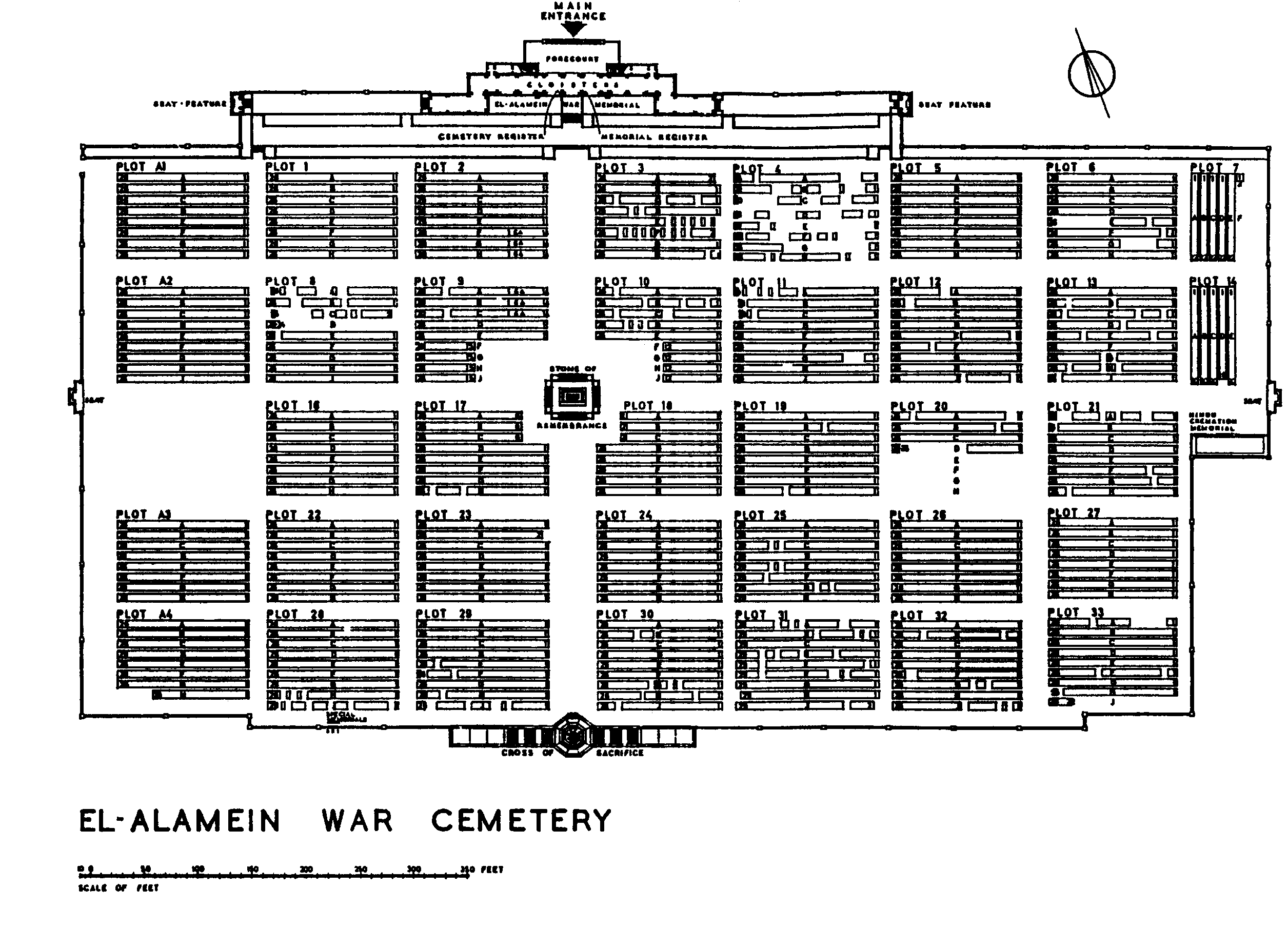
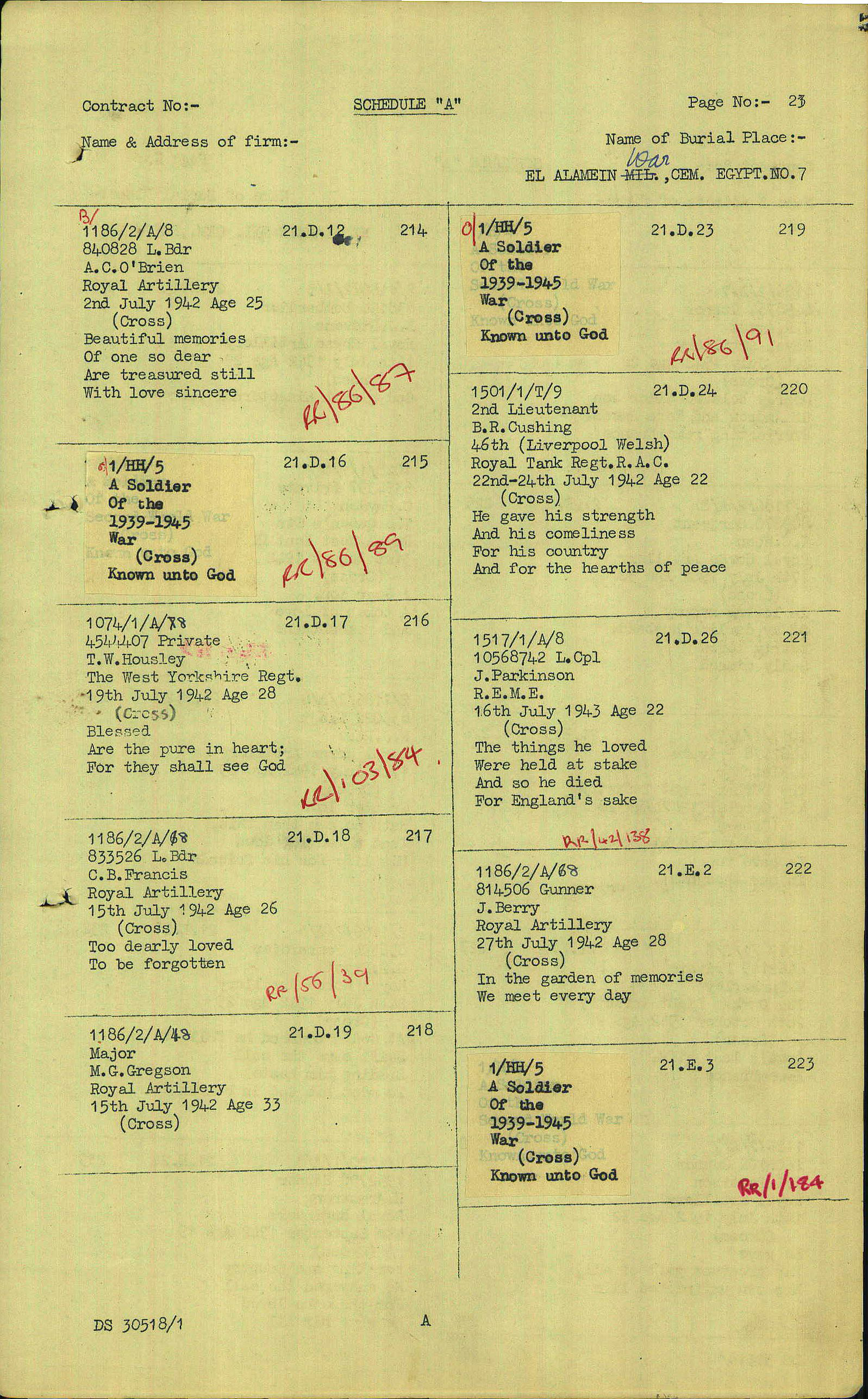
The headstone at El Alamein War Cemetery bears a cross and five lines of text. “Major, M.G. Gregson, Royal Artillery, 15th July 1942 Age 33.” There is no personal inscription — no family-chosen words at the bottom, no “beloved son” or “always remembered,” nothing to distinguish it from the thousands of identical white stones that stand in rows across the desert sand a hundred and thirty kilometres west of Alexandria. The headstone schedule confirms it: the space where other families wrote their farewells is blank.

We do not know why. Perhaps the family was not asked in time, or could not decide, or chose silence over sentiment. Perhaps the words felt inadequate. What we do know is that Major Mark Gilchrist Gregson, service number 40383, 1st Field Regiment Royal Artillery, died on the fifteenth of July 1942 during the First Battle of El Alamein, and that at the moment of his death his elder brother Guy was serving as a temporary lieutenant-colonel in the same desert, within the same theatre of war, under the same Egyptian sky.

Both were gunners. Both were Gregsons. Both were sons of Henry Guy and Inez Mary Mowat Gregson. One came home. The other is in Plot XXI, Row D, Grave 19.

Mark Gregson's headstone, El Alamein War Cemetery
Plot XXI, Row D, Grave 19. Major M.G. Gregson, Royal Artillery, 15th July 1942 Age 33. No personal inscription. — El Alamein War Cemetery

Two Gunners

The childhood photograph — five children arranged on a carved wooden bench in a studio, probably around 1913 to 1916 — shows them all: Guy the eldest on the right, already in a suit jacket and tie; then John; then Mark, third in line; Martin; and Jane, the youngest, in white. It is the only photograph of all five siblings together. Of the four boys, two would choose the Royal Artillery. Guy was commissioned from Woolwich in 1926; Mark followed, taking his own commission some years later. By 1942, both held the rank of major — Guy as a temporary lieutenant-colonel — and both were serving in the Middle East.

Beyond the bare military facts, almost nothing is known about Mark. His CWGC certificate tells us he was thirty-three when he died, which places his birth around 1908 or 1909. He was married to Christine Rozel Pigot, of Chard, Somerset. He served with the 1st Field Regiment, Royal Artillery. He was buried six days after he fell, at map reference 882c-2346, in the flat desert east of the Alamein line, before being moved to the permanent cemetery. His middle name, Gilchrist — a Gaelic name meaning “servant of Christ” — suggests the Scottish ancestry of their mother’s Mowat line. That is all we have. No letters. No diary. No oral history. Mark left no voice behind.

Ruweisat Ridge, 15 July 1942

The First Battle of El Alamein is not the one most people remember. It was not Montgomery’s set-piece victory of October 1942, with its barrage and its bagpipes and its thousand guns. It was the desperate, improvised, furiously violent fight that stopped Rommel’s advance in July, when the Afrika Korps reached the last defensible line before the Nile Delta and the Eighth Army held it with whatever it had to hand. The desert war was, above all, a gunner’s war. Royal Artillery field regiments formed the backbone of the ad hoc columns and defensive boxes that plugged the gaps in the Alamein line. Artillery officers died at the same rate as the infantry they supported, and sometimes faster.

Mark died on 15 July 1942. The date falls within the Second Battle of Ruweisat Ridge, one of the fiercest actions of the entire campaign. Along that low, stony ridge south of the coastal road, British and Commonwealth troops attacked and counter-attacked in a series of operations that cost both sides heavily. The 1st Field Regiment RA would have been in direct support of the infantry assaults, its gun lines exposed to counter-battery fire, air attack, and the sudden armoured thrusts that made the desert war uniquely dangerous for gunners. Adjacent graves in Plot XXI, Row D, hold men from the Royal Tank Regiment, the West Yorkshire Regiment, and other Royal Artillery units — the mixed dead of the Alamein battlefield, buried together in the order they fell.

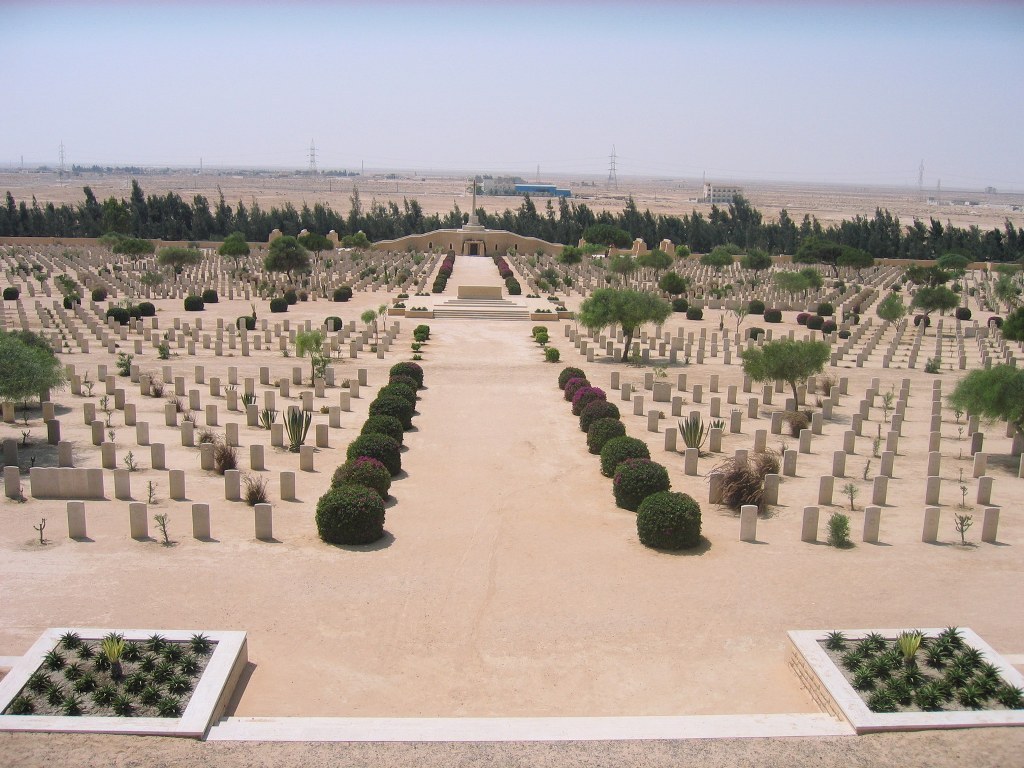
El Alamein War Cemetery
El Alamein War Cemetery, 130 kilometres west of Alexandria. 7,240 Commonwealth burials. Designed by Sir J. Hubert Worthington.

Mark was thirty-three. He had been married to Christine. He was a major commanding guns in the desert. And then he was a name on a headstone with no inscription.

The Other Brother

Guy’s first Mention in Despatches covers the period 1 May to 22 October 1942 and places him in the Middle East as a “Major (temporary Lieutenant-Colonel).” His exact unit during this period is not recorded in any surviving document. The 5th Royal Horse Artillery, the regiment he would command at Tunis and Villers-Bocage, did not arrive in Egypt until 18 July 1942 — three days after Mark’s death — which means that for at least part of this period, Guy was serving with another formation. What that formation was, where exactly he was on 15 July, and whether he was anywhere near his brother when Mark fell are questions that only his service record or a family member could answer.

What we know for certain is this: two Gregson brothers, both Royal Artillery officers, were in the Western Desert at the same time. One was killed. The other, within ten months, would win the Distinguished Service Order at the capture of Tunis.

The Gap

Between Guy’s Sudan Defence Force service, which ended after Keren in 1941, and his confirmed command of the 5th Royal Horse Artillery at Tunis in May 1943, there is a hole in the record roughly eighteen months wide. The London Gazette confirms he was still formally attached to the SDF as late as 30 December 1941. His first MID places him in the Middle East from May 1942. But the unit he served with, the date he assumed command of 5 RHA, and the circumstances of his transition from colonial secondment to one of the most prestigious postings in the Royal Artillery — commanding a horse artillery regiment in the Desert Rats — are entirely undocumented.

Mark’s death falls squarely in this gap. It is the most painful of the biography’s silences. Did Guy know immediately? Did they see each other in Egypt? Had they met since the childhood photograph, since Gresham’s, since the family home — wherever that was? Did Guy ever visit the grave? The cemetery sits on the desert road between Alexandria and Mersa Matruh; any officer serving in the theatre would have passed it a hundred times. Whether Guy stopped, whether he stood before Plot XXI, Row D, Grave 19, and read the five lines of text on his brother’s headstone — this is something only the family can tell us.

El Alamein War Cemetery plan
Cemetery plan showing Plot XXI where Mark is buried. Any officer serving in the theatre would have passed this cemetery on the desert road between Alexandria and Mersa Matruh.

Tunis

By December 1942, Guy was commanding the 5th Royal Horse Artillery within the 22nd Armoured Brigade, 7th Armoured Division — the Desert Rats. How he got there is unknown. That he was there is beyond doubt: the DSO citation for the capture of Tunis, dated 6 to 8 May 1943, names him explicitly.

“This officer commands 5 RHA which on 6, 7, and 8 May was in support of 22 Armd Bde during the final break through and capture of TUNIS. It was due to his tireless work of co-ordinating and directing the fire of his Regt and arranging additional support when necessary, in a difficult operation that 22nd Armd Bde were able to make a steady advance in the face of the enemy. His total disregard for his own personal safety and high example of courage is an inspiration to all those who serve with or under him.”

— DSO Citation, WO 373/25/513. Endorsed by Montgomery’s Eighth Army

The capture of Tunis on 7 May 1943 ended the North African campaign. The 7th Armoured Division and the 22nd Armoured Brigade were among the first British formations into the city. Guy’s regiment provided the artillery support that allowed the brigade’s advance against the last organised Axis resistance in Tunisia. The recommendation came from the commander of 22nd Armoured Brigade and was endorsed up the chain — through the CRA of the 7th Armoured Division, through the corps commander, through the army commander — all the way to the Commander-in-Chief, Middle East Forces. The award was immediate: a DSO given in the field, not through the periodic honours system.

The citation form records his name as “Guy, Peter, GREGSON” — using “Peter” where “Patrick” is his legal middle name. It is a small detail, but it confirms what the family has always known: Guy was also called Peter, and the military clerk wrote down the name he actually used.

What the Record Cannot Say

There is a version of this story that writes itself — the elder brother, grieving, driving himself through the Tunisian campaign with a fury born of loss, earning the DSO as a kind of memorial to the brother who fell. It would make a good scene in a novel. It may even be true. But the record does not support it, and this biography will not invent what the documents do not contain.

What the record does contain is a coincidence so precise it hardly needs embellishment. Two brothers, both named Gregson, both Royal Artillery, both in the desert in 1942. One fell at the Alamein line in July. The other won the DSO at Tunis in May of the following year, in the battle that ended the campaign Mark did not live to see finished. The same war, the same arm of service, the same theatre. One headstone in the sand. One medal in the tray.

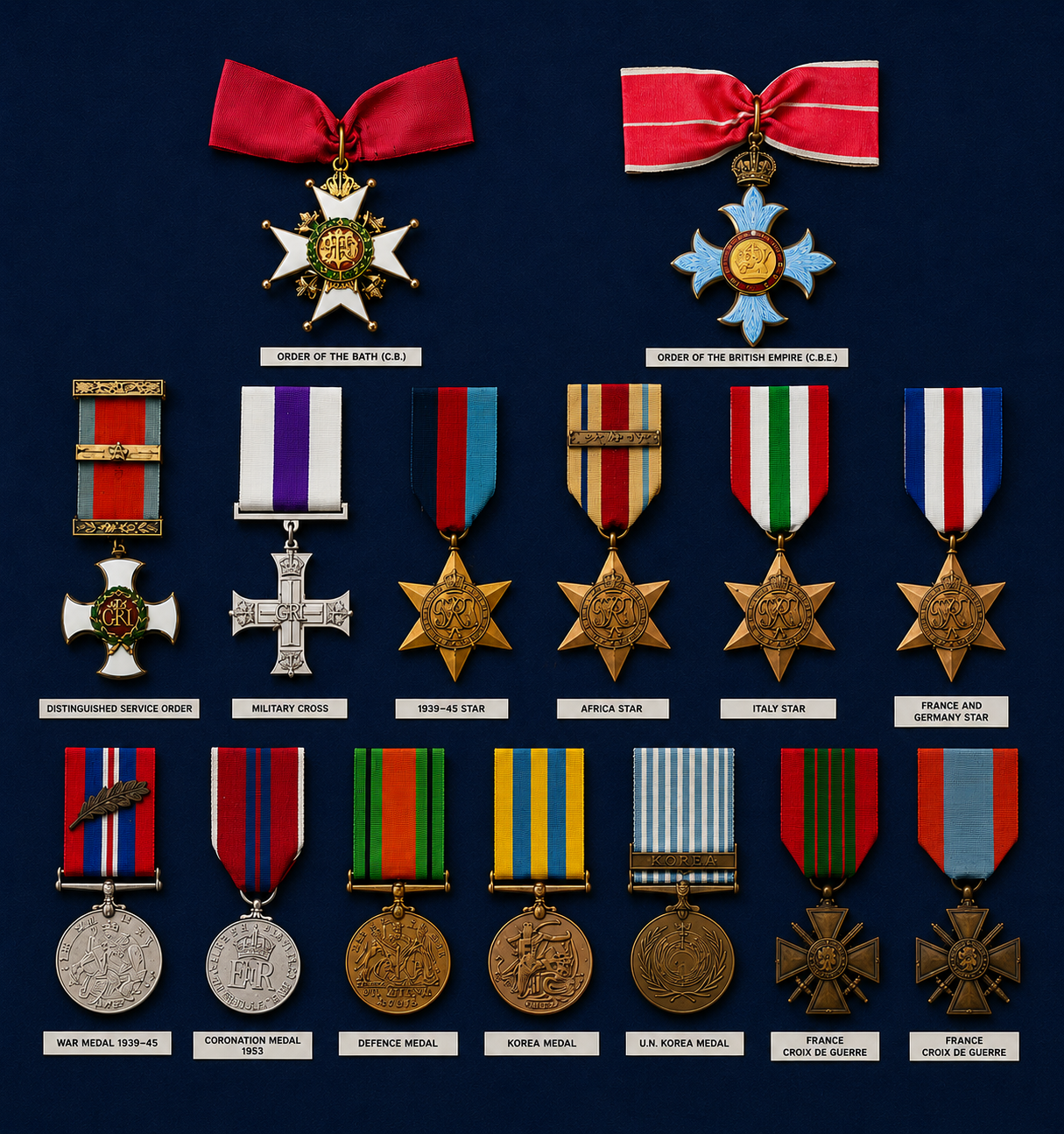
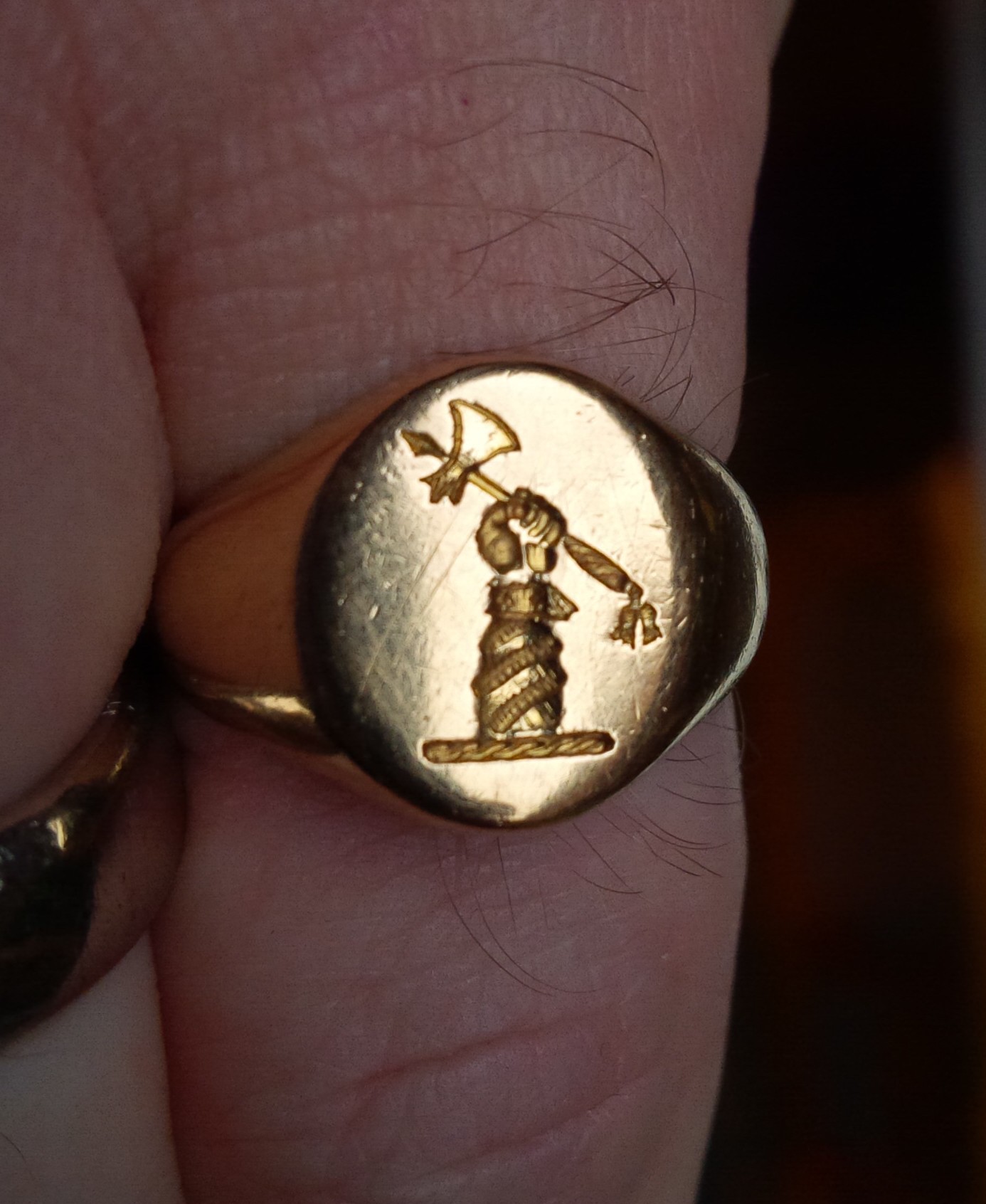
The childhood photograph — Guy on the right, Mark third from the left, all five children arranged on that carved bench — was taken in a studio somewhere in England, probably around 1914, when the first war was beginning and the second was a generation away. Two of those boys would grow up to be gunners. One would die at thirty-three in the desert. The other would live to eighty-two, retire to a farm in Suffolk, and leave behind a medal tray with fifteen decorations, a signet ring bearing the family crest, and three reels of tape on which he talked for sixty minutes about Sudan and never once mentioned his brother’s name.

What We Don’t Know

The eighteen-month gap between Guy’s SDF service and his confirmed command of 5 RHA is the biography’s most significant hole. His service record, held by the Ministry of Defence, would fill it — but service records from this period are not routinely released. Mark’s war diary (1st Field Regiment RA) would tell us the circumstances of his death; it is held at the National Archives under WO 166 or WO 171.

The blank inscription on Mark’s headstone is itself a question. The CWGC offered families sixty-six characters for a personal inscription; many chose not to use them, but the reasons varied. A conversation with Marcus — Mark’s nephew — might shed light on what the family chose and why.

Guy’s IWM oral history, recorded in 1979, covers only his Sudan years. He does not mention Mark, El Alamein, or the transition to 5 RHA. Whether this was because Conrad Wood did not ask, or because Guy chose not to speak of it, we cannot know.

Chapter Three

The Desert Rats

1942–1943

On the morning of 7 May 1943, the guns of 5th Royal Horse Artillery were firing in support of an armoured brigade that was about to end a war. Ahead of them, the road into Tunis lay open for the first time in six months. Behind them, stretching back across fifteen hundred miles of desert, lay the wreckage of two armies and two years of fighting. And somewhere in the middle of it — standing in an observation post close enough to the forward tanks that the brigade commander’s endorsement would later note his “total disregard for his own personal safety” — was a forty-year-old lieutenant-colonel named Guy Peter Gregson, directing the fire of three batteries of field guns onto the last Axis positions in North Africa.

He had been at it for three days. The citation that would earn him the Distinguished Service Order covers 6, 7, and 8 May with the economy of language that military prose demands and the precision that makes it, at its best, a kind of poetry. His regiment was in support of 22nd Armoured Brigade during “the final break through and capture of TUNIS.” The advance was steady. The operation was difficult. The fire was coordinated and directed by one man. That man was Guy.

But how did a cavalry officer from the Sudan Defence Force — a man who eighteen months earlier had been converting horsemen into artillerymen at a Nile outpost — come to command one of the most storied regiments in the Royal Horse Artillery, inside the most famous armoured division in the British Army? The answer, like so much of Guy Gregson’s war, sits in a gap in the record that no surviving document has yet filled.

The Regiment He Joined

The 5th Royal Horse Artillery was a regular regiment of the Royal Artillery — three batteries designated G, K, and CC — that had spent the first years of the war in England before embarking for the Middle East. The regiment sailed in March 1942 and arrived in Egypt on 18 July, having taken four months via the Cape route, the Suez Canal being rather too busy with other traffic. Three days before 5 RHA set foot on Egyptian soil, Mark Gregson was killed at Ruweisat Ridge. Whether Guy knew the regiment was coming, whether he had already been earmarked for command, whether someone in the Royal Artillery’s posting machinery had identified the SDF gunner with a Military Cross as the right man for a horse artillery regiment — all of this is speculation. The records are silent.

What we know is that 5 RHA was thrown into the fighting almost immediately. From July through October 1942, the regiment served with 23rd Armoured Brigade Group in the defence of the Alamein Line and at Alam el Halfa, where Rommel made his last attempt to break through to Alexandria and was stopped by Montgomery’s carefully prepared defensive battle. In October and November, 5 RHA transferred to 24th Armoured Brigade Group for the Second Battle of El Alamein — the set-piece offensive that cracked the Axis line and sent the Afrika Korps into a retreat that would not stop until Tunisia. Through all of this, the regiment was learning the brutal curriculum of desert gunnery: how to shoot and scoot before counter-battery fire found you, how to support armour across ground with no features, how to keep ammunition flowing across supply lines that stretched for hundreds of miles.

Guy’s name does not appear in the unit history until late 1942. His first Mention in Despatches covers the period to October 1942 and identifies him as a temporary lieutenant-colonel in the Middle East, but not with which unit. Somewhere between the summer and the winter, between the death of his brother and the advance that followed Alamein, he took command. By 1 December 1942, when 5 RHA formally joined the 7th Armoured Division within 22nd Armoured Brigade, Guy Gregson was commanding officer. He had arrived in the Desert Rats.

The Jerboa on the Sleeve

The 7th Armoured Division wore a red desert rat — a jerboa — on their sleeve, and the name had stuck since the earliest days of the North African campaign. They had fought at Sidi Barrani and Beda Fomm, at Tobruk and Gazala and Alamein. By the time Guy joined, the division had been in the desert longer than any other British formation. Its men were lean, sunburned, contemptuous of anything that smelled of base areas, and possessed of a unit pride that bordered on the religious. To command a regiment inside this division was not merely a posting; it was an admission to a tribe.

The 22nd Armoured Brigade, Guy’s immediate formation, was commanded by Brigadier “Looney” Hinde — a cavalryman of considerable dash whose nickname was said to derive not from his mental state but from his initials, though the former explanation was more widely believed. The division itself was taken over in January 1943 by Major-General Bobby Erskine, a Scots Guards officer who would lead it through the rest of North Africa and into Normandy. Both men would endorse Guy’s DSO recommendation. Both, in the clipped language of the endorsement chain, used the word “outstanding.”

The role of a Royal Horse Artillery regiment in an armoured brigade was precise and demanding. The guns — twenty-four 25-pounders, eight per battery — moved with the tanks, providing fire support that could be called down within minutes of a request from the leading armour. The commanding officer’s job was not to sit at regimental headquarters and move pins on a map. It was to be forward, with or ahead of the brigade commander, reading the battle as it developed and coordinating fire from his own batteries while calling in additional support from divisional or corps artillery when the situation demanded it. It required a particular kind of officer: one who could calculate fire plans under pressure, who understood the armoured battle from the inside, and who was willing to position himself close enough to the fighting to see what needed to be hit. Guy, trained at Woolwich, blooded at Keren, and temperamentally incapable of directing anything from the rear, was the type.

Fifteen Hundred Miles

The advance from Alamein to Tunis covered roughly fifteen hundred miles and took six months. It was not, despite the popular image, a single headlong dash across the desert. The Eighth Army pursued Rommel’s retreating forces through Libya — past Tobruk, Benghazi, and the port of Tripoli, which fell on 23 January 1943 — and then into southern Tunisia, where the terrain changed from open desert to hill country and the fighting took on a different character. The Afrika Korps, reinforced by fresh German and Italian divisions that had been pouring into Tunisia since the Allied landings in Morocco and Algeria the previous November, turned and fought a series of sharp defensive actions. The Kasserine Pass, where American forces took a severe mauling in February, was the most famous. But the 7th Armoured Division, pushing up from the south as part of the Eighth Army, fought its own battles — at the Mareth Line, at Wadi Akarit, at Enfidaville — in terrain that suited defenders and punished attackers.

For 5 RHA, the advance meant constant movement, constant fire missions, and the grinding logistics of keeping twenty-four guns supplied with ammunition across a supply chain that grew longer by the day. The batteries — G, K, and CC — leapfrogged forward in the standard pattern: one firing, one moving, one ready to take over. When the brigade halted, the guns dug in. When it moved, the guns limbered up and followed the tanks. It was a rhythm that required stamina more than heroism, though heroism was demanded often enough.

The specific engagements of 22nd Armoured Brigade during this advance — the firefights, the ambushes, the days when nothing happened and the days when everything did — are recorded in war diaries that have not yet been consulted. What we know is the outcome. By the first week of May 1943, the Eighth Army and the Allied forces from the west had compressed the remaining Axis forces into a pocket around Tunis and Bizerta. The end was coming. Everyone knew it. The question was which formation would get there first.

Three Days at Tunis

The final assault on Tunis began on 6 May 1943. The 7th Armoured Division, operating as part of 10 Corps, drove into the crumbling Axis perimeter from the south. The 22nd Armoured Brigade led the division’s advance, with Guy’s regiment providing the artillery support that allowed the tanks to push forward against positions that, even at this late stage, were defended with determination. The German and Italian troops in Tunisia knew what surrender meant; they had been told to fight to the last. Some did. Most, by now, were looking for a way out.

The difficulty, from a gunner’s perspective, was not simply the volume of fire required. It was the coordination. An armoured advance through defended country demands artillery support that shifts as fast as the tanks move — targets appearing and disappearing, friendly forces intermixed with enemy, the whole picture changing every few minutes. The commanding officer of the supporting regiment has to hold the entire battlefield in his head: where his own batteries are, where the tanks are, where the enemy guns are, and which additional fire he can pull in from the units on his flanks. He has to do this while moving, while under fire, and while maintaining communications on a radio net that, in 1943, was only marginally more reliable than shouting.

“It was due to his tireless work of co-ordinating and directing the fire of his Regt and arranging additional support when necessary, in a difficult operation that 22nd Armd Bde were able to make a steady advance in the face of the enemy.”

— DSO citation, 6–8 May 1943

That phrase — “arranging additional support when necessary” — is the mark of a gunner who understood that his own regiment’s twenty-four guns were not always enough, and who had the authority, the contacts, and the nerve to reach beyond his own command for more firepower. It suggests a man who was on the radio to divisional artillery, to corps artillery, pulling in fire from regiments he did not command, concentrating it on targets that his own observation had identified. This is not what a cautious officer does. This is what a very good one does when he knows the battle depends on it.

Tunis fell on 7 May. The 7th Armoured Division was among the first British formations into the city, and the scenes that followed were extraordinary — crowds of Tunisians in the streets, French tricolours appearing from windows, German soldiers surrendering in their thousands. Within a week, all organised Axis resistance in North Africa had ended. A quarter of a million German and Italian troops went into captivity. The campaign that had begun at Sidi Barrani in December 1940 was over.

“Outstanding Throughout”

The recommendation for Guy’s DSO originated with the commander of 22nd Armoured Brigade — Looney Hinde, the man who had watched Guy direct fire from the forward positions for three days. From there it passed to the Commander Royal Artillery of the 7th Armoured Division, who added his own endorsement: “this officer has been outstanding throughout.” It went next to the General Officer Commanding the 7th Armoured Division — Bobby Erskine — and then upward through the commander of 10 Corps to the headquarters of the Eighth Army, where it crossed the desk of the army commander himself. Bernard Montgomery signed it off. From there it reached the Commander-in-Chief, Middle East Forces. Six levels of command, each adding a signature or an endorsement, each confirming what the man below had written.

The award was immediate. An immediate DSO is not given through the periodic honours system, the twice-yearly lists that reward sustained good service. It is given in the field, for a specific action, on the recommendation of the officers who saw it. It is, in the hierarchy of military recognition, the next thing below a Victoria Cross in weight, and it carries a different kind of meaning: not a single act of supreme valour, but a sustained performance of command under fire that made the difference between success and failure. The citation says it plainly. It was due to Guy’s work that the brigade was able to advance. Not that the advance was assisted by his work. That the advance was made possible by it.

The citation form records one further detail. His name is given as “Guy, Peter, GREGSON” — Peter, not Patrick. It is the military clerk writing down the name the officer actually used, the name his friends and colleagues knew, rather than the legal name on his commission. A small thing, but it catches something of the man: even on the most formal document of his war, the name that stuck was the one he had chosen for himself.

“His total disregard for his own personal safety and high example of courage is an inspiration to all those who serve with or under him.”

— DSO citation for Lt-Col G.P. Gregson, 5 RHA, May 1943

That final sentence of the citation is boilerplate in one sense — many DSO citations use similar language. But it was written by a brigadier who had spent three days watching Guy operate under fire, and endorsed by every officer in the chain above him. “All those who serve with or under him” is not a phrase a recommending officer uses lightly. It means the men of G, K, and CC Batteries saw their commanding officer forward, in danger, doing the work. It means they knew he was there.

Guy Patrick Gregson's medal tray — fifteen medals
The medal tray: fifteen decorations spanning East Africa to Korea. The DSO is fourth from left, with the Bar clasp. — Source: A03, Family Holdings

The Italian Shore

The victory at Tunis did not lead to rest. Within four months, 5 RHA and the 7th Armoured Division were committed to the invasion of mainland Italy. Operation Avalanche — the amphibious landing at Salerno, south of Naples — began on 9 September 1943 and came perilously close to disaster. The initial landings met fierce German resistance, and for several days the beachhead was in genuine danger of being pushed back into the sea. The fighting was as intense as anything the division had experienced in North Africa, and the terrain — flat coastal plain backed by mountains, with every road and village a potential strongpoint — was a gunner’s nightmare and a gunner’s opportunity in equal measure.

The details of 5 RHA’s specific actions at Salerno are not yet documented in the sources consulted for this biography. What is known is that the regiment landed with the 7th Armoured Division, fought in the beachhead battles, and remained in Italy through October 1943 before the division was withdrawn. The 7th Armoured had been chosen for a greater task: it was to return to England to prepare for the invasion of France. By January 1944, Guy and his regiment were back in Britain, the North African campaign and the Italian interlude behind them, the hedgerows of Normandy ahead.

Between Alamein and England, 5 RHA had served under three different armoured brigade groups, fought across two continents, supported the final breakthrough at Tunis, and landed on a hostile shore at Salerno. Guy had commanded the regiment through at least the last six months of this odyssey, and probably longer. He had arrived in the Desert Rats as an outsider — a colonial secondment officer, a man whose recent experience was pack howitzers and camel patrols — and had earned a DSO endorsed by Montgomery. Whatever doubts the regular officers of the Royal Horse Artillery might have had about a man who had spent three years at Shendi and Nyala, the citation settled the matter.

The Making of a Commander

The Sudan chapter of Guy’s life made his temperament. North Africa made his reputation. The skills he would carry into Normandy — the ability to coordinate massed fire across a fast-moving armoured battle, the instinct for where to stand to see what needed seeing, the willingness to go forward when going forward was dangerous — were forged in the desert between Alamein and Tunis. He went in as an officer who had proved himself with four pack howitzers in the Eritrean mountains. He came out as a regimental commander who had been endorsed by the army commander as worthy of one of the highest decorations in the gift of the Crown.

There is a particular quality to the DSO that matters here. The Victoria Cross rewards an act. The DSO rewards a performance — days rather than minutes, sustained command rather than a single decision. What Guy did at Tunis was not one brave thing. It was three days of brave things, done continuously, under fire, while holding the fire plan of an entire armoured brigade in his head. The citation does not mention a single dramatic moment because there was no single dramatic moment. There was a man doing his job, superbly, for seventy-two hours, in conditions that would have exhausted most officers in twelve.

Within a year he would do it again, at Villers-Bocage, in circumstances even more desperate. But that story belongs to the next chapter, and to Normandy, and to the day when the most famous tank action of the Second World War descended on the regiment that Guy had led from the desert to the sea.

What We Don’t Know

The gap between Guy’s SDF service and his command of 5 RHA remains the biography’s most significant silence. His service record — held by the Ministry of Defence and not routinely released for this period — would confirm when he assumed command and under what circumstances. Whether he served with another unit between the SDF and 5 RHA, or whether he joined 5 RHA directly upon its arrival in Egypt, is unknown.

The 5 RHA war diary, held at the National Archives, would provide a day-by-day account of the regiment’s actions from July 1942 through January 1944 — the engagements on the road to Tunis, the fighting at Salerno, and the texture of daily life under Guy’s command. The 22nd Armoured Brigade war diary would complement this with the broader tactical picture.

Chapter Four

The Day After Wittmann

13–15 June 1944

At half past eight on the morning of the thirteenth of June 1944, a column of Cromwell tanks, half-tracks, and scout cars belonging to the 4th County of London Yeomanry was strung out along the road east of Villers-Bocage, a small Norman market town of stone houses and shuttered windows thirteen miles south of Bayeux, when a single Tiger tank emerged from the tree line to the north and began killing them.

The Tiger belonged to SS-Hauptsturmführer Michael Wittmann, commander of the 2nd Company, schwere Panzer-Abteilung 101 — the heavy tank battalion of I SS Panzer Corps. What followed in the next fifteen minutes became one of the most famous small-unit actions of the Second World War, a story retold so often and with such relish by the German side that it would take decades for British historians to unpick the propaganda from the fact. The bare facts were bad enough. Wittmann’s Tigers, joined by elements of the Panzer-Lehr Division already positioned around the town, caught the leading elements of the 22nd Armoured Brigade in column of march — the most vulnerable formation imaginable — and destroyed them in detail. Cromwells and Shermans brewed up along the road. The half-tracks burned. Men died in their vehicles or were cut down as they scrambled into the hedgerows. By mid-morning, the 4th CLY had effectively ceased to exist as a fighting unit.

The ambush at Villers-Bocage was a catastrophe, and it was one week old when the full scale of it became clear to the men who had to live with its consequences. Among those men, standing on a ridge called Point 174 a mile and a half west of the burning town, was Lieutenant-Colonel Guy Gregson, commanding the 5th Royal Horse Artillery.

He had not been present for the ambush itself. His task began afterwards, when the remnants of the 22nd Armoured Brigade pulled back from the town to a defensive position around the hamlet of Tracy-Bocage and the high ground of Point 174, and the question ceased to be whether the brigade could advance and became whether it could survive. The answer, as it turned out, depended almost entirely on the guns.

The Bocage

To understand what happened at Villers-Bocage, you have to understand the ground. The bocage — the ancient hedgerow country of Normandy — was the worst terrain in western Europe for armoured warfare. Small fields enclosed by earthen banks topped with dense hedgerows, each one a natural anti-tank obstacle. Sunken lanes so narrow that a tank could not traverse its turret without snagging the branches on either side. Orchards, stone farmhouses, church towers — every one a potential observation post, every one invisible from fifty yards away. The desert, where Guy had won his DSO, had been a place of vast horizons and long-range gunnery. The bocage was its opposite: a claustrophobic, deadly, close-quarters killing ground where you could not see the enemy until he was close enough to throw a grenade.

The 7th Armoured Division had been sent inland from the beaches on the twelfth of June with orders to exploit a gap between the British and American sectors, swing east through Villers-Bocage, and seize the high ground of Point 213 on the road to Caen. It was an ambitious flanking manoeuvre, the kind of thing the Desert Rats had done a dozen times in North Africa. But North Africa had been flat and open, and the bocage was neither. The division that had raced across the desert to take Tunis found itself threading through lanes that a carthorse would have found constricting.

The plan called for speed. Speed was exactly what the bocage denied.

Wittmann’s Morning

Michael Wittmann was twenty-nine years old, a veteran of the Eastern Front who had destroyed over a hundred Allied tanks, and he possessed the quality that every tank commander prayed for: an instinct for ground. On the morning of 13 June, positioned with a handful of Tigers in an orchard north-east of Villers-Bocage, he saw the British column pass below him on the road to Point 213 and recognised what he was looking at — an armoured brigade in column of march, strung out along a single road, with no infantry screen and no flank protection. It was the kind of target that might present itself once in a war.

He attacked with what he had. The precise number of Tigers involved — five, or six, or possibly only four — has been debated for eighty years. What is not debated is the result. The 4th County of London Yeomanry lost its commanding officer, most of its tanks, and its capacity to fight. A Squadron was destroyed almost entirely. The Rifle Brigade company travelling with the column was caught in its half-tracks and badly mauled. In the town itself, a confused close-quarters battle between Tigers, anti-tank guns, and dismounted infantry raged through the afternoon. By evening, the British had been forced out.

Wittmann would be dead within two months, killed in his Tiger near Cintheaux during Operation Totalize. But on the morning of the thirteenth of June, he had stopped the 7th Armoured Division cold and inflicted on the 22nd Armoured Brigade the worst single day in its history. The brigade was not destroyed — it still had two battlegroups intact — but it was badly shaken, and it now occupied a position that was, by any conventional reckoning, untenable.

The man who had to make it tenable was Brigadier W.R.N. Hinde — known throughout the army as “Looney” Hinde, a nickname that reflected his appetite for risk rather than any deficiency of intellect. Hinde pulled the brigade back to Point 174 and the hamlet of Tracy-Bocage, organised what he had into a defensive box, and called for guns.

The guns were Guy Gregson’s department.

The Box at Point 174

A defensive box was a formation the Desert Rats knew intimately from North Africa — a tight perimeter of armour, infantry, and artillery, all-round defence, guns inside the position rather than behind it. In the desert it had been the standard response to an armoured threat when you could not advance and could not retreat. In the bocage it was something different: a box surrounded not by open sand but by hedgerows and orchards that concealed an enemy who was gathering in strength by the hour.

The brigade occupied the high ground around map reference 817578 — Point 174, a modest ridge that offered observation to the west towards the American sector and, critically, fields of fire to the east towards Villers-Bocage itself. Guy placed his observation posts on the ridge and set about the task that would earn him the Bar to his DSO: coordinating the fire of every gun he could reach.

The resources at his disposal were formidable, if he could knit them together. His own regiment, the 5th Royal Horse Artillery, gave him twenty-four 25-pounder gun-howitzers — the workhorse of British field artillery, firing an 87.6-millimetre shell to thirteen thousand yards. Beyond that, he had been given control of an Army Group Royal Artillery formation, almost certainly 4 or 5 AGRA attached to XXX Corps, which added medium and heavy guns to his plan. And then, from the Caumont heights to the south-west where the American sector began, came the most unexpected reinforcement of all: the 33rd Field Artillery Battalion of the 1st US Infantry Division — the Big Red One — with their 155-millimetre howitzers, each shell weighing ninety-five pounds and capable of reaching fifteen miles.

In total, Guy controlled approximately a hundred and sixty guns. Eighty-four British — his own twenty-four 25-pounders plus the AGRA’s mediums and heavies — and seventy-six American 155s firing from the flank. The fire plan required him to coordinate three separate national and organisational systems, different calibres, different rates of fire, different radio nets, different procedures. British twenty-five-pounders could sustain five rounds a minute at maximum effort. American 155s fired about one round every two minutes but hit with the force of a small earthquake. The art was in the orchestration — bringing them all down on the same target at the same time, or walking them across an axis of advance to create a wall of steel that no infantry or armour could cross.

This was what Guy Gregson had trained for his entire career. From the 3.7-inch pack howitzers at Shendi to the combined-arms gunnery of the Western Desert, every posting had been a rehearsal for this moment: a single officer, on a ridge in Normandy, conducting an orchestra of destruction.

The Evening of 14 June

The Germans did not leave them waiting long. On the evening of 14 June, Panzer-Lehr Division under Generalleutnant Fritz Bayerlein — one of the most capable armoured commanders in the Wehrmacht, a veteran of Rommel’s staff in Africa — launched a coordinated counter-attack against the brigade box with infantry and tanks. Elements of the 2nd Panzer Division joined the assault. The surviving Tigers of schwere Panzer-Abteilung 101, Wittmann’s battalion, were in the mix. It was a heavy, deliberate attack by first-class troops against a position they had every reason to believe was vulnerable.

They were wrong. Not because the position was strong — it was not — but because the guns were.

“It was due in the main to the magnificent artillery support and the speed and accuracy with which it was brought down that the attack was beaten off with heavy loss to the enemy.”

— Bar to DSO citation, WO 373/48/1

The word magnificent appears in the citation and it was not casually chosen. British military citations of this period were written in a deliberately understated register — “gallant,” “determined,” “creditable” — and when a brigadier reached for magnificent, he was saying that what he had witnessed was extraordinary. The fire that Guy brought down on the Panzer-Lehr attack was not merely adequate. It was the kind of concentrated, precision-timed barrage that breaks an assault before it reaches the wire.

A hundred and sixty guns firing on pre-registered targets, the fall of shot adjusted in real time by forward observation officers lying in hedgerows within rifle range of the German infantry. Twenty-five-pounders at sustained fire, their barrels hot enough to cook on, the crews stripped to the waist in the Norman summer. AGRA mediums dropping their heavier shells onto the forming-up points where Bayerlein’s Panzergrenadiers were assembling. And from the Caumont heights, five miles to the south-west, the American 155s delivering their ninety-five-pound shells in a deep arc that cleared the bocage hedgerows and fell with a sound that survivors compared to an express train passing overhead.

The attack was beaten off with heavy loss. The citation does not specify how heavy, but the evidence of the ground, recovered by later historians, suggests that Panzer-Lehr took serious casualties in men and vehicles. Bayerlein, who had survived the North African campaign and would survive the rest of the Normandy fighting only to surrender his division to the Americans in the Ruhr, knew what concentrated artillery felt like. He had been on the receiving end of it at El Alamein. Now he was on the receiving end of it again, and the man directing it was the same kind of officer he had faced in the desert — a Royal Horse Artillery colonel who understood that in the bocage, where you could not see the enemy until he was on top of you, the guns were the only thing that could stop him before he arrived.

Over Open Sights

While Guy coordinated the fire plan from his command post on Point 174, one of his batteries was fighting at a range where fire plans ceased to matter and only the speed of the gun layer’s hands made the difference between living and dying. CC Battery, 5th Royal Horse Artillery, engaged German armour and infantry over open sights — direct fire, the gun pointing at the target, the crew able to see what they were shooting at. In the Royal Artillery, open sights meant close range. It meant the enemy was within a few hundred yards. It meant the gun was essentially a large-calibre rifle, and if you missed, the tank you were aiming at would not.

The twenty-five-pounder was not designed as an anti-tank weapon, although it could function as one at short range with its armour-piercing shot. CC Battery’s engagement was the kind of action that artillery units remember for generations — the moment when the gunners stopped being technicians and became something closer to infantry, firing at targets they could see with their own eyes, taking casualties from weapons they could hear being loaded. It was exactly the kind of fighting Guy had first encountered at Keren, three years earlier, when his Sudanese gun troop had been strafed by Italian bombers and his soldiers had asked him whether the British battery’s calmness was the correct way to behave.

The difference was that at Keren he had been a troop commander with four guns and a handful of men. At Villers-Bocage he commanded a regiment and controlled an artillery group, and his batteries were fighting simultaneously at ranges that varied from fifteen thousand yards to a few hundred. The span of that responsibility — the man on the ridge who must think in both miles and metres, who must keep the American 155s falling in the right place while one of his own batteries fights for its life at point-blank range — is what the citation means when it calls his energy tireless and his judgement sure.

“Within a Few Hundred Yards of the Enemy”

Brigadier Hinde’s recommendation, endorsed up the chain by Major-General Erskine at 7th Armoured Division, Lieutenant-General Bucknall at XXX Corps, and finally by the army commander, made a point of Guy’s personal conduct under fire.

“Col Gregson’s personal example under shell-fire in visiting his Batteries within a few hundred yards of the enemy was deserving of the highest praise and had an admirable effect on all ranks.”

— Bar to DSO citation, recommended by Brigadier “Looney” Hinde, 22 Armd Bde

To visit his batteries, Guy had to leave the relative safety of the command post on Point 174, move forward through the bocage under shell-fire and sniper fire, and present himself at gun positions that were already under direct observation and engagement by the enemy. A commanding officer who stays at his command post and directs the battle by radio is doing his job. A commanding officer who goes forward to his batteries under fire is doing something more — he is showing the men who are doing the dying that he is willing to be where they are, to share the risk that he is asking them to take. The citation calls this personal example. It is the oldest and most effective form of leadership in the British Army, and it was the quality that ran through every one of Guy Gregson’s commands, from the Sudanese cavalry troop that ran from the first bang to the gun lines in the bocage.

The phrase within a few hundred yards of the enemy is precise. In the bocage, a few hundred yards was very close indeed — close enough to hear German voices, close enough for a sniper to pick off an officer who showed himself above a hedgerow. Guy was thirty-eight years old, a lieutenant-colonel who had already won the DSO and the MC, and he chose to walk into that.

Hinde called it deserving of the highest praise. Four officers in the chain of command agreed. The Bar to the DSO was awarded as an immediate decoration — given in the field, not through the periodic honours list, because the action that earned it was considered too significant to wait.

The Line of Communication

There is a phrase in the citation that is easy to miss but which tells you something crucial about the scale of what Guy achieved: the maintenance of the line of communication to the rest of the Division. The 22nd Armoured Brigade was not fighting in isolation. It was the forward element of the 7th Armoured Division, and behind it — to the west, along the narrow Norman lanes — ran the supply route that connected the brigade to the rest of the division and, beyond that, to the beachhead. If that line of communication was cut, the brigade box at Point 174 would become not a defensive position but a pocket. And pockets, in Normandy in June 1944, did not last long.

Guy’s artillery did not merely beat off the counter-attack. It kept the road open. The guns, by breaking the German assault before it could envelop the position, preserved the line of retreat that the brigade would need when the order came — as it did, on the night of 14–15 June — to withdraw. The withdrawal from Villers-Bocage was conducted under fire, through the bocage, at night, and it succeeded because the route had not been cut. The reason the route had not been cut was that a hundred and sixty guns, directed by one man on a ridge, had made it impossible for Bayerlein’s Panzer-Lehr to close the trap.

The Chain of Endorsement

The Bar to DSO recommendation was written by Brigadier Hinde, who had watched the battle from the same ridge and who knew, because he was a professional soldier of considerable experience, what the artillery had done. It was endorsed by Major-General Erskine, the GOC of the 7th Armoured Division — the same Erskine who had commanded the division at Tunis, where Guy had won his first DSO. Erskine knew Gregson’s quality because he had seen it before. Above Erskine, Lieutenant-General Gerard Bucknall at XXX Corps added his endorsement, and above Bucknall the army commander signed off.

The fates of the endorsers are themselves a footnote to the Villers-Bocage story. Erskine was removed from command of the 7th Armoured Division in August 1944, amid controversy over the division’s performance in Normandy — a controversy in which the failure to hold Villers-Bocage featured prominently. Bucknall was sacked from XXX Corps the same month, replaced by Brian Horrocks, one of Montgomery’s most trusted lieutenants. The battle that earned Guy Gregson the Bar to his DSO was, for the officers above him, the beginning of the end. They were removed not because they had lost a battle — the box at Point 174 had held — but because the opportunity that Villers-Bocage represented had been squandered, and Montgomery wanted men who would not squander the next one.

Guy, the man who had actually held the position, was decorated. The men who had sent him there were fired. It is the kind of irony the British Army specialises in.

After the Bocage

The 5th Royal Horse Artillery continued with the 7th Armoured Division through the rest of the Normandy campaign and into the breakout, across France, through Belgium, and into Germany. The bocage fighting gave way to the open country that the Desert Rats understood — the long pursuits, the river crossings, the armoured thrusts that carried the division to the German frontier.

Guy received a second Mention in Despatches on 22 March 1945, covering the campaign from Normandy through north-west Europe. After the war, the French government awarded him the Croix de Guerre, gazetted on 24 June 1947 — a recognition, three years after the fact, that what he had done at Villers-Bocage and in the subsequent fighting had been done in their country and for their liberation.

But it is the Bar to the DSO that defines the chapter. Two DSOs for two battles, Tunis and Villers-Bocage, twelve months apart, both won with the same regiment in the same brigade in the same division. In both cases the citation was written by the brigade commander. In both cases it was endorsed by Erskine. In both cases the decisive factor was the same: Guy Gregson’s ability to coordinate devastating artillery fire while personally exposing himself to enemy action at the forward edge of the battle.

At Tunis, the language had been total disregard for his own personal safety. At Villers-Bocage, it was indefatigable and tireless energy and sure judgement. The portrait that emerges from the two citations, read side by side, is of an officer who was not merely brave — bravery in 1944 was common enough to be unremarkable — but effective under fire in a way that changed the outcome of battles. He could think while being shot at. He could plan while his batteries fought at point-blank range. He could walk forward into the bocage, visit a gun line under sniper fire, adjust the fall of shot, and walk back to his command post to direct the American 155s onto a different target entirely.

The man who had laughed when his Sudanese cavalry troop ran from the first bang had become, by June 1944, one of the most effective artillery commanders in the British Second Army. The skills were Woolwich’s. The nerve was Keren’s. The judgement was thirteen years of shooting, from pack howitzers on the Nile to a hundred and sixty guns in the Norman hedgerows.

The medal tray
The DSO and its Bar: fourth from left in the tray, distinguished by the clasp. Two immediate awards, both under Hinde's command, both endorsed by Erskine.

What We Don’t Know

The most significant unresolved question is the landing date. The 5 RHA unit history records the regiment landing in Normandy on 8 July 1944 — D+32 — which is twenty-four days after the date on the Bar to DSO citation. The citation, signed by four senior officers including the divisional and corps commanders, places Guy at Villers-Bocage on 14 June. Either the unit history’s landing date is wrong, refers to a rear echelon, or Guy was attached to a different formation for the initial phase. The citation is a primary document and takes precedence, but the discrepancy needs resolution.

The 5 RHA war diary, if it survives at the National Archives (likely under WO 171), would settle the question and provide the operational detail that the citation only summarises. It would name the batteries, the ammunition expenditure, the casualties, the map coordinates of the gun lines. It would tell us exactly where CC Battery fought over open sights, and at what range.

Guy’s IWM oral history, recorded in 1979, covers only his Sudan years. He does not speak of Villers-Bocage, Tunis, or the Western Desert. Whether additional recordings exist, or whether family letters survive from the Normandy period, is unknown.

Chapter Five

37,818 Shells

Korea, 1952–1953

At half past three on the morning of 29 May 1953, the guns stopped. Not all at once — there is no clean ending to an artillery engagement — but in diminishing waves, the roar that had shaken the Korean hillside for hours fell away into scattered fire, then harassing shots, then silence. The Hook was held. The Chinese assault, launched against a single battalion at odds of five to one, had broken on a wall of steel that Guy Gregson had spent months designing and a single night executing. The shell count, when the quartermasters finished their tally, came to 37,818 rounds across all calibres. It remains one of the most concentrated defensive fire missions in the history of the Commonwealth Division.

Guy had come to Korea in 1952 as Brigadier, Commander Royal Artillery of the 1st Commonwealth Division — the only division-level multinational formation in the war, comprising British, Canadian, Australian, and New Zealand units, each with its own guns, its own ammunition stocks, its own tactical doctrines. Coordinating their fire was a job that required not only technical mastery but diplomatic skill. A British CRA directing Canadian guns onto a position held by Australians, using American ammunition delivered by Korean porters, needed to speak several professional languages at once. Guy had been doing exactly this kind of work since Sudan, where he had translated Woolwich gunnery into Arabic for cavalrymen who had never seen a gun. The scale had changed. The principle had not.

The Hook

The Hook was a ridgeline west of the Samichon River, named for its shape on the map, commanding the approach to the Jamestown Line — the main defensive position across the Korean peninsula. It had been fought over before. The First Battle of the Hook in October 1952 and the Second in November had both seen fierce Chinese attacks driven back by Commonwealth firepower. By the spring of 1953, with armistice negotiations grinding toward a conclusion at Panmunjom, both sides understood that the final line on the map would become the permanent border. Every hill held or lost in these last months would be a permanent fact. The Chinese wanted the Hook. The Commonwealth Division intended to keep it.

The position was held by the 1st Battalion, Duke of Wellington’s Regiment — the Dukes — under Brigadier Joseph Kendrew’s 29th British Infantry Brigade. They were good soldiers in a bad position. The Hook was overlooked from higher ground to the north, exposed to direct observation, and accessible to the Chinese through a network of approach trenches and tunnels. The infantry held the line. The artillery held the infantry.

Eleven Thousand Rounds

The Chinese did not arrive without warning. Between 19 and 29 May, over twenty thousand shells fell on the Hook and its approaches — a systematic bombardment designed to destroy the bunkers, cut the wire, collapse the communication trenches, and break the will of the defenders before the infantry assault began. On the single night of 28 May, approximately eleven thousand rounds struck the position. The Hook was a moonscape. Trenches that had been dug, reinforced, and reveted over months were blown open in hours. The men of the Dukes crouched in whatever cover remained and waited for the ground attack they knew was coming.

It came after dark. Chinese infantry of the People’s Volunteer Army advanced in strength, outnumbering the defenders by roughly five to one, following a pattern that Guy had studied and written about in a letter to Colonel Brennan two months earlier. The Chinese infantry methods were sophisticated: multiple echelons, rapid infiltration of gaps, a willingness to absorb casualties in the assault wave to get close enough to use grenades and submachine guns in the trenches. They were brave and well-led. What they could not overcome was the fire plan.

The Wall of Steel

Guy’s defensive fire plan was not improvised. It was the product of months of preparation — registered targets, pre-planned concentrations, timed programmes, and the meticulous coordination of every gun within range. When the Chinese attacked, the plan was activated and the mathematics of industrial killing took over.

The combined fire came from every direction. British and Commonwealth 25-pounders — the workhorse of the divisional artillery — fired at a rate that turned their barrels white-hot. The Canadian 81st Field Regiment alone fired 5,800 rounds on the night of 28 May, a rate of sustained fire that pushed crews and weapons to their mechanical limits. American I Corps artillery added the heavier calibres: 155mm guns, 8-inch howitzers, and 240mm weapons whose shells could collapse a bunker in a single hit. A United States rocket battery contributed 325 rockets. Centurion tanks of C Squadron, 1st Royal Tank Regiment — not under Guy’s command, but firing on the same targets — added 504 rounds of 20-pounder and 22,500 rounds of machine-gun fire.

The total across all calibres: 37,818 shells. The Dukes’ own regimental account recorded the result with soldierly understatement: “The Chinese were caught by the well planned artillery, tank and machine gun Defensive Fire tasks.”

“The Chinese were caught by the well planned artillery, tank and machine gun Defensive Fire tasks.”

— Duke of Wellington’s Regiment Association, account of the Third Battle of the Hook

“Well planned” does a great deal of work in that sentence. The plan was Guy’s. He had designed the interlocking fire tasks, calculated the ammunition expenditure, coordinated the multinational gun lines, and ensured that when the moment came, every battery knew its targets, its rates of fire, and its priorities. The CRA of a Commonwealth division did not fire the guns. He made certain that when four nations’ worth of guns fired simultaneously, they hit the right ground at the right time in the right sequence. At three-thirty in the morning, the Hook was still in Commonwealth hands.

The Last Battle Before the Silence

The armistice was signed at Panmunjom on 27 July 1953, less than two months after the Hook. The Third Battle of the Hook was one of the last major engagements of the war, fought in the full knowledge that the negotiators were nearing agreement and that every position held or lost would become permanent. There is a particular grimness to battles fought in the final weeks of a war — the men who die in them are no less dead for the peace that follows, and the commanders who order the fire plans know that the political settlement will be signed regardless of whether this hill or that ridge changes hands. Guy’s fire plan did not end the Korean War. It ensured that when the line was drawn, the Hook was on the right side of it.

Guy was awarded the CBE in the Korea Additional Honours of 4 December 1953: “Brigadier (temporary) Guy Patrick Gregson, D.S.O., M.C. (34436), late Royal Regiment of Artillery.” It was his fifth decoration for gallantry or distinguished service, and the last he would receive for combat. The next honour, five years later, would come from an old friend at a desk in Bulford, not from a hillside in Korea.

The Missing Voice

There is a gap at the centre of this chapter where Guy’s own words should be. The IWM oral history, recorded in 1979, covers only his Sudan years — Conrad Wood did not ask about Korea, or Guy chose not to speak of it. But on 12 September 1953, three months after the Hook, Guy sat down and wrote a letter to Colonel T.G. Brennan, his subordinate commanding the 20th Field Regiment RA. The letter ran to twenty pages, with twenty-three pages of appendices, maps, and photographs. It is the most detailed first-person account of any battle in Guy’s career — the only time he set down in writing, at length, what had happened and how.

That letter is held at the Imperial War Museum. It is in transit. When it arrives, this chapter will be rewritten around it. Until then, we have the statistics, the regimental accounts, and the single fact that at three-thirty in the morning on 29 May 1953, the position was held and 37,818 shells had been fired. The plan worked. The man who made it left a twenty-page explanation of how, and we are waiting to read it.

What We Don’t Know

Guy’s voice is entirely absent from this chapter. The IWM oral history covers only Sudan. The Brennan papers, when they arrive, will be the first time we hear Guy describe a battle in his own words as a senior officer — not a captain in the desert but a brigadier directing the firepower of an entire division. The letter may also reveal how he felt about the Korean War, the Commonwealth Division’s multinational character, and the Chinese soldiers he fought against.

An earlier letter to Brennan (28 March 1953) covering Chinese infantry methods and attacks on the Royal Canadian Regiment and the Black Watch is also at the IWM. Together, the two letters may give us the closest thing to a Korean oral history that Guy ever produced.

Chapter Six

A Lighter, More Mobile Force

1954–1959

On 19 August 1957, General Sir George Erskine sat at his desk at Southern Command headquarters and wrote a citation recommending one of his subordinates for the Companion of the Bath. The subordinate was Major-General Guy Patrick Gregson, commanding the 1st Infantry Division at Bulford on Salisbury Plain. The two men had known each other for fourteen years. Erskine had commanded the 7th Armoured Division when Guy won his DSO at Tunis and his Bar to DSO at Villers-Bocage. He had watched him coordinate a hundred and sixty guns under fire. He had endorsed the recommendations that sent Guy’s name to Montgomery. Now, twelve years later, in a different kind of army in a different kind of world, he was recommending the same man again — not for gallantry this time, but for thinking.

“This officer’s outstanding and infectious enthusiasm deserve acknowledgement and encouragement. I most strongly recommend him for a C.B.”

— General Sir George Erskine, GCB KBE DSO, GOC-in-C Southern Command, 19 August 1957

From Rhine to Salisbury Plain

After Korea, Guy disappeared into the peacetime army. He was appointed Brigadier Royal Artillery of the British Army of the Rhine — a senior post, responsible for all RA units in the British occupation zone of Germany, but one that left no trace in the documentary record beyond a single mention in the CB citation. BAOR headquarters relocated to Rheindahlen in October 1954; Guy’s tenure may have straddled that move. We know nothing else about his time on the Rhine. No correspondence survives. No one, so far as the record shows, asked him about it.

In January 1956, he took command of the 1st Infantry Division at Bulford, on the open chalk downland of Salisbury Plain. From approximately August 1956, he was dual-hatted as Commander, Salisbury Plain District — responsible for both the division and the training area on which it exercised. He was promoted Major-General on 29 January 1957, at the age of fifty.

What he found at Bulford was a division that existed more on paper than in the field. The Cold War British Army was being squeezed from every direction — by the Treasury, which wanted cuts; by the nuclear strategists, who argued that conventional forces were irrelevant in the age of the hydrogen bomb; and by the politicians, who were preparing to end National Service and halve the army’s strength. The 1st Infantry Division, Erskine noted in the citation, “has been very weak and the normal opportunities for training his Division have not existed.” Translated from the language of official recommendation, this means the division was under-strength, under-funded, and under-equipped. Most generals, given a weak division and no training opportunities, would have managed the situation, submitted their reports, and waited for retirement or a better posting.

Guy did something else.

Military Studies and Experiments

“In spite of the fact that his Division has been very weak and the normal opportunities for training his Division have not existed, he has taken the initiative in starting a number of most valuable Military Studies and experiments. The most important of these studies has shown the way to a much lighter and more mobile fighting force.”

— CB Citation, WO 373/165/183, August 1957

The citation names three studies. The first and most significant showed “the way to a much lighter and more mobile fighting force” — a phrase that, in the context of 1956, was either visionary or heretical depending on whom you asked. The British Army had spent a decade rebuilding its conventional strength after 1945. Lighter and more mobile meant fewer men, fewer tanks, fewer guns. It meant accepting that the next European war, if it came, would be fought by smaller, faster formations that could disperse to survive a nuclear strike and concentrate to fight. It meant, in short, the future — a future that the Sandys Defence White Paper would demand in February 1957, a full year after Guy began his experiments at Bulford.

Whether Guy anticipated Sandys or whether the War Office was quietly encouraging divisional commanders to explore the options before the White Paper landed is not clear from the surviving record. What is clear is that he did not wait to be told. The other two studies — an improved method of MT maintenance and a simplified MT accounting system — were the kind of practical reforms that a gunner officer, trained at Woolwich to think in logistics as well as ballistics, would naturally identify. They were described in the citation as “most valuable contributions to military thought at the present time,” a phrase that Erskine, who was not given to flattery, would not have used lightly.

The Same Commander, Twice

The CB recommendation is signed by General Sir George Erskine, GCB, KBE, DSO, ADC, General Officer Commanding-in-Chief, Southern Command. The same George Watkin Eben James Erskine who had commanded the 7th Armoured Division from January 1943 to August 1944 — the Desert Rats, Guy’s division, through Tunis and Villers-Bocage. The same Erskine who had been removed from command after the controversies that followed the Normandy battles, who had served in Belgium, commanded British troops in Egypt, fought the Mau Mau in Kenya, and returned to England as one of the army’s most senior officers. He knew Guy. He had seen him under fire. And now he was seeing him under a different kind of pressure — the institutional pressure of austerity, reorganisation, and the slow erosion of the army he had spent his career building.

The opening line of the citation carries the weight of that history: “Major General GREGSON has a fine fighting war record in the field.” Written by any other general, this would be a conventional preamble. Written by the man who had personally witnessed that war record — who had endorsed Guy’s DSO at Tunis and his Bar at Villers-Bocage, who had watched him coordinate guns under shell-fire and sniping — it reads as a statement of personal knowledge. Erskine was not relying on a file. He was remembering.

There is a quiet satisfaction in the arc. From the dust of Tunis to the corridors of Bulford, across twelve years and the entire transformation of the British Army, one commander’s consistent faith in one gunner officer. The DSO was for courage. The Bar was for courage under worse circumstances. The CB was for something different and, in its way, harder: the willingness to think when thinking was not what the system rewarded.

Major-General Guy Patrick Gregson
Major-General Guy Patrick Gregson, c. 1960s. The only known individual photograph of Guy as an adult. — Source: A04, Family Holdings

Twenty-Eight Days

Guy left the 1st Infantry Division on 1 April 1959, succeeded by Major-General Hobbs. The London Gazette records one further appointment: Deputy Commander, British Army of the Rhine, from 31 March 1959, and then off the active list on 28 April 1959. Twenty-eight days. It has the look of a valedictory posting — a title and a farewell, not a command. Whether Guy minded, whether he had wanted to continue, whether the brevity of the appointment stung or suited him, is not recorded.

He was fifty-three. He had served for thirty-three years. He had commanded a regiment in combat, directed the artillery of a division in Korea, and pioneered the doctrine that the army would spend the next decade implementing. His reward was a Companion of the Bath, written by the one man in the army who had known him longest and best, and twenty-eight days as deputy commander of a headquarters he had served in as a brigadier five years earlier. The active list, and the active career, ended on 28 April 1959.

But Guy Patrick Gregson did not retire. He had, it turned out, one more act.

What We Don’t Know

The CB citation is the sole substantive source for this entire chapter. What the “lighter and more mobile fighting force” experiments actually involved — the tactics tested, the formations trialled, the conclusions reached — is not described. Whether Guy’s work was cited in the Sandys White Paper process, whether it influenced Army doctrine directly, whether the studies survive in any archive — all unknown.

Guy’s time as BRA Rhine Army (~1954–55) is a complete blank. His daily life at Bulford, his relationship with Erskine during this second period of shared service, his views on the nuclear deterrence debate — none of this is documented.

Chapter Seven

The Retirement That Wasn’t

1960–1988

On the thirty-first of March 1968, at a quarter to midnight, the Civil Defence Corps of the United Kingdom ceased to exist. There was no ceremony. No medals were struck, no last parade called, no flag lowered to a bugle call. A Treasury memorandum had concluded that the country could not afford to plan for nuclear war and devalue the pound at the same time, and the pound had won. Across England, Regional Directors of Civil Defence — most of them retired senior officers who had spent years planning for the unthinkable — received letters informing them that their services were no longer required. In Cambridge, one of those letters was addressed to a sixty-one-year-old major-general named Guy Gregson, who had given forty-three years of continuous service to the Crown, from his commission at Woolwich in 1926 to this moment, and who now found himself, for the first time in his adult life, without a role.

It was not retirement. It was redundancy. The distinction matters.

The Nuclear Planner

Guy had left the regular Army in 1959, having served as Director of the Royal Artillery and overseen the reorganisation of Britain’s gunner force for the nuclear age. He was fifty-three, a Companion of the Bath, a Commander of the Order of the British Empire, holder of the DSO and Bar, the Military Cross, and enough campaign medals to fill a display tray. He had commanded guns from Keren to Korea. A lesser man might have called it enough. Guy took a job planning for Armageddon.

The appointment was Regional Director, Civil Defence, Eastern Region, with headquarters in Cambridge. The title was bureaucratic. The responsibility was not. Civil Defence in Britain by 1960 was no longer about wardens with stirrup pumps and buckets of sand. It was about hydrogen bombs. The Soviet Union had tested a fifty-megaton weapon. NATO war planning assumed that any European conflict would go nuclear within days. And the Eastern Region of England — the six flat counties stretching from Cambridgeshire to the Norfolk coast — was, by a grim accident of geography, one of the most strategically sensitive pieces of real estate in the Western alliance.

The reason was the airfields. RAF Lakenheath and RAF Mildenhall, both in Suffolk, were American bases — USAF facilities operating under the NATO umbrella, home to nuclear-capable aircraft that would, in a crisis, be among the first assets the Soviet Union would try to destroy. RAF Honington and RAF Wattisham added to the concentration. East Anglia was, in effect, a forward operating base for American nuclear power, ringed by quiet market towns and sugar beet fields, and any Soviet strike plan would have placed multiple warheads on the region before most of its inhabitants had finished their breakfast.

Guy’s job was to plan for what happened after the warheads landed.

Government After the Bomb

The machinery he administered was part of a programme that the government preferred not to discuss. The Regional Seats of Government — RSGs — were hardened bunkers designed to serve as emergency administrative centres in the event of nuclear attack. Each of the twelve civil defence regions in England and Wales had one. The theory was grimly rational: if central government in London was destroyed or rendered inoperable, regional directors and their staffs would assume authority over their areas, coordinating rescue, managing population movement, maintaining essential services, and — the phrase that appeared in the planning documents with quiet frequency — disposing of the dead.

The Cambridge headquarters was part of this infrastructure. Whether Guy worked from the RSG itself or from a conventional office that would relocate to the bunker in a crisis is not recorded. What is recorded, in the broad outline of the civil defence system, is the scale of what a Regional Director was expected to manage: population dispersal plans for millions of people, the identification and stocking of fallout shelters, the training of thousands of Civil Defence Corps volunteers, liaison with military commanders, police, fire services, and the Regional Commissioner who would, in theory, become the civilian authority if the government in London fell silent.

It was, in other words, exactly the kind of work Guy had spent his career doing — planning the movement of large numbers of people and resources under conditions of extreme violence, with inadequate information, against a timetable set by the enemy. The difference was that the enemy was now thermonuclear, the timetable was measured in minutes rather than hours, and the odds of any plan surviving first contact with reality were, as every officer in the system privately understood, essentially nil.

Guy had coordinated a hundred and sixty guns at Villers-Bocage and directed thirty-seven thousand shells onto the Chinese at the Hook. He had built an artillery troop from horsemen who ran from the first bang. He was not, temperamentally, a man who believed that impossible odds excused poor planning. So he planned. For eight years, in a university city that went about its business of medieval architecture and molecular biology, a retired major-general sat in an office and worked out what to do when the bombs fell on Lakenheath.

“All Their Staffs Are Being Sacked”

The crisis that ended Guy’s career came not from Moscow but from the Treasury. On 18 November 1967, Harold Wilson’s government devalued the pound sterling from $2.80 to $2.40 — a humiliation that Wilson attempted to frame as a technical adjustment with his infamous assurance that “the pound in your pocket” had not been devalued. It had, of course. And the spending cuts that followed were savage.

Civil Defence was an obvious target. It had always been politically awkward — a programme that existed to acknowledge the possibility of nuclear war, which was precisely the possibility that deterrence theory was supposed to make unthinkable. The annual cost was modest by Whitehall standards, but the symbolism of abolition was useful: it signalled fiscal seriousness without touching any constituency that could fight back. The Civil Defence Corps had no trade union, no parliamentary lobby, no newspaper that would campaign on its behalf. It had retired officers and volunteer wardens, and neither group possessed the political weight to prevent what happened next.

Home Secretary Roy Jenkins announced the abolition in early 1968. The debate in the House of Lords on 27 March captured the mood of men who understood what was being lost. The words in Hansard are blunt: “All the Regional Directors of Civil Defence, all their staffs, are being sacked.” The effective date was 31 March 1968. Approximately one hundred million pounds in savings were claimed. The entire national civil defence infrastructure — the volunteer corps, the regional headquarters, the warning systems, the planning staffs — was dismantled in a single administrative stroke.

Guy was sixty-one. He had served the Crown in one capacity or another since 1926 — forty-two years, if you counted from his commission; thirty years of active soldiering from Shendi to Seoul; eight years of civil defence work that he had presumably taken on because he believed it mattered. Whether he was angry, philosophical, or merely resigned, we do not know. He is not named in any Hansard debate. He left no letter, no diary entry, no recorded observation about the abolition. The IWM oral history, recorded eleven years later, covers only his Sudan years and stops. The silence is total.

What we can say is this: Guy Gregson’s career of service ended not with a dining-out night at the mess, not with a presentation sword or a letter from a grateful minister, but with a Treasury cut. The man who had won a DSO at Tunis and a Bar at Villers-Bocage, who had directed the guns at the Hook and reorganised the Royal Artillery for the nuclear age, was made redundant to save money. It was not the ending that forty-three years of service had earned. But it was the ending the country gave him.

Bears Farm

After the abolition, Guy settled at Bears Farm, Hundon — a small village five miles north of Sudbury in the Suffolk countryside, deep in the kind of quiet, hedge-bound, church-towered England that the civil defence plans had been designed to protect. It is not clear whether he bought the property before or after the redundancy, but it would be his home for the last twenty years of his life.

Hundon is the sort of place that does not draw attention to itself. A parish church dedicated to All Saints. A village green. Farms and lanes. The nearest town, Sudbury, was a modest market town on the River Stour, known principally as the birthplace of Thomas Gainsborough. If Guy had wanted to be at the centre of things — a London club, a regimental association, the cocktail circuit of retired generals — he could not have chosen a less convenient address. That he chose Hundon suggests he did not want to be at the centre of things.

The evidence for the Bears Farm years is almost entirely drawn from his will and his probate record. Together, they sketch a life in faint pencil. He was active in the local church — bequests went to All Saints Hundon and All Saints Little Thurlow, the next parish along. He formed friendships strong enough to be remembered in his will: Mick Cutts and Brenda Mayes, local neighbours, each received a specific bequest. At some point — the date is unrecorded — he married for a second time: Iris Patricia Slade-Powell became his wife, and it was she who would survive him.

We know almost nothing about Iris. Her double-barrelled name suggests a certain social background, but the marriage date, the circumstances of their meeting, and the nature of their life together at Bears Farm are all undocumented. Whether she was the reason he came to Suffolk, or whether Suffolk brought them together, is among the many questions that only the family could answer.

The Gregson signet ring
The family signet ring bearing the Knight Gregson crest: a cubit arm holding a battleaxe. Vigilo. — Source: A06, Family Holdings

Three Reels of Tape

On 21 May 1979, a researcher named Conrad Wood arrived at Bears Farm with a tape recorder. Wood was working for the Imperial War Museum’s Sound Archive, collecting oral histories from men who had served in the Sudan Defence Force. Guy was seventy-three. He had been living at Hundon for eleven years. Whatever he had done in those years — gardened, read, attended church, walked the lanes — he had also kept his memories sharp, because when Wood switched on the recorder, Guy talked for three reels, approximately sixty minutes, and produced the most vivid first-person account of the SDF in the archive’s collection.

He spoke about Shendi and the punkah boy. About the four Europeans at Nyala. About the dervish extras for Korda. About the first frightful bang of the pack howitzers and the men who ran like rabbits and came back laughing. About the near-mutiny and the old harami. About Keren, the bombers, the self-appointed bodyguard with eyes like a gimlet. He spoke with the precision of a man who had told these stories before — to dinner guests, perhaps, or to his son Marcus — and with the warmth of a man who had loved every moment of his time in Sudan.

What he did not speak about was everything that came after.

The recording covers the Sudan years and stops. There is nothing about the Western Desert, nothing about Mark, nothing about Tunis or Villers-Bocage or Korea or the Cold War or the abolition of civil defence. Whether Wood asked only about Sudan, or whether Guy deflected questions about the later years, the tape does not reveal. The three reels are the only known recording of Guy’s voice, and they capture him entirely in the past — a seventy-three-year-old man sitting in a farmhouse in Suffolk, talking about a thirty-one-year-old captain sleeping on a roof beside the Nile.

The Last Post

The final decade at Bears Farm is a near-complete blank. Guy lived there through the Falklands War and the miners’ strike, through Thatcher’s Britain and the last years of the Cold War whose contingencies he had once been paid to plan for. Whether he followed the military news, whether he kept in touch with old comrades from the SDF or 5 RHA or the Hook, whether he ever returned to the desert or to Korea, we do not know. He was a private man in a private place, and he left almost no trace of these years beyond the fact of his presence.

Guy Patrick Gregson died on 10 December 1988, at Sudbury, Suffolk. He was eighty-two. The probate record, granted on 14 April 1989, names his son Marcus John Gregson as sole executor. The estate was modest — seventy thousand pounds gross, ten thousand net — the accounts of a man who had lived within his means in a farmhouse, not of a retired major-general with a London address and a portfolio. The gap between gross and net suggests debts or obligations that had to be settled, but their nature is not recorded.

He was cremated. His ashes were placed at All Saints Churchyard, Barnardiston, near Sudbury — not Hundon, where he had lived, but the next village, where perhaps there was a family connection or a preference expressed before his death. It is another small silence in a life that, by its final chapter, had become a sequence of them.

Fifteen Medals

What Guy left behind, besides the farm and the modest estate and the ashes at Barnardiston, was a medal tray. Fifteen decorations, mounted in the order of precedence that the military establishes for such things: the CB and CBE first, as appointments to orders of chivalry; then the DSO and Bar, the Military Cross; then the campaign medals, from the 1939–45 Star through to the UN Korea Medal; then the Coronation Medal and the General Service Medal with its Malaya clasp. The collection spans the entire arc of his career — from the Western Desert to the Cold War, from the pack howitzers at Keren to the nuclear reorganisation at Woolwich.

Fifteen medals
Fifteen medals mounted with the DSO Bar clasp. From East Africa to Korea. The tray remains in the family.

The tray remains in the family. Marcus inherited it, along with the signet ring bearing the family crest — the link to the Knight Gregson line that the genealogical research has traced but not yet proven. The medals are the material evidence of a life that the documentary record covers only in fragments: a citation here, a Gazette entry there, three reels of tape, a probate form, a headstone that does not exist because the ashes were scattered or interred without one.

There is a question that biographies of military men rarely ask, because the answer is usually too depressing to contemplate: what does a man built for service do when there is no more service to give? Guy Gregson answered it in the most English way imaginable. He bought a farm. He went to church. He made friends with his neighbours. He sat in his farmhouse and told stories about Sudan to a man with a tape recorder. And when he died, he left behind a tray of fifteen medals, a son who would keep them, and a silence about everything that had happened between the first bang of the howitzers and the last afternoon at Bears Farm.

The silence, in the end, is the most Gregson thing of all. He had coordinated the guns at the greatest tank battle in British history. He had fired thirty-seven thousand shells in a single night. He had planned for nuclear annihilation across six counties. And he never said a word about any of it.

What We Don’t Know

Almost everything specific about the Civil Defence years is unknown. Guy is never named in Hansard. There are no personal sources for the period 1960–1988 beyond the will, the probate record, and the IWM recording — which covers only the Sudan years. His role within the Eastern Region’s civil defence structure, his relationship to the Regional Seat of Government programme, and his response to the 1968 abolition are entirely undocumented at the personal level.

The Bears Farm years are similarly opaque. Whether Guy ever spoke of Mark. Whether he kept in touch with old comrades from the SDF, 5 RHA, or Korea. What he thought of his forced redundancy. Whether the second marriage to Iris was happy or companionable or complicated. What the farm looked like, what he grew, whether he kept animals or simply kept the peace — all of this is lost unless the family can recover it.

The IWM oral history was recorded at Bears Farm on 21 May 1979. Conrad Wood spent three reels — approximately sixty minutes — on the Sudan years alone. Whether further recordings were planned, whether Guy declined to discuss later periods, or whether the scope was always limited to the SDF is not known. The archive holds only the three Sudan reels.

Chapter Eight

The Loose Rein

A Son’s Portrait

At some point in the last years — Marcus cannot remember exactly when, only that they were at Bears Farm, and that the light was fading — he told his father he loved him. The effect was immediate and unmistakable. Guy Patrick Gregson, CB, CBE, DSO and Bar, MC, the man who had coordinated a hundred and sixty guns at Villers-Bocage and fired thirty-seven thousand shells in a single night on the Hook, who had faced down a near-mutiny in the Sudan and planned for nuclear annihilation across six English counties, virtually curled up in embarrassment. He did not say it back. He would not have known how. But Marcus said it, and he has never been sorry. “I’m very glad that I did, though,” he wrote, six decades later, in words that carry the weight of a son who understood his father completely and loved him anyway.

The previous seven chapters of this biography have been built from citations and campaign diaries, from London Gazette entries and Imperial War Museum tapes, from shell counts and order-of-battle tables and the dry language of military commendation. They tell the story of what Guy did. This chapter, the last, attempts something harder: what Guy was. The evidence is not a citation or a Gazette entry. It is the memory of his eldest son, Marcus John Gregson, set down in his seventies through a series of twenty-four personal stories written for his own children and grandchildren. They are the testimony of a man who knew Guy not as a general but as a father — brilliant, maddening, modest, frugal, funny, emotionally sealed, and loved.

The Horseman

If the military record defines Guy’s public life, the horse defined his private one. He was, by every account, a terrific horseman — not merely competent, not merely keen, but genuinely exceptional. He won numerous races over fences. He played polo for England just after the war. He show-jumped for England. He won the Military Gold Cup at Sandown Park more than once, though he never quite cracked the Gunners’ Cup, a failure that evidently rankled. These were not the pastimes of a dilettante officer filling time between postings. They were the achievements of a man whose understanding of horses was as instinctive and as serious as his understanding of gunnery.

What Marcus remembers most vividly is not the trophies but the manner of the riding. “He had a lovely way with horses,” he wrote, “seeming never to take close control.” Guy allowed his horses their head and rode them on a loose rein — trusting the animal’s intelligence, intervening only when correction was needed, letting instinct and training do the work that a heavier hand would have spoiled. Marcus understood this. He also understood that his father was describing something larger than horsemanship. “I have adopted this as my metaphor for managing people,” he wrote — and in that single sentence captured the essence of Guy Gregson’s leadership, in the saddle and out of it.

The Father

Guy’s first marriage, to Marcus’s mother Oriel, ended while he was fighting in Korea. The news reached him on the other side of the world: his wife wanted to marry someone in South Africa. The divorce was finalised around 1953. Marcus was seven. He would spend his childhood divided between two continents — “about two months of each year for each parent” — flying to Johannesburg for one set of holidays, joining Guy at whichever military posting was current for the other.

What is remarkable, in Marcus’s telling, is what Guy did not do. He did not weaponise the divorce. He did not poison his son against his mother. “He very seldom said anything negative about my (real) Mum,” Marcus wrote — a restraint that anyone who has witnessed the aftermath of a bitter separation will recognise as extraordinary. Marcus’s mother had a phrase she repeated: “Your father always thinks his geese are swans.” It was meant as criticism — that Guy saw the best in things, that his optimism was a kind of naivety. Marcus heard it differently. To think your geese are swans is, after all, a form of generosity.

The defining test of Guy’s fatherhood came not in wartime but in peacetime, and it concerned not guns but books. In 1963, Marcus won an Army Scholarship — the traditional path for a Gregson male. Marcus chose neither the Church nor the Army. He wanted to go to Cambridge. For a man of Guy’s background and generation, this was not a trivial deviation. It meant forfeiting the scholarship fees that Guy, never wealthy, had already effectively committed. Marcus braced himself for the argument. It never came. Guy left the decision with his son. “It took me a while to appreciate just how well he reacted,” Marcus wrote. “Normally quite beady with money, he never mentioned the necessity of paying back the scholarship fees.” The loose rein, once again.

Guy’s pride, when it came, took the form of understatement. When a young Marcus won a minor pony club race and tried to diminish the achievement — “I only won the —” — his father cut him off. “Don’t say ‘only.’ Winning anything is hard. Well done.” It is the kind of sentence that stays with a child for life, and it did.

Black and White

Marcus’s portrait of his father’s character is drawn with the clear-eyed affection of a man who loved someone without needing to idealise him. Guy was, in his son’s phrase, “pretty much a black and white man.” He did not do shades of grey. Things were right or they were wrong, people were sound or they were not.

“He didn’t emote,” Marcus wrote, and the verb is perfectly chosen. Guy did not suppress his emotions in the dramatic manner of a man struggling against his nature. He simply did not produce them for public consumption. The emotions were there — the trembling at Grania’s wedding proves as much — but they operated below the surface, like groundwater, shaping the landscape without ever breaking through it. This was not coldness. It was architecture. Guy had been built by Woolwich and the SDF and the Western Desert, by a generation that regarded emotional continence as the foundation of character.

His humour was dry and more refined than his son’s. He was a fan of Rudyard Kipling, and for Marcus’s confirmation gave him a compendium of Kipling’s works, elegantly printed on Indian paper. He was “enormously modest,” refusing to parade either his military career or his horsemanship. The modesty was genuine, not tactical.

Bears Farm

In June 1960, Guy married Iris Patricia Slade-Powell and bought Bears Farm, Hundon, for six thousand pounds. He was fifty-four. The property would be their home for the rest of Guy’s life — twenty-eight years of Suffolk mud and sugar beet and the particular quiet of a village that does not draw attention to itself.

The economy was legendary. Guy had what Marcus calls “a forensic relationship with the petrol in his car.” He would drive forty miles to the NAAFI at Swaffham for marginally cheaper whisky. He rejected a calculator when one was given to him, preferring mental arithmetic. He did the farm accounts at the dining room table, glasses pushed up onto the top of his forehead, working through the figures with the concentration of a man who had once calculated shell trajectories under fire.

The daily routine had the structure of a military household adapted, slightly imperfectly, to civilian life. Guy was devoted to Laramie. The evening ritual was invariable: the dogs were let out last thing, and Guy’s command as they stood on the lawn in the darkness has become one of the most quoted lines in the family archive: “Piddle, damn you.” The general who had coordinated a hundred and sixty guns at Villers-Bocage was standing in a Suffolk garden in his slippers, talking to a Labrador.

The Last Years

Guy’s heart had been failing for years. The angina was “painful and rather debilitating.” In late 1987, the stroke came. He was “hardly there,” in Marcus’s words — present in body but largely absent in the ways that had made him himself.

And then something happened that Marcus records with a wonder he clearly still feels. Guy met his grandson Max, then about three years old. The man who squeezed adult hands with ferocious force was, with the infant, extraordinarily gentle. “He must have been able to recognise Max’s youth,” Marcus wrote. The loose rein one last time. The lightest possible touch, applied to the smallest possible person.

Guy Patrick Gregson died on 10 December 1988. He was eighty-two. Jack Willett was at the church gates. Twenty-eight years of service. The medal tray passed to Marcus, who keeps it still.

Geese and Swans

Marcus’s mother said that Guy always thought his geese were swans. She meant it as a criticism. It may be the most accurate thing anyone ever said about him.

Guy Gregson looked at the Sudanese cavalrymen who had never seen a gun and saw gunners. He looked at the battered remnants of 5th Royal Horse Artillery and saw a fighting regiment. He looked at the multinational artillery of the Commonwealth Division and saw a single weapon. He looked at his son, who had broken a family tradition stretching back to the Norman Conquest, and saw a young man making a good decision. He looked at Jack Willett, whom no one else could manage, and saw twenty-eight years of faithful service. He looked at his horses and gave them their head.

He did not emote. He did not parade. He did not collect his own medals. He did not tell his son he loved him back. He stood in the garden at Bears Farm in the Suffolk darkness and told the dogs to piddle, and he watched Laramie, and he drove to Swaffham for the whisky, and he pushed his glasses up onto the top of his forehead and did the sums the hard way, and he was, in every particular, exactly the man that the previous seven chapters of this biography would lead you to expect: brave, modest, frugal, stubborn, dry, emotionally impregnable, and held in the deep, inarticulate love of a son who once told him so and watched him curl up in embarrassment.

The medals hang at home. The geese were swans all along.

A Note on Sources

This chapter is drawn almost entirely from Marcus Gregson’s StoryWorth memoirs — twenty-four personal stories written in 2022–2023. All quotations are Marcus’s own words. Where his memories touch on events described in earlier chapters, they have been cross-referenced against the primary sources in the Source Library.


Compiled from the Source Library of 28 verified research files, primary documents, official citations, and the 1979 Imperial War Museum oral history.

Research and compilation: Maxwell Gregson, June 2026.

For Dad, on his 80th birthday.