| Generation | Name | Dates | Role | Key Fact |
|---|---|---|---|---|
| Great-great-grandfather | Henry Gregson | 1802–1885 | Solicitor, Mayor of Lancaster | Married Anne Kirkes, Liverpool |
| Great-grandfather | Maj Matthew Henry Gregson, RE | 1846–1933 | Major, Royal Engineers | Born Lancaster; stationed India, Chatham |
| Grandfather | Col H.G.F.S. Gregson, CMG | 1872–1949 | Capt, The Buffs → Col, AOD | Born Indore; wounded Boer War; buried Whitelackington |
| Inez Mary Mowat Gilchrist | 1877–? | — | Born India; d/o William Gilchrist | |
| Father’s generation | Lt-Col John Henry Gregson, RA | c.1904–? | Lt-Col, Royal Artillery | Born St Helena |
| Maj-Gen Guy Patrick Gregson | 1906–1988 | CB CBE DSO* MC, RHA | Born Cape Town — the subject | |
| Maj Mark Gilchrist Gregson, RA | c.1909–1942 | 1st Fd Regt RA, 4th Indian Div | KIA Ruweisat Ridge; wife: admiral’s daughter | |
| Martin James Gregson | c.1910–? | — | Born Devonport | |
| Jane Gregson | after 1911–? | — | Daughter: Anna Cacanas |
On a ledger stone in the Church of the Blessed Virgin Mary, Whitelackington, the inscription reads simply: Colonel, CMG, born 28 Oct 1872. The Colonel was Guy’s father — Henry Guy Fulljames Savage Gregson, born at Indore in British India, educated at Rugby, commissioned into The Buffs, and shot through the thigh in the Orange Free State before his twenty-eighth birthday.
The Boer War casualty roll records it in the flat idiom of military paperwork: “Wounded Severely on 13/12/1899 at Zoutspan Drift. Lieutenant. Thigh.” He was attached to Mounted Infantry, serving with the 2nd Battalion, King’s Shropshire Light Infantry, when a British patrol was surprised by Boer commandos near a drift across the Orange River. He was twenty-seven. The wound ended his career as an infantry officer. He transferred to the Army Ordnance Department — the military’s logistics and supply arm — and spent the rest of his service behind the lines rather than in front of them. It was the kind of career swerve that the Army understood without explanation: a man who could no longer march could still organise.
By 1902 he was a Captain, living in Kensington. By 1911 the census finds him a Major in the Army Ordnance Department, head of a household of ten — wife, four sons, his widowed father, and three servants — in nine rooms. By 1917 he was a Lieutenant-Colonel and a Companion of the Order of St Michael and St George, gazetted in the New Year Honours for services in France. By 1939, Kelly’s Handbook of Distinguished People lists him as Colonel, retired. He spent his last decade at the Old Vicarage, Seavington St Mary, two miles east of Whitelackington, where he is buried.
He died on 20 April 1949. His wife Inez, his widowed father, his five children, his three servants — all the life of the 1911 Census household — had scattered by then. But the ledger stone at Whitelackington holds the essential facts: Colonel. CMG. Born 28 October 1872. The rest has to be assembled from the India Office, the Boer War rolls, the census, and a parish marriage register in a Devon seaside town.
Inez Mary Mowat Gilchrist was born on 5 April 1877 in the Central Provinces of India — the same region where her future husband had been born five years earlier. Her father, William Gilchrist, served in the Indian administration, probably the Public Works Department. Both the Gregsons and the Gilchrists were families of British India, living in the same part of the subcontinent a generation before their children met.
The Devon parish marriage register at Sidmouth records the wedding: 30 December 1902, the day before New Year’s Eve. He was thirty, a bachelor, Captain in the Buffs, of the Parish of Kensington, London. She was twenty-five, a spinster, of Sidmouth. His father: Matthew Henry Gregson, Major, Royal Engineers. Her father: William Gilchrist, of the Indian service. The marriage was by licence, not banns — arranged quickly, without the three weeks of public readings.
The witnesses tell their own story. T.A. Gilchrist — probably Inez’s brother or cousin. M.H. Gregson — Matthew Henry, the father, signing on behalf of the groom’s family. And Elizabeth Inez Cowan — almost certainly the woman Anna Cacanas remembered decades later as “Granny Cowan,” who raised Inez “with some cruelty.” She shares the forename “Inez” with the bride. The bride was named for her.
The CWGC certificate for Guy’s brother Mark records their mother as “Inez Mary Mowat Gregson.” For years, the assumption was that Mowat was her maiden name. It was not. It was a middle name — Scottish, like Gilchrist, like Cowan. Her maiden name was Gilchrist. Mark’s middle name, “Gilchrist,” was the traditional Victorian tribute to his mother’s family. The confusion was natural; the correction came from the Devon register itself.
The grandchildren called her “Pooje.” Anna Cacanas remembered her as “tall, beautiful, quite strict.” She kept hens and knew them all by name. She raised her children in a succession of military postings — St Helena, Cape Town, Devonport — before settling in Somerset. Her husband was shot in South Africa, decorated in France, retired to a vicarage. She outlived him. We do not yet know when she died.
The military tradition runs deep in the Gregson roots, beginning on the paternal line with Guy’s grandfather.
Matthew Henry Gregson was born in Lancaster in 1846, the son of Henry Gregson — solicitor, Justice of the Peace, twice Mayor of Lancaster — and Anne Kirkes of Liverpool. Henry Gregson was a Victorian civic figure of the first order: a man of property, standing, and municipal authority in a prosperous Lancashire county town. His wife’s sister Catherine married Thomas Fulljames, the Gloucestershire architect who designed the Shire Hall at Gloucester and rebuilt half the churches in the county. The Kirkes sisters’ double marriage connected two Lancashire families to the professional establishment of the West Country, and the “Fulljames” that would eventually appear as a middle name three generations later honoured that link.
But Matthew Henry did not follow his father into the law. He became a Major in the Royal Engineers — the Army’s builders, surveyors, and technical specialists. By 1872 he was stationed in India, where his son Henry Guy was born at Indore. By 1881 the family was back in England, at the School of Military Engineering, Brompton Barracks, Chatham — the Royal Engineers’ training establishment. His second son Geoffrey Kirkes Gregson was born there that year. His wife, Mary Emma Griffith Savage, was the daughter of Lieutenant-General Henry John Savage, from Halifax, Nova Scotia. The military ran on both sides.
Mary Emma died in London on 5 April 1906. Three days later, on 8 April, her grandson Guy Patrick Gregson was born in Cape Town. She never held him. He never knew her. By 1911, Matthew Henry — a widower at sixty-five, his career behind him — was living with his son’s family, still described in the census as “Major, Royal Engineers, Retired.” He died in Kensington in 1933 and was buried at St Mary’s, Hendon.
The line from Lancaster runs straight. Henry Gregson the solicitor married Anne Kirkes the Liverpool merchant’s daughter. Their son became a Royal Engineer and married a general’s daughter. Their grandson became a Buff and married a Gilchrist from India. Their great-grandsons — three of them — all served in the Royal Artillery. The step from civic respectability to military service took one generation. After that, the uniform was hereditary.
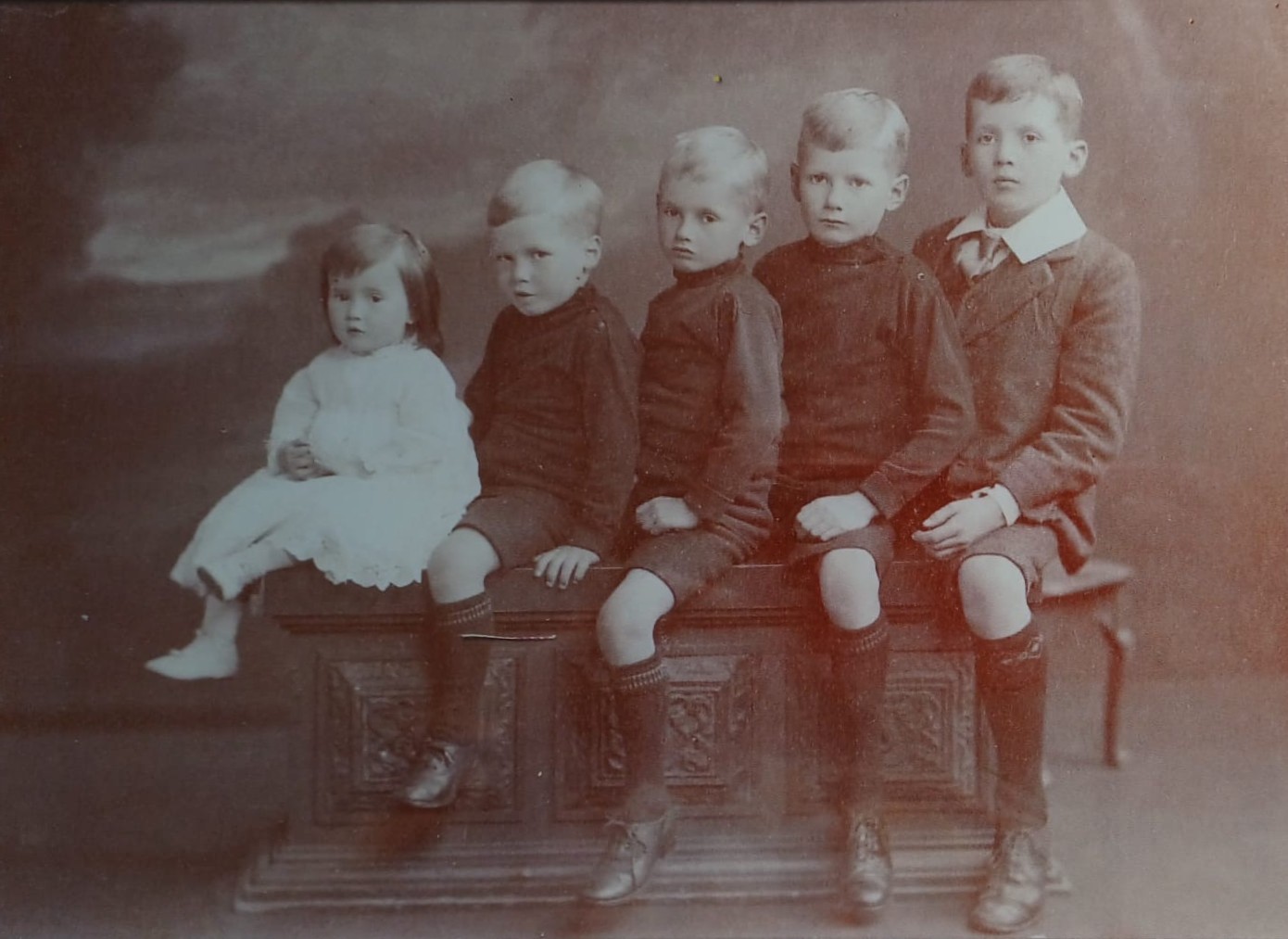
The 1911 Census lists four sons. Jane, the youngest, was not yet born — Inez reports four children, all living. The birthplaces read like an itinerary of empire: St Helena, Cape Town, Devonport, Devonport. The family moved from posting to posting, and the children arrived where the Army put them.
John Henry Gregson — the eldest, born on St Helena around 1904. The island was a British garrison in the South Atlantic, best known as Napoleon’s prison but still operational as a coaling station and military staging post at the turn of the century. John followed his brothers into the Royal Artillery and rose to Lieutenant-Colonel. His service number, 27918, is lower than Guy’s 34436 and Mark’s 40383 — the sequence confirms he was commissioned first, around 1923–24. In 1947, the London Gazette records him receiving the Order of Orange Nassau with Swords from the Netherlands, a decoration awarded to Allied officers who contributed to the liberation of the Low Countries. He is the least documented of the three gunner brothers, and the most deserving of further research.
Guy Patrick Gregson — born 8 April 1906, Cape Town. The subject of this biography. Service number 34436.
Mark Gilchrist Gregson — born around 1909 at Devonport, the great naval and military port on the Devon coast. He carries his mother’s maiden name as his middle name. Major, 1st Field Regiment, Royal Artillery, 4th Indian Division. Service number 40383. Killed in action on 15 July 1942 during Operation Bacon at Ruweisat Ridge, the first major British counterattack of the First Battle of El Alamein. Buried at El Alamein War Cemetery, Plot XXI, Row D, Grave 19. The headstone bears no personal inscription.
Martin James Gregson — age one in the 1911 Census, born at Devonport. His middle name “James” is the only new detail the census provides. His life after childhood is undocumented in the records assembled so far.
Jane Gregson — the youngest, born after April 1911. She married and had a daughter, Anna Cacanas, whose memories of visiting the grandparents at Whitelackington are the sole surviving first-hand account of Henry Guy and Inez’s home.
One aunt told Marcus that every male Gregson since the Norman Conquest had gone either into the Church or the Army. Three of the five children bore this out. Marcus, Guy’s son, broke the chain by choosing Cambridge and the City. He was the first Gregson in recorded memory to do so. Guy accepted the decision without complaint.
Mark married Christine Rozel Pigot Williams. Her father was Admiral Hugh Pigot Williams — a man who had commanded the British naval mission to the Ottoman Empire and served as Fleet Commander of the Ottoman Navy from 1910 to 1912. Her grandfather was General Sir John William Collman Williams, KCB, of the Royal Marines. Her uncle, Major-General Edward Ingouville-Williams — known throughout the Army as “Inky Bill” — commanded the 34th Division on the Somme and was killed in action on 22 July 1916. Another uncle, Major-General George Williams, was killed in the Boer War.
Two military dynasties — the Gregsons of Lancaster and the Williams family of Havant — were joined by a marriage that lasted five years before the desert took one of them. Christine’s uncle fell on the Somme. Her husband fell at Alamein. Two world wars took men from the same family.
“Pigot” was not a double-barrelled surname. It was a middle name, passed through the Williams family to honour a connection to the prominent Pigot naval dynasty. “Rozel” was a place name from Jersey — Rozel Bay, on the northeast coast — honouring Christine’s grandmother, Georgiana Isabella Ingouville of La Frégonnière, Jersey. Christine’s mother, Christine de Villiers Steytler, was South African, of Huguenot descent. She died in 1924, when Christine was fourteen.
The Admiral lived at the Manor House, Bedhampton — effectively Havant, Hampshire. In 1927, a Great Western Railway shareholder record places Colonel Gregson at Cosham, three miles from Bedhampton. The families were neighbours. Whether Mark met Christine through proximity, through military circles, or through some other channel, the two families shared the same Hampshire geography before they shared a marriage.
After Mark’s death, Christine remarried Henry Woodward. She died in September 1991 in Chichester, West Sussex. No children from either marriage have been found.
The grandchildren called it “Whitelackington.” Anna Cacanas described “the lovely Regency house near Ilminster” — the nursery wing with its own kitchen, the swinging baize door, the smoking room where Grandfather enforced silence for the six o’clock news, the sunk garden on the west side, the kitchen garden with its pump, the mulberry tree, the enormous cedar, the fruit cage. The brothers — all the brothers — were expected at Holy Communion at half past eight on Sundays. Uncle Mark used to bound in from the back, still in his bedroom slippers.
The 1939 Register places the family more precisely: Old Vicarage, Seavington St Mary, in the Chard Rural District — two miles east of Whitelackington. Colonel Retired. Wife, born 5 April 1877. A cook named Cox. A nurse named Ware. Two records officially closed — probably children still living under the same roof.
Burke’s Landed Gentry records him as “of Whitelackington, Ilminster, Somerset.” The ledger stone is at the Church of the Blessed Virgin Mary, Whitelackington. The family identified with the place, even if the house was technically in the next village. When it was finally sold — “for something like seventeen thousand,” Anna recalled — Pooje was shocked to see the sale reported in The Times. She considered it very vulgar.
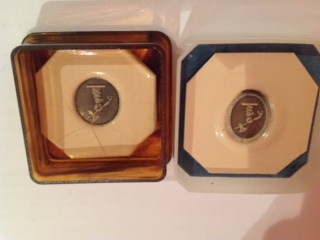
Guy’s son Marcus remembered two things about the family’s ancestry: a Norman knight named Gregory de Normanton, and a crest showing a hand holding a battleaxe. A gold signet ring in the family collection bears precisely this device — an armoured cubit arm with diagonal wavy bands, holding a battleaxe, mounted on a torse. Fairbairn’s Book of Crests (1905) records five Gregson entries, all featuring the same motif. The entry for “Gregson of Lowlyn, Durh.” matches the ring exactly.
The crest belongs to the Gregson family of Murton, Durham, traceable to John Gregson, who died in 1607. From Murton the family dispersed: one branch to Lowlynn in Northumberland, where Henry Knight assumed the Gregson name in 1831 and received a formal grant of arms from the College of Arms in 1842 — motto Vigilo, “I keep watch.” Another branch to Burdon, near Sunderland, where Colonel Lancelot Allgood Gregson used the same crest and motto as High Sheriff of Durham in 1897. And another to Lancaster, where Henry Gregson became Mayor and his grandson married a general’s daughter from Nova Scotia.
The Lancaster Gregsons and the Knight Gregsons of Lowlynn are not the same branch. But they descend from the same root, and they share the same arms. Marcus’s family lore — the Norman knight, the battleaxe — was not a claim to the specific Lowlynn grant. It was a memory of the broader Gregson identity, carried through the generations from Durham to Lancashire to India to Cape Town to Somerset.
And the chairs. Marcus told the story of the Hepplewhite dining chairs, purchased by a Gregson ancestor directly from the craftsman “when the family lived in Lancashire” around 1800. The story checks out. The Gregsons lived in Lancaster at the turn of the nineteenth century. Hepplewhite apprenticed with Gillows of Lancaster. The chairs have passed from Whitelackington to Salisbury Plain to Bears Farm, and are destined to travel further still — through Marcus to Max and beyond. Four generations of family lore, and the records confirm every word.
Guy married twice. His first wife was Oriel Leonie Lucas-Scudamore, daughter of Colonel Edward Lucas-Scudamore, who had inherited Kentchurch Court in Herefordshire — one of the oldest continuously inhabited houses in England, associated with the Scudamore family since the Norman Conquest and with the legendary Owain Glyndŵr. They married on 22 June 1945 in Sherman, Connecticut, USA. Why a British lieutenant-colonel was in rural New England at the end of the war is unexplained. The marriage produced one son, Marcus John Gregson, born 20 June 1946 in London. It ended in divorce around 1953, while Guy was commanding guns in Korea.
His second wife was Iris Patricia Slade-Powell. They married in June 1960 and bought Bears Farm, Hundon, Suffolk, for six thousand pounds. He was fifty-four. She was rising thirty-seven. They built a stud farm, bred racehorses, and lived there for the rest of Guy’s life. One daughter, Sally-Ann — known as Annie.
The name “Guy” passes through five generations. Henry Guy Gregson gave it to his son Guy Patrick. Guy’s son, Marcus, passed it down to his eldest son Julian: Julian Guy Gregson. And, Marcus’s other son, Max, passed it down to his first son, Lorenzo (“Enzo”) Guy Gregson. The tradition holds. Five generations spanning 150 years and counting.
Marcus — banker, horseman in his early days, father of three — turned eighty on 20 June 2026. This archive is his birthday present: a record of the Gregson line, assembled by his youngest son from documents scattered across two centuries and three continents, to be passed to the Gregsons who follow.
Guy died when Max was four years old. There are no direct memories — only one, inherited. On a late visit to Guy in hospital, the family braced themselves. Guy’s handshake had always been vice-like; the pain he was in made it worse. When the small boy was brought forward, they expected the worst. But Guy, for the first time in months perhaps, found the strength to be gentle. He held his grandson’s hand softly. No pain. No flinch. A quiet, deliberate goodbye — the last act of a man who had spent a lifetime knowing exactly how much force to apply.
| Source | Type | What It Establishes | Validity |
|---|---|---|---|
| 1911 England Census | Census (TNA) | Full household: HGFS = Major AOD; Inez born India; Matthew Henry = Maj RE; children’s birthplaces; Jane not yet born | ●●●●● PRIMARY |
| Devon Parish Marriage Register, Sidmouth | Parish register (SWHT) | Marriage 30 Dec 1902; Inez = Gilchrist; William Gilchrist = father; Captain in the Buffs; Matthew Henry = Maj RE; Elizabeth Inez Cowan = witness | ●●●●● PRIMARY |
| India Office Births & Baptisms | British Library | HGFS born 28 Oct 1872, Indore; father Mathew Henry; mother Mary Emma Griffith | ●●●●● PRIMARY |
| Anglo-Boer War Records | Military record | Captain, The Buffs; wounded severely Zoutspan Drift 13/12/1899; Rugby School | ●●●●● PRIMARY |
| 1939 Register | Census (TNA) | Col Retired; Old Vicarage, Seavington St Mary; wife DOB 5 Apr 1877; cook + nurse | ●●●●● PRIMARY |
| London Gazette 29886 | Official record | CMG, 1917 New Year Honours; Lt-Col, Army Ordnance Depot | ●●●●● PRIMARY |
| WWI Medal Index Card (WO 372) | TNA military record | AOD, Lt Col, CMG; France from 1 Mar 1915; 1914-15 Star | ●●●●● PRIMARY |
| Somerset Monumental Inscriptions | Parish burial record | Ledger stone, BV Mary Whitelackington; “Colonel, CMG, born 28 Oct 1872”; d. 20 Apr 1949 | ●●●●● PRIMARY |
| Civil Death Index (GRO) | Civil registration | Henry G F S Gregson, Q2 1949, Chard, Somerset | ●●●●● PRIMARY |
| Civil Marriage Index (GRO) | Civil registration | Henry Guy F S Gregson + Ines Mary Gilchrist, Q4 1902, Honiton | ●●●●● PRIMARY |
| Burke’s Landed Gentry, 1972 | Published reference | “son of late Henry Guy Fulljames Savage Gregson, CMG, of Whitelackington” | ●●●●○ PUBLISHED |
| Kelly’s Handbook of Distinguished People, 1939 | Published directory | “Gregson, col. Hy. Guy Fulljames Savage” | ●●●●○ PUBLISHED |
| CWGC Certificate — Mark Gilchrist Gregson | Official record | Parents: Henry Guy + Inez Mary Mowat; wife Christine Rozel Pigot; 1st Fd Regt RA | ●●●●● PRIMARY |
| Fairbairn’s Book of Crests, 1905 | Published heraldic reference | Five Gregson entries, all battleaxe crest; “Gregson of Lowlyn” matches signet ring | ●●●●○ PUBLISHED |
| Falkenburg Manuscript, 2016 | Genealogy (researched) | Knight Gregson of Lowlynn; 1842 College of Arms grant; 17 children of HKG Sr | ●●●○○ SECONDARY |
| Reid Manuscript, 1968 | Genealogy (researched) | De Normanton origin; Whalley/Lancashire; spurs-to-battleaxe crest evolution | ●●●○○ SECONDARY |
| Marcus Gregson’s StoryWorth Memories | First-person memoir | Whitelackington; Granny Cowan; Lancashire chairs; two Croix de Guerre; Guy’s character | ●●●●○ PRIMARY (oral) |
| Geni.com — Christine Woodward profile | Genealogy platform | Christine = d/o Admiral Hugh Pigot Williams; b. 1910; remarried Woodward; d. 1991 | ●●●○○ SECONDARY |
The strongest facts are confirmed by multiple independent sources:
| Fact | Sources (count) |
|---|---|
| Father’s full name (HGFS Gregson) | India Office + 1911 Census + Marriage register + Burke’s + London Gazette + Kelly’s (6) |
| Father born 28 Oct 1872 | India Office + 1939 Register + Monumental inscription (3) |
| Mother’s maiden name = Gilchrist | Marriage register (parish + civil) + Mark’s middle name (3) |
| Matthew Henry = Major, Royal Engineers | Marriage register + 1911 Census (2) |
| Inez born India | 1911 Census (1) — further confirmation needed |
| Father wounded Boer War | Anglo-Boer War Records + career transfer to AOD (2) |
| Three brothers all RA | London Gazette (John, Guy, Mark) + CWGC (Mark) (4) |
| Lancaster lineage | 1911 Census (Matthew Henry “Lowers Lancaster”) + Peter Barker genealogy + Lancaster parish marriages (3) |