Research in Progress
This chapter draws on a single primary source — the CB citation. The following would substantially deepen it:
- 1st Infantry Division composition and training records, 1956–59
- The Sandys Defence White Paper (13 February 1957) and its impact on conventional force structure
- BAOR reorganisation records and the end of National Service
- Erskine’s IWM papers (1030007436) — may contain correspondence with Guy from both the wartime and Southern Command periods
On 19 August 1957, General Sir George Erskine sat at his desk at Southern Command headquarters and wrote a citation recommending one of his subordinates for the Companion of the Bath. The subordinate was Major-General Guy Patrick Gregson, commanding the 1st Infantry Division at Bulford on Salisbury Plain. The two men had known each other for fourteen years. Erskine had commanded the 7th Armoured Division when Guy won his DSO at Tunis and his Bar to DSO at Villers-Bocage. He had watched him coordinate a hundred and sixty guns under fire. He had endorsed the recommendations that sent Guy’s name to Montgomery. Now, twelve years later, in a different kind of army in a different kind of world, he was recommending the same man again — not for gallantry this time, but for thinking.
“This officer’s outstanding and infectious enthusiasm deserve acknowledgement and encouragement. I most strongly recommend him for a C.B.”
— General Sir George Erskine, GCB KBE DSO, GOC-in-C Southern Command, 19 August 1957From Rhine to Salisbury Plain
After Korea, Guy disappeared into the peacetime army. He was appointed Brigadier Royal Artillery of the British Army of the Rhine — a senior post, responsible for all RA units in the British occupation zone of Germany, but one that left no trace in the documentary record beyond a single mention in the CB citation. BAOR headquarters relocated to Rheindahlen in October 1954; Guy’s tenure may have straddled that move. We know nothing else about his time on the Rhine. No correspondence survives. No one, so far as the record shows, asked him about it.
In January 1956, he took command of the 1st Infantry Division at Bulford, on the open chalk downland of Salisbury Plain. From approximately August 1956, he was dual-hatted as Commander, Salisbury Plain District — responsible for both the division and the training area on which it exercised. He was promoted Major-General on 29 January 1957, at the age of fifty.
What he found at Bulford was a division that existed more on paper than in the field. The Cold War British Army was being squeezed from every direction — by the Treasury, which wanted cuts; by the nuclear strategists, who argued that conventional forces were irrelevant in the age of the hydrogen bomb; and by the politicians, who were preparing to end National Service and halve the army’s strength. The 1st Infantry Division, Erskine noted in the citation, “has been very weak and the normal opportunities for training his Division have not existed.” Translated from the language of official recommendation, this means the division was under-strength, under-funded, and under-equipped. Most generals, given a weak division and no training opportunities, would have managed the situation, submitted their reports, and waited for retirement or a better posting.
Guy did something else.
Military Studies and Experiments
“In spite of the fact that his Division has been very weak and the normal opportunities for training his Division have not existed, he has taken the initiative in starting a number of most valuable Military Studies and experiments. The most important of these studies has shown the way to a much lighter and more mobile fighting force.”
— CB Citation, WO 373/165/183, August 1957The citation names three studies. The first and most significant showed “the way to a much lighter and more mobile fighting force” — a phrase that, in the context of 1956, was either visionary or heretical depending on whom you asked. The British Army had spent a decade rebuilding its conventional strength after 1945. Lighter and more mobile meant fewer men, fewer tanks, fewer guns. It meant accepting that the next European war, if it came, would be fought by smaller, faster formations that could disperse to survive a nuclear strike and concentrate to fight. It meant, in short, the future — a future that the Sandys Defence White Paper would demand in February 1957, a full year after Guy began his experiments at Bulford.
Whether Guy anticipated Sandys or whether the War Office was quietly encouraging divisional commanders to explore the options before the White Paper landed is not clear from the surviving record. What is clear is that he did not wait to be told. The other two studies — an improved method of MT maintenance and a simplified MT accounting system — were the kind of practical reforms that a gunner officer, trained at Woolwich to think in logistics as well as ballistics, would naturally identify. They were described in the citation as “most valuable contributions to military thought at the present time,” a phrase that Erskine, who was not given to flattery, would not have used lightly.
The Same Commander, Twice
The CB recommendation is signed by General Sir George Erskine, GCB, KBE, DSO, ADC, General Officer Commanding-in-Chief, Southern Command. The same George Watkin Eben James Erskine who had commanded the 7th Armoured Division from January 1943 to August 1944 — the Desert Rats, Guy’s division, through Tunis and Villers-Bocage. The same Erskine who had been removed from command after the controversies that followed the Normandy battles, who had served in Belgium, commanded British troops in Egypt, fought the Mau Mau in Kenya, and returned to England as one of the army’s most senior officers. He knew Guy. He had seen him under fire. And now he was seeing him under a different kind of pressure — the institutional pressure of austerity, reorganisation, and the slow erosion of the army he had spent his career building.
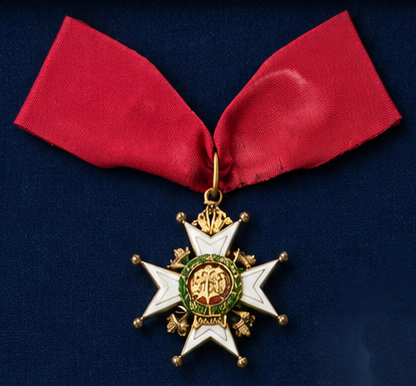
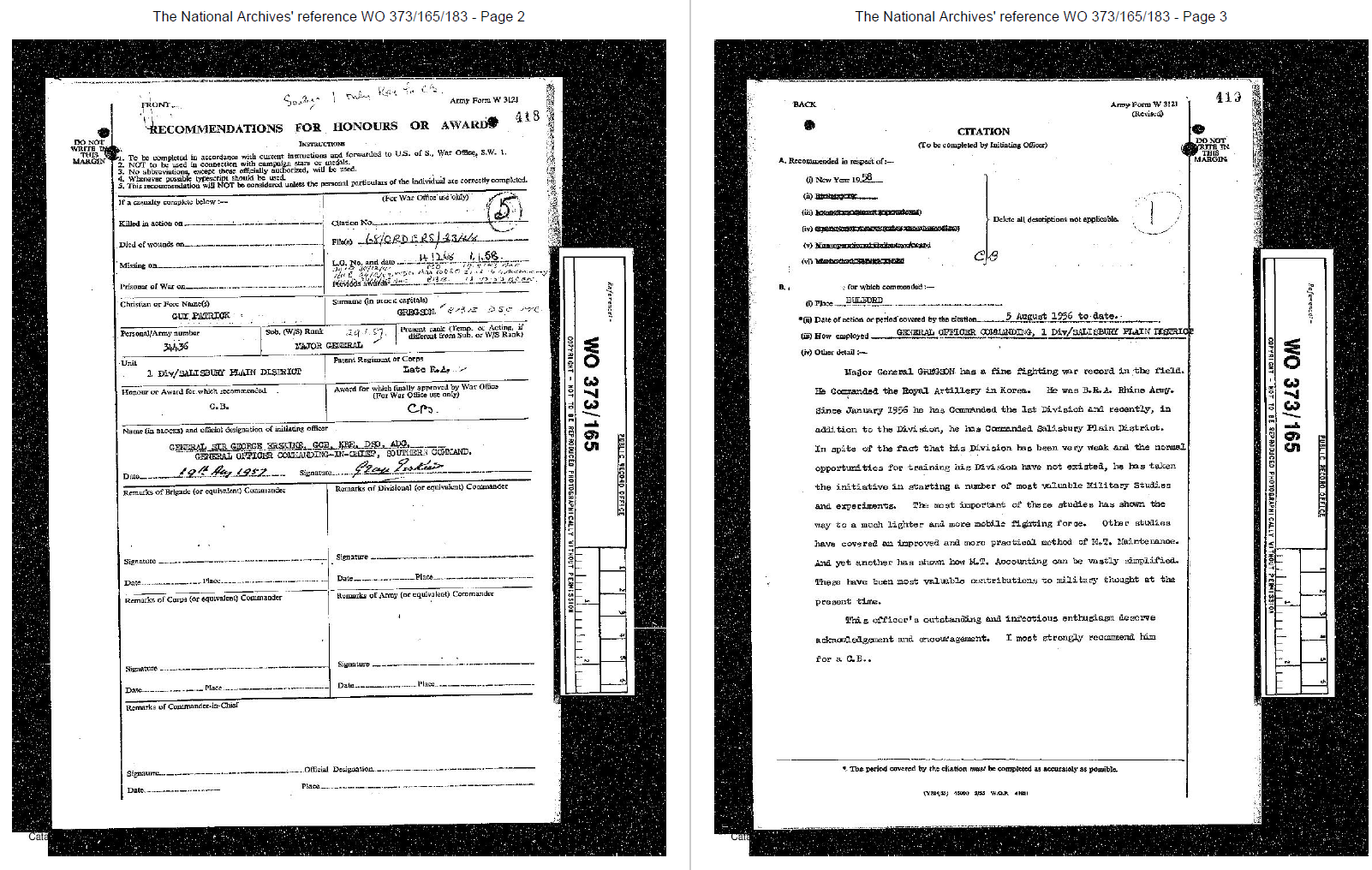
The opening line of the citation carries the weight of that history: “Major General GREGSON has a fine fighting war record in the field.” Written by any other general, this would be a conventional preamble. Written by the man who had personally witnessed that war record — who had endorsed Guy’s DSO at Tunis and his Bar at Villers-Bocage, who had watched him coordinate guns under shell-fire and sniping — it reads as a statement of personal knowledge. Erskine was not relying on a file. He was remembering.
There is a quiet satisfaction in the arc. From the dust of Tunis to the corridors of Bulford, across twelve years and the entire transformation of the British Army, one commander’s consistent faith in one gunner officer. The DSO was for courage. The Bar was for courage under worse circumstances. The CB was for something different and, in its way, harder: the willingness to think when thinking was not what the system rewarded.
Twenty-Eight Days
Guy left the 1st Infantry Division on 1 April 1959, succeeded by Major-General Hobbs. The London Gazette records one further appointment: Deputy Commander, British Army of the Rhine, from 31 March 1959, and then off the active list on 28 April 1959. Twenty-eight days. It has the look of a valedictory posting — a title and a farewell, not a command. Whether Guy minded, whether he had wanted to continue, whether the brevity of the appointment stung or suited him, is not recorded.
He was fifty-three. He had served for thirty-three years. He had commanded a regiment in combat, directed the artillery of a division in Korea, and pioneered the doctrine that the army would spend the next decade implementing. His reward was a Companion of the Bath, written by the one man in the army who had known him longest and best, and twenty-eight days as deputy commander of a headquarters he had served in as a brigadier five years earlier. The active list, and the active career, ended on 28 April 1959.
But Guy Patrick Gregson did not retire. He had, it turned out, one more act.
Explore Further
- Read the CB citation on the Awards page — Erskine’s recommendation in the original language
- The Gregson family — the family tree and what we know about each member
What We Don’t Know
The CB citation is the sole substantive source for this entire chapter. What the “lighter and more mobile fighting force” experiments actually involved — the tactics tested, the formations trialled, the conclusions reached — is not described. Whether Guy’s work was cited in the Sandys White Paper process, whether it influenced Army doctrine directly, whether the studies survive in any archive — all unknown.
Guy’s time as BRA Rhine Army (~1954–55) is a complete blank. His daily life at Bulford, his relationship with Erskine during this second period of shared service, his views on the nuclear deterrence debate — none of this is documented.
Research Plan
The following would transform this chapter from an essay into a narrative:
- TNA WO 305 / WO 291 — Operational research and military studies from 1st Infantry Division, 1956–59. If Guy’s “lighter and more mobile force” study was formally published, it would be here.
- The Sandys Defence White Paper (Cmnd 124, February 1957) — the political context for Guy’s experiments. Compare the White Paper’s language with the CB citation’s.
- Erskine’s IWM papers (Documents 1030007436) — span 1915–1964, include 7 Armd Div correspondence. May contain letters to or about Guy from both command periods.
- 1st Infantry Division records — TNA or Army Historical Branch. Composition, strength returns, training schedules would show how “very weak” the division actually was.
- BAOR records, 1954–55 — Guy’s BRA Rhine Army period. HQ Rheindahlen files may name him in staff lists or correspondence.
- Family interview with Marcus — Guy may have spoken about Bulford, Erskine, or the experiments in conversation. This is the period Marcus (b. 1946) would have been old enough to remember visiting his father.