Research in Progress
- 1 RHA war diary (TNA WO 169 series) — would confirm when Guy joined the regiment, document the Ed Duda fighting day by day, and identify Major Turnbull.
- Mark’s war diary (1st Field Regiment RA, TNA WO 166/171) — would reveal the circumstances of his death on 15 July 1942.
- Guy’s service record (Ministry of Defence) — would fill the remaining gap between 1 RHA (Tobruk) and 5 RHA (Tunis).
- Family interview with Marcus — the blank headstone inscription, whether Guy ever visited the grave, and what the family knew about Mark’s death.
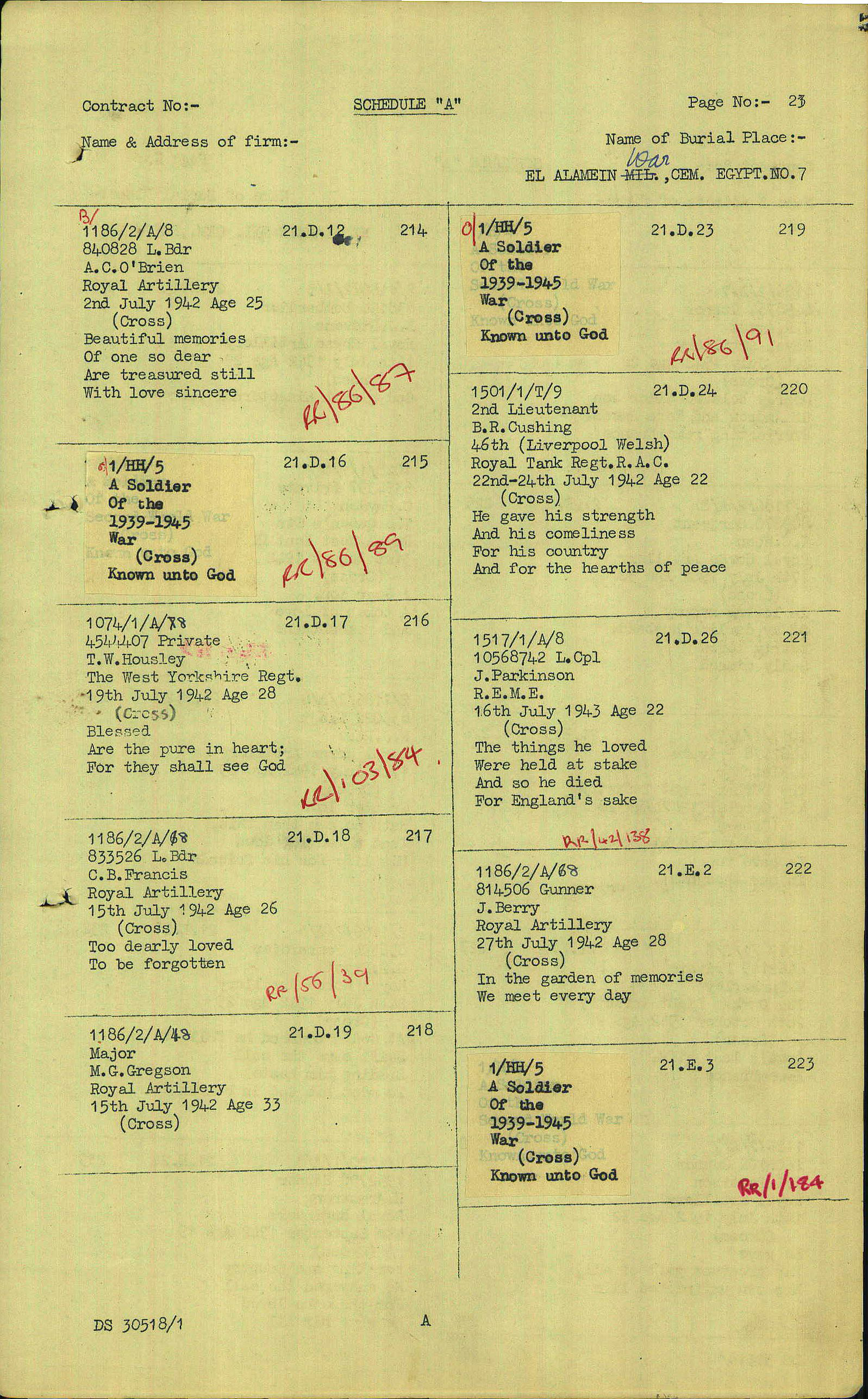
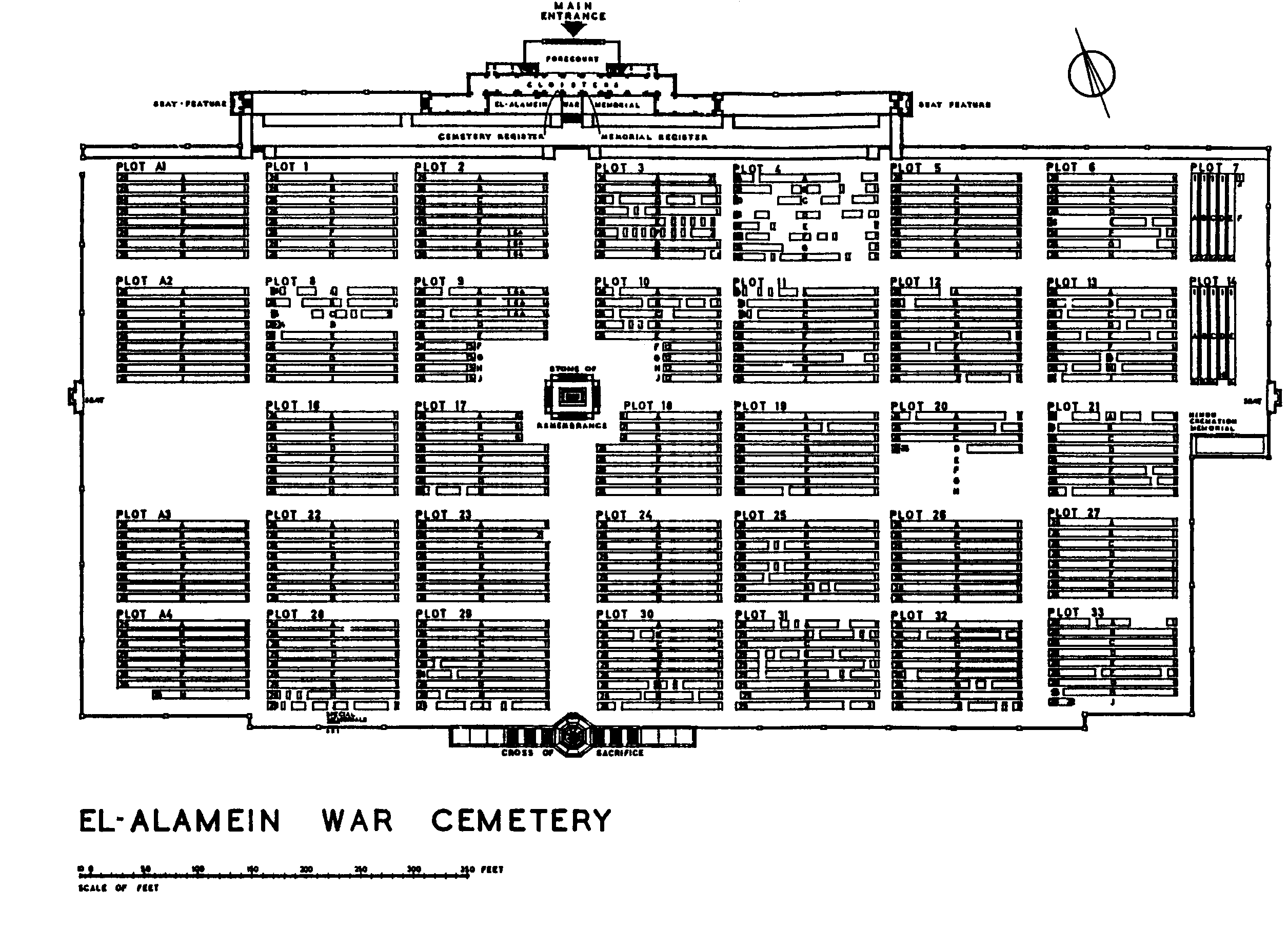
The headstone at El Alamein War Cemetery bears a cross and five lines of text. “Major, M.G. Gregson, Royal Artillery, 15th July 1942 Age 33.” There is no personal inscription — no family-chosen words at the bottom, no “beloved son” or “always remembered,” nothing to distinguish it from the thousands of identical white stones that stand in rows across the desert sand a hundred and thirty kilometres west of Alexandria. The headstone schedule confirms it: the space where other families wrote their farewells is blank.
We do not know why. Perhaps the family was not asked in time, or could not decide, or chose silence over sentiment. Perhaps the words felt inadequate. What we do know is that Major Mark Gilchrist Gregson, service number 40383, 1st Field Regiment Royal Artillery, died on the fifteenth of July 1942 during the First Battle of El Alamein, and that at the moment of his death his elder brother Guy was serving as a temporary lieutenant-colonel in the same desert, within the same theatre of war, under the same Egyptian sky.
Both were gunners. Both were Gregsons. Both were sons of Colonel Henry Guy Fulljames Savage Gregson, CMG, a Boer War veteran himself — shot through the thigh at Zoutspan Drift in 1899 — and Inez Mary Mowat Gilchrist. Three brothers served in the Royal Artillery: John, Guy, and Mark. One fell at Alamein. The other two came home.
Two Gunners
The childhood photograph — five children arranged on a carved wooden bench in a studio, probably around 1913 to 1916 — shows them all: John, Guy, Mark, Martin, and Jane, the youngest, in white. It is the only photograph of all five siblings together. Of the four boys, three would serve in the Royal Artillery. John was commissioned first, then Guy from Woolwich in 1926, then Mark some years later. By 1942, both Guy and Mark held the rank of major — Guy as a temporary lieutenant-colonel — and both were serving in the Middle East.
Beyond the bare military facts, almost nothing is known about Mark. His CWGC certificate tells us he was thirty-three when he died, which places his birth around 1908 or 1909. He was married to Christine Rozel Pigot Williams — the daughter of Admiral Hugh Pigot Williams, who had commanded the Ottoman fleet — and they lived near Chard, Somerset, five miles from his parents’ home. He served with the 1st Field Regiment, Royal Artillery. He was buried six days after he fell, at map reference 882c-2346, in the flat desert east of the Alamein line, before being moved to the permanent cemetery. His middle name, Gilchrist, was his mother’s maiden surname — Inez Mary Mowat Gilchrist, born in India, daughter of William Gilchrist of the Indian service. That is all we have. No letters. No diary. No oral history. Mark left no voice behind.
The Rat of Tobruk
Sometime in the middle months of 1941, after the fall of Eritrea, Guy Gregson was shipped into hell. He left the Sudan Defence Force and joined the 1st Regiment, Royal Horse Artillery — one of the most prestigious units in the entire British Army, whose A Battery, the Chestnut Troop, had fired at Waterloo. The regiment was inside Tobruk.
Tobruk had been besieged since 10 April 1941, when Rommel’s Afrika Korps surrounded the Libyan port city and its defences. For 241 days — one of the longest sieges in British military history — the garrison held out: supplied by destroyer runs from Alexandria at night, the “Spud Run,” through seas patrolled by the Luftwaffe. Twenty-six ships were sunk on the run. Guy reached the fortress by one of them.
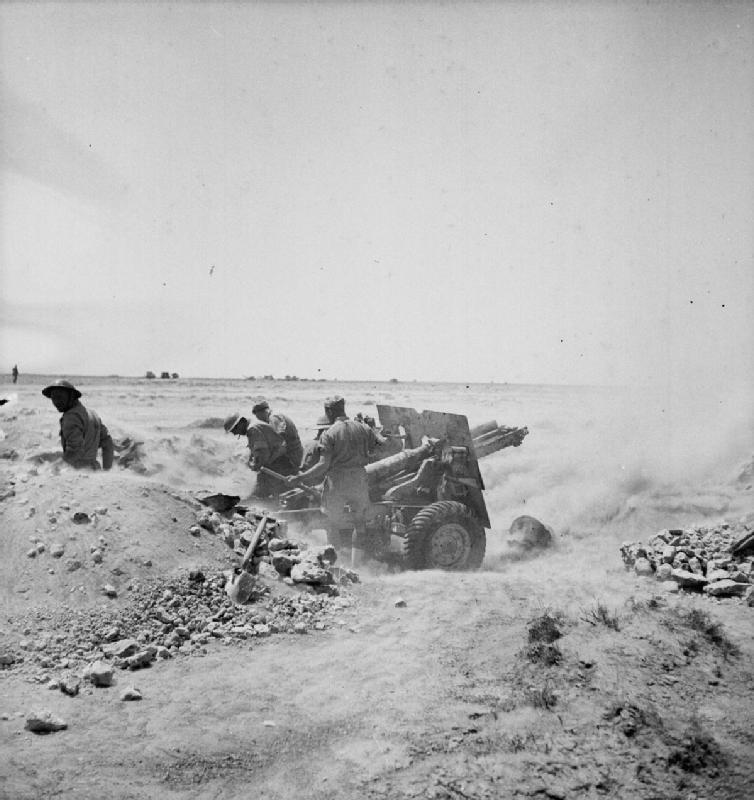
He was given command of A/E Battery — the combined Chestnut Troop and E Battery, whose gunners had fired the very first British artillery round of the First World War on 22 August 1914. His weapons were sixteen 25-pounders. His job was to support the breakout.
Ed Duda, 3 December 1941
Operation Crusader — the relief of Tobruk — began on 18 November 1941. The plan required two forces to converge: the Eighth Army advancing from the east, and the Tobruk garrison breaking out southward. They were to meet at Ed Duda, a low hill on the escarpment eight miles south of the perimeter, commanding the road the Germans used to supply their siege lines. Whoever held Ed Duda held the key to the siege.
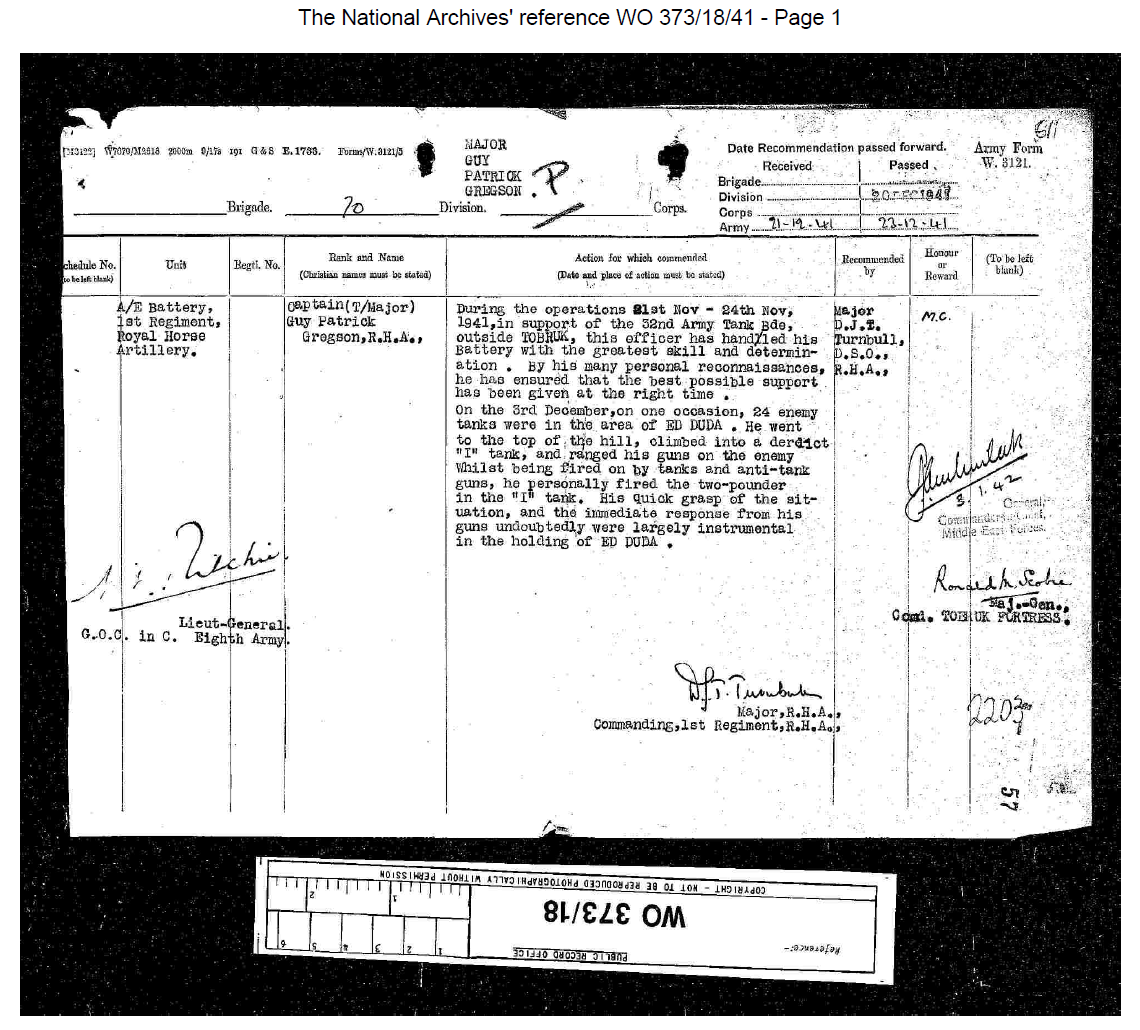
From 21 to 24 November, Guy’s battery supported the 32nd Army Tank Brigade as its Matilda tanks punched south from the perimeter. The citation would later note his “greatest skill and determination” and his “many personal reconnaissances” during this phase. On 26 November, the Matildas seized Ed Duda in a twenty-minute dash. The corridor was open. Tobruk was, briefly, relieved.
Then Rommel counter-attacked. On 29 November, the 15th Panzer Division stormed Ed Duda and overran the Essex Regiment’s positions. That same day, Captain Salt of the Chestnut Troop — Guy’s own battery, Guy’s own men — was killed at his observation post on Ed Duda, broadcasting a running description of the German armour until his tank was hit. The corridor was severed. The garrison was isolated again.
On 3 December, Rommel ordered one last attempt to take Ed Duda and reopen the bypass road. Twenty-four German tanks — the remains of the 21st Panzer Division, which by now could barely field a company’s worth of armour — advanced on the hill.
Guy went to the top of Ed Duda. He found a knocked-out Matilda — an “I” tank, in the military abbreviation of the day — its hull wrecked but its turret and 2-pounder gun still functional. He climbed in.
“He went to the top of the hill, climbed into a derelict ‘I’ tank, and ranged his guns on the enemy whilst being fired on by tanks and anti-tank guns, he personally fired the two-pounder in the ‘I’ tank. His quick grasp of the situation, and the immediate response from his guns undoubtedly were largely instrumental in the holding of ED DUDA.”
— MC Citation, WO 373/18/41. Recommended by Major Turnbull DSO, CO 1st Regiment RHA. Endorsed by GOC Tobruk Fortress (Maj-Gen Scobie) and GOC-in-C Eighth ArmyRead it again slowly. He climbed into a stationary, already-damaged tank, alone, on the most contested hilltop in the Western Desert. He had no crew, no driver, no ability to move. From inside its seventy-eight millimetres of armour he did two things at once: directed his battery’s 25-pounder fire by radio onto the approaching German tanks, and personally aimed and fired the Matilda’s 2-pounder through its gun port — a weapon that could, at close range, punch through the side of a Panzer III. He did this while twenty-four enemy tanks and their anti-tank guns were firing at him.
Four days earlier, one of his own officers had died doing the same kind of work from a tank on the same hill. Guy knew exactly what he was climbing into.
The German attack failed. On 4 December, the 21st Panzer tried again and was repulsed. That afternoon, Rommel issued the retreat order. The battle for Tobruk was over. The siege was lifted on 10 December 1941. Operation Crusader was the first major British victory over German forces in the war.
Guy received the Military Cross. He was thirty-five years old. He had been a gunner for fifteen years, a commander of Sudanese cavalry, a converter of horsemen into artillerymen, a veteran of Keren, a Rat of Tobruk, and now a man who had personally fought a tank battle from a wrecked Matilda while directing a battery of horse artillery. And the war was not half over.

Ruweisat Ridge, 15 July 1942
The First Battle of El Alamein is not the one most people remember. It was not Montgomery’s set-piece victory of October 1942, with its barrage and its bagpipes and its thousand guns. It was the desperate, improvised, furiously violent fight that stopped Rommel’s advance in July, when the Afrika Korps reached the last defensible line before the Nile Delta and the Eighth Army held it with whatever it had to hand. The desert war was, above all, a gunner’s war. Royal Artillery field regiments formed the backbone of the ad hoc columns and defensive boxes that plugged the gaps in the Alamein line. Artillery officers died at the same rate as the infantry they supported, and sometimes faster.
Mark died on 15 July 1942. The date falls precisely within Operation Bacon, the first major British counterattack of the First Battle of El Alamein. On the night of 14–15 July, Auchinleck launched the 4th and 5th New Zealand Brigades and the Indian 5th Infantry Brigade against Ruweisat Ridge. The 1st Field Regiment RA, part of the 4th Indian Division, was in direct support of the Indian brigade’s attack on the eastern end of the ridge. The objectives were taken before dawn, but at first light the 8th Panzer Regiment counterattacked, overrunning exposed positions. Artillery officers died at the same rate as the infantry they supported, and sometimes faster. Adjacent graves in Plot XXI, Row D, hold men from the Royal Tank Regiment, the West Yorkshire Regiment, and other Royal Artillery units — the mixed dead of the Alamein battlefield, buried together in the order they fell.
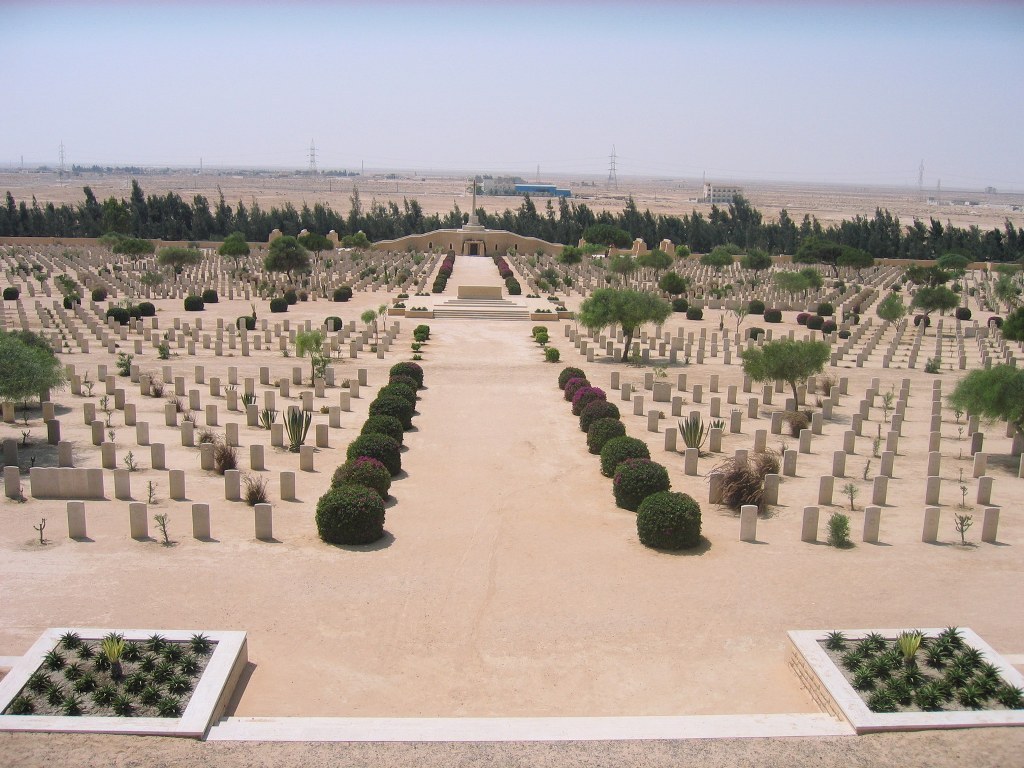
Mark was thirty-three. He had been married to Christine, the daughter of an admiral who had once commanded the Ottoman fleet. He was a major commanding guns in the desert, the middle of three brothers who all served in the Royal Artillery. And then he was a name on a headstone with no inscription.
The Other Brother
After Tobruk was relieved in December 1941, Guy remained in the Middle East — probably still with 1st RHA, possibly moving to another unit as the desert war consumed formations faster than they could be rebuilt. His first Mention in Despatches covers the period 1 May to 22 October 1942 and gives his rank as “Major (temporary Lieutenant-Colonel)” — but does not name his unit. The 5th Royal Horse Artillery, the regiment he would command at Tunis and Villers-Bocage, did not arrive in Egypt until 18 July 1942 — three days after Mark’s death. Where exactly Guy was on 15 July, and whether he was anywhere near his brother when Mark fell, are questions that only his service record could answer.
What we know for certain is this: two Gregson brothers, both Royal Artillery officers, were in the Western Desert at the same time. One was killed. The other, within ten months, would win the Distinguished Service Order at the capture of Tunis.
The Narrowing Gap
There was a time when the record between Keren and Tunis was a hole eighteen months wide. The MC citation has narrowed it considerably. We now know Guy went from the SDF to 1st RHA at Tobruk by November 1941, and from there to 5th RHA by late 1942 or early 1943. The remaining mystery covers roughly ten months: from the relief of Tobruk in December 1941 to the point when he assumed command of 5 RHA, probably around the time it joined 7th Armoured Division on 1 December 1942.
Mark’s death falls squarely in this gap. Did Guy know immediately? Did they see each other in Egypt after Tobruk was relieved? Had they met since the childhood photograph, since Gresham’s, since the family home? Did Guy ever visit the grave? The cemetery sits on the desert road between Alexandria and Mersa Matruh; any officer serving in the theatre would have passed it a hundred times. Whether Guy stopped, whether he stood before Plot XXI, Row D, Grave 19, and read the five lines of text on his brother’s headstone — this is something only the family can tell us.
Tunis
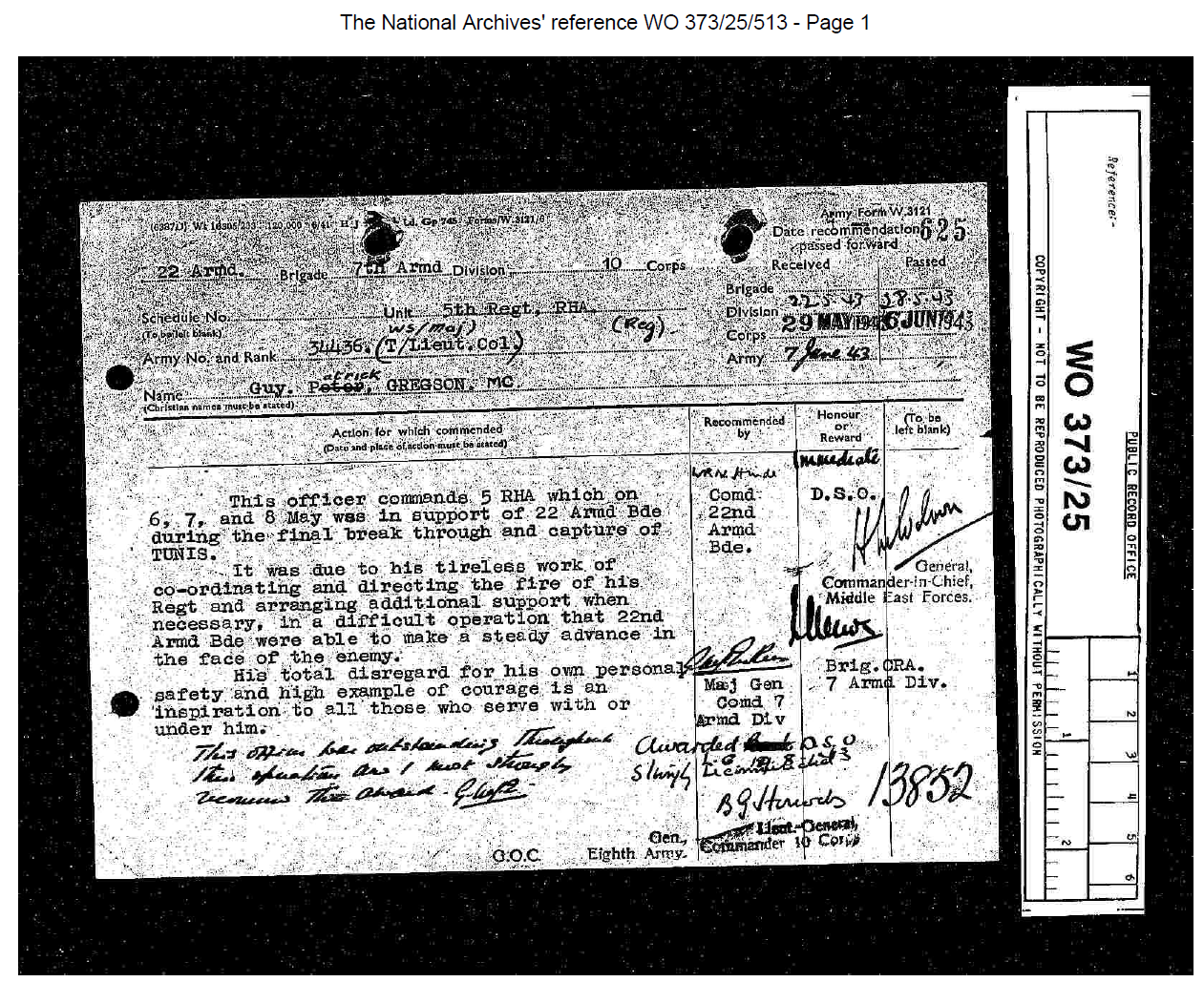
By December 1942, Guy was commanding the 5th Royal Horse Artillery within the 22nd Armoured Brigade, 7th Armoured Division — the Desert Rats. How he got there is unknown. That he was there is beyond doubt: the DSO citation for the capture of Tunis, dated 6 to 8 May 1943, names him explicitly.
“This officer commands 5 RHA which on 6, 7, and 8 May was in support of 22 Armd Bde during the final break through and capture of TUNIS. It was due to his tireless work of co-ordinating and directing the fire of his Regt and arranging additional support when necessary, in a difficult operation that 22nd Armd Bde were able to make a steady advance in the face of the enemy. His total disregard for his own personal safety and high example of courage is an inspiration to all those who serve with or under him.”
— DSO Citation, WO 373/25/513. Endorsed by Montgomery’s Eighth ArmyThe capture of Tunis on 7 May 1943 ended the North African campaign. The 7th Armoured Division and the 22nd Armoured Brigade were among the first British formations into the city. Guy’s regiment provided the artillery support that allowed the brigade’s advance against the last organised Axis resistance in Tunisia. The recommendation came from the commander of 22nd Armoured Brigade and was endorsed up the chain — through the CRA of the 7th Armoured Division, through the corps commander, through the army commander — all the way to the Commander-in-Chief, Middle East Forces. The award was immediate: a DSO given in the field, not through the periodic honours system.
The citation form records his name as “Guy, Peter, GREGSON” — using “Peter” where “Patrick” is his legal middle name. It is a small detail, but it confirms what the family has always known: Guy was also called Peter, and the military clerk wrote down the name he actually used.
What the Record Cannot Say
There is a version of this story that writes itself — the elder brother, grieving, driving himself through the Tunisian campaign with a fury born of loss, earning the DSO as a kind of memorial to the brother who fell. It would make a good scene in a novel. It may even be true. But the record does not support it, and this biography will not invent what the documents do not contain.
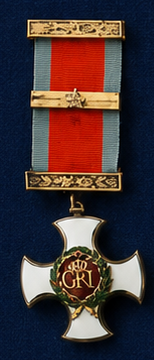
What the record does contain is a coincidence so precise it hardly needs embellishment. Two brothers, both named Gregson, both Royal Artillery, both in the desert in 1942. One fell at the Alamein line in July. The other won the DSO at Tunis in May of the following year, in the battle that ended the campaign Mark did not live to see finished. The same war, the same arm of service, the same theatre. One headstone in the sand. One medal in the tray.
The childhood photograph — Guy on the right, Mark third from the left, all five children arranged on that carved bench — was taken in a studio somewhere in England, probably around 1914, when the first war was beginning and the second was a generation away. Two of those boys would grow up to be gunners. One would die at thirty-three in the desert. The other would live to eighty-two, retire to a farm in Suffolk, and leave behind a medal tray with fifteen decorations, a signet ring bearing the family crest, and three reels of tape on which he talked for sixty minutes about Sudan and never once mentioned his brother’s name.
Explore Further
- Mark Gregson memorial — Christine, the Admiral’s daughter, and two military dynasties
- The Gregson family — three brothers, all gunners, and the Lancaster lineage
- North Africa map — the Alamein line, Ruweisat Ridge, and the road to Tunis
- The full citations on the Awards page — DSO, Bar to DSO, and MC in the original language
- Paternal lineage records — the primary documents that trace Guy’s line to Lancaster
What We Don’t Know
The MC citation has filled a major gap — we now know Guy was with 1 RHA at Tobruk by November 1941. But roughly ten months remain unaccounted for: from the relief of Tobruk (December 1941) to his assumed command of 5 RHA (probably late 1942). Did he stay with 1 RHA? Move to another unit? His service record (Ministry of Defence) or the 1 RHA war diary (TNA WO 169) would tell us. The 1 RHA diary would also name the CO, Major Turnbull DSO, who recommended Guy for the MC — and document Captain Salt’s death on 29 November.
The blank inscription on Mark’s headstone is itself a question. The CWGC offered families sixty-six characters for a personal inscription; many chose not to use them, but the reasons varied. A conversation with Marcus — Mark’s nephew — might shed light on what the family chose and why.
Guy’s IWM oral history, recorded in 1979, covers only his Sudan years. He does not mention Tobruk, Ed Duda, Mark, or El Alamein. Whether this was because Conrad Wood did not ask, or because Guy chose not to speak of it, we cannot know. But a man who climbed into a wrecked tank under fire from twenty-four German panzers, four days after losing one of his own officers on the same hill, and then never mentioned it in sixty minutes of tape — that silence tells its own story about what Guy thought was worth talking about, and what he carried without words.