Research in Progress
- MC citation — NOW IN HAND (WO 373/18/41). The MC was for Ed Duda, Tobruk (Dec 1941), not Keren. See Chapter 2 and the Awards page.
- IWM Brennan papers — may contain references to Guy’s Sudan service in correspondence context
- Gresham’s School admission register — letter sent to archivist Liz Larby. Will name Guy’s father and parental address at entry.
In the mountains above Keren, in February 1941, the Italian bombers came through low. Guy Gregson’s gun troop — four 3.7-inch pack howitzers crewed by Sudanese cavalrymen who had never seen an artillery piece eight months earlier — was dug in next to a British regular battery. The ground shook. Men were hit on both sides of the line. And then his soldiers turned to him and asked a question that, forty years later, he could still hear.
“They said to me, ‘is that the way to behave?’ Pointing to the British battery, who hadn’t batted an eye, and was steady as rocks. ‘Oh, yes, of course,’ scared stiff myself. But you know, ‘yes, that’s quite the way to behave.’ And from then on, they never moved at all.”
— Guy Gregson, IWM Sound 4424, recorded 21 May 1979The Battle of Keren was the largest set-piece engagement of the East Africa campaign — two Indian divisions, a Free French brigade, and elements of the Sudan Defence Force thrown against an Italian garrison of twenty-three thousand men dug into a natural mountain fortress. General Platt told his officers before the assault: “It is going to be a bloody battle, against both the enemy and the gruelling, gruesome ground.” He was right. The fighting ground on for nearly two months.
But the question that matters here is not how the battle was won. It is how a troop of Sudanese horsemen came to be firing pack howitzers in the Eritrean mountains at all. To answer that, you have to go back two years, to a cavalry compound on the Nile, and a thirty-one-year-old captain who was broke.
“A More Lucrative Station”
Guy Patrick Gregson had spent eleven years as a subaltern doing what subalterns of his generation did when the Empire was quiet and money was theoretical: he played polo and he raced. He was good at both. He was terrible with money. By the time promotion to captain arrived in the summer of 1937, he was facing a choice that the army offered to officers in his position — India, where the polo was better and the bills were somebody else’s problem, or somewhere, as he put it with the gift for understatement that ran through everything he said, “more lucrative.”
“I spent a very large part of my service in England largely playing polo and racing. And although one achieved some success, one became more and more broke and became a stage on promotion to a captain where I had to decide either to go to India or to some more lucrative station. And I decided that the Sudan would be the place for me. The Sudan had great attractions for me, I was particularly interested in the game shooting. There was good polo to be played, and it was a fairly austere life, which suited my desire to come square financially.”
— Guy Gregson, IWM Sound 4424He chose Sudan. The money was extraordinary by the standards of the late 1930s — fifty pounds a month, clear of tax, which in today’s terms would be the equivalent of roughly eighty thousand pounds gross, and in lifestyle terms rather more: domestic labour was cheap, accommodation provided, mess arrangements subsidised, and there was nothing to spend it on. A friend named Willie Newell, already stationed at Shendi, had a word with the selection board. Guy, with a candour that his generation rarely permitted itself, called it what it was: “a certain degree of nepotism.”
Within weeks of his appointment, he was on a boat across the Channel, a train across France, a second boat from Toulon to Egypt, and a third train south along the Nile into Sudan — the Sudan Railways having bought their coaches, inexplicably, from a cancelled Russian contract, so that Guy crossed the desert in carriages built for Siberia. At the end of the line was one of the last outposts of mounted soldiering in the British Empire.
Shendi
The Sudan Horse was a cavalry unit of three mounted squadrons, recruited from riverain Arabs with facial scarification — “three cups on their faces” — who rode hard across distances that European armies would have covered by rail. Only about seventy British officers served in the whole of Sudan. There were no British other ranks. Officers held Turkish military titles: Guy was a bimbashi — from the Turkish binbaşı, literally “chief of a thousand” — wearing the crown and star on each epaulette. In the British Army, those insignia denoted a colonel. The effect was both magnificent and faintly absurd — a thirty-one-year-old captain from Woolwich addressed as if he commanded a regiment, living in a mud-walled bungalow without electricity, running water, or fans, in heat that routinely reached a hundred and eighteen degrees in the shade.
His first impression of Shendi was bleak. The compound sat on the Nile, a hundred and twenty-five miles north of Khartoum, surrounded by desert that shimmered to the horizon in every direction.
“It was just miles and miles of howling desert. You have to see it to believe it, particularly in the summer. At that temperature, when you think about 118 in the shade, you can imagine! I think if I’d had the moral courage, I’d have jumped on the train and gone back.”
— Guy on his first sight of ShendiBut the compound itself was irrigated into an improbable garden — lawns, flowers, “beautiful flowers,” Guy remembered — carved from the surrounding desert. Officers slept on the roof. They lived in mud-built bungalows without electricity, without tap water, without fans. The only ventilation came from a punkah — a large cloth panel hung from the ceiling, pulled back and forth by a rope to create a breeze. The punkah-wallah sat outside the room, keeping the rope moving rhythmically with his toe. His reliability was measured by the simplest possible diagnostic.
“You knew directly he went to sleep because you started to pour with sweat again.”
— Guy on the punkah-wallah at ShendiThe routine was shaped entirely by the heat. Up at five. Training until half past nine, when the sun made further work impossible. Breakfast, then squadron office — charges, offences, paperwork. No work in the hot afternoons. Polo at five. Darkness fell, Guy said, “with a bang” at six or seven. In the evenings it cooled enough for cards or conversation. Through the winter there was “glorious weather” and “tremendous compensations.” In the cool season, officers took their entire squadron trekking for six weeks at a time, covering enormous stretches of country, visiting sheikhs, training on the move. What Shendi lacked in comfort it made up for in a kind of freedom that the peacetime army at home could never have offered — independent command, vast territory, and the society of men who had chosen to be there.
Servants were recruited through the native officers. Guy had a personal servant named Ahmed — “very trustworthy and reliable” — who was really in control of the other servants, chose his own subordinate staff, and maintained his own quarters. “I don’t doubt he had his rake off on it,” Guy said. “Everybody has a rake off on everything. But he served me very well, and he produced very good helpers.” Ahmed kept his own family in a world that Guy understood was not his to see. “That was quite a private world.” It is a small remark, but it says something about the man who made it: a recognition, unusual for its time and class, that the people who served him had lives that were not his business.
The Graves at Jakdul Wells
When asked about the compensations of life in Sudan, Guy said he “rather enjoyed the trekking around the country.” One story above all illustrated what that meant. During a holiday week, he took camels into the Bayuda Desert — the great bend of the Nile south of the Fourth Cataract — aiming for a place called the Jakdul Wells, mentioned in Winston Churchill’s The River War as a staging post on the doomed 1884 march to relieve General Gordon at Khartoum. The game warden told him there was nothing out there.
“There was a place in the bend of the Nile called the Jakdul Wells. I was particularly keen to shoot an ibex, and I asked the game warden. He said, ‘Oh, nonsense, there’s nothing out there.’ But there was! There was a little small group of jebels right out in the desert, miles and miles from anywhere — off hand, about seventy miles one way, and about another seventy miles on the other way, till you got across the bend in the river. And I said, well, anyway, I’ll have a go!”
— Guy on the Jakdul Wells expedition. Jebels: rocky outcrops, from the Arabic jabalHe went with a few of his men and some camels, found ibex among the rocky hills where the game warden swore there were none, and shot what he called “a very good” one. But what he found at the wells was something else entirely. The graves of the British soldiers who had marched through half a century earlier — the Redcoats of the Desert Column, men of the Camel Corps who had struggled across a hundred and seventy-six miles of waterless desert under Brigadier-General Herbert Stewart — were still there, perfectly preserved. “I found their little graves all beautifully preserved right out in this howling wilderness. And there was still the bully beef tins among the rocks where they’d stayed and rested, and they were all perfectly preserved there all that time.”
It is one of those details that tells you more about a landscape than any amount of description. The desert preserved everything and forgot nothing. The men who had died on that march — of thirst, exhaustion, disease — were still waiting in the howling wilderness when a polo-playing gunner stumbled upon them, fifty-three years later, while shooting ibex.
Four Europeans at Nyala
After about a year at Shendi, Guy would have gone mad, he said, if he had stayed longer. He was given command of a mounted infantry company at Nyala, in Darfur — “up on the edge of French Equatorial Africa, just south of Fasher,” three to four days by camel from the provincial capital at El Fasher. A small fort had been built after the 1921 Nyala Rising, when an influential Islamic preacher had inspired six thousand men to attack the town. Two British officers had been killed before the rising was put down.
The European population of Nyala comprised, in its entirety, four men. Guy. His second-in-command, Tony Irwin, whom he liked. A district commissioner called Wordsworth — “a relation of the poet” — who reviewed books for a London publisher, the parcels arriving by camel. And a man called Nightingale, who held the local record for lion hunting. There was no telephone. There was no electric light. There was, as Guy summarised it, “no nothing.” Communications went by pony or camel messenger.
It was, he said, the most beautiful country, with a lovely climate and people who were “very, very nice and charming.” But even Guy, who had a considerable appetite for isolation, admitted that if he had had to stay very long, “things used to hang a bit heavy.” He ran a horse breeding scheme — six or seven stallions for local Arab mares — and he shot. And he waited for something to happen.
Dervishes for Korda
Before the war came, there was a film. In 1939, Alexander Korda was shooting a Technicolor epic of The Four Feathers at the Shabluka Gorge on the Nile, north of Khartoum, using the stern-wheel gunboat Melik and Hadendowa tribesmen brought hundreds of miles from the Red Sea Hills by railway. Korda needed several hundred men who could look like dervish warriors charging out of the desert. Guy provided three to four hundred of his Sudan Defence Force soldiers.
“I said to my chaps, ‘now all you’ve got to do is look like dervishes and go back into the desert. And when you get the signal, you come in and you attack the enemy here, and just do it as a dervish would.’ And they were mounted, and off they went, and they were back to dervishes in one second, all their military finery gone, and they looked like a wild lot of Arabs coming out of the desert. They did it most beautifully.”
— Guy on directing SDF troops as extras in The Four Feathers, Shabluka Gorge, 1939It is one of the last snapshots of the old Sudan — soldiers of the British Empire discarding their uniforms to play their own grandfathers, charging across the desert in a pantomime of the wars that had made the country they now served. The footage was so striking that it was reused in later films for the next two decades. Within months, the men who had played at being dervishes would be fighting a real war.
The Leopard in the Red Sea Hills
One leave period, Guy travelled to the Red Sea Hills to shoot ibex. He got off at a halt called Kamaksana, where camels were supposed to be waiting. They were not. After two days, they came. He went inland with Beja tribesmen — the Hadendowa, the warriors Kipling had called “Fuzzy-Wuzzy” in his famous poem, the men who had broken a British infantry square at the battles of El Teb and Tamai in 1884. They wore long pins and sticks through their distinctive dressed-out tiffa hairstyle and carried spears. “They were fine men, great fighting men,” Guy said. They went three days into the mountains.
One morning, when Guy had just come back from a shoot up on the hilltops — having climbed the mountain in the dark — there was a commotion in the camp. A man had been mauled by a leopard, a known killer that the Hadendowa had been trying to get for some time. The animal had come through the camp. The faster men had chased it uphill, got above it with their spears, and one had jumped off a rock ledge onto the leopard’s back and put a spear into it. But the leopard turned on him.
“There was a man there really cut to ribbons. He’d been ripped up by a leopard. His face was stripped down. He’d bitten right through his arm and his hand and had terrible wounds. Well, I didn’t really know what to do, and the very, very high temperature, mass of flies and everything, against the wound remaining open. But I had a bottle of TCP, which I carried, and I pushed bits of cloth with TCP on it right through his arm, and covered up all his wounds. And they got him away on a camel back on this long journey to the train at Kamaksana, and they took him down to the hospital in Port Sudan. And the last I heard of him was that he had lived and he was all right. So one was lucky.”
— Guy on treating a leopard-mauled Hadendowa warrior in the Red Sea HillsIt is a story that Guy told with the same understated manner he brought to everything — a man ripped to ribbons, battlefield first aid with TCP and strips of cloth, a camel ride across the desert to the nearest railway, and the modest conclusion: “one was lucky.” It also tells something about the world he moved through. A British artillery captain, three days by camel into the mountains of eastern Sudan, keeping a man alive with a bottle of antiseptic while the Hadendowa warriors who had brought down a leopard with spears watched him work.
A Frightful Bang
The war declaration caught Guy on leave in England. He was whistled back to Sudan at short notice and ordered to march his company from Nyala to El Obeid — several hundred miles on foot and horseback across Darfur and Kordofan. They spent the phoney war period in the Nuba hills, waiting. Then came the summons back to Shendi, and with it a task that drew on everything the Royal Military Academy at Woolwich had taught him.
He was to convert his old cavalry squadron into a troop of four 3.7-inch pack howitzers. The weapon was a mountain gun — ninety-four millimetres, firing a twenty-pound shell to six thousand yards, designed to break down into eight mule loads for transport over difficult terrain. A practised crew could assemble and fire in two minutes. The catch was that Guy’s crews were not practised. They were horsemen. They had never seen a gun.
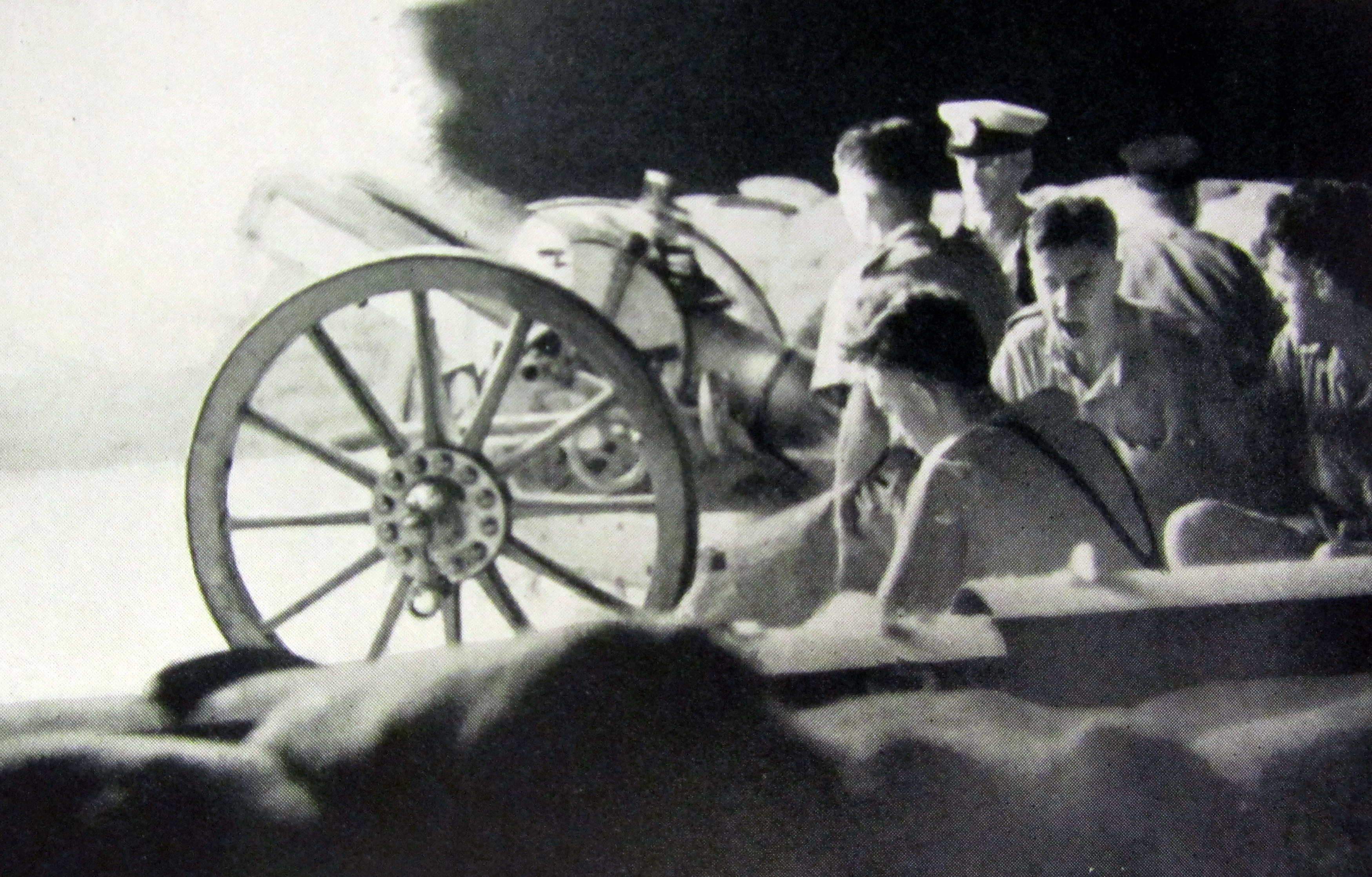
Three troops were formed simultaneously at Shendi — Guy’s, Willie Newell’s, and Jed Palmer’s — twelve guns in total, the Sudan Defence Force’s entire artillery capability, all created from scratch. The decision on formation was taken around May 1940. The guns had to be ready by autumn. Guy needed literate, numerate men for the technical roles — layers, who had to read degrees and minutes on the gun sights, and understand the technicalities of fire direction. He worked with the district commissioner and his native officers to round up recruits, and he knew exactly what he was looking for.
“You get intelligence in the Arab side of the Sudan, in the shaggy chaps that have three cups on their faces, and they come from the river, and they are far ahead on brain power. If you are going to train layers and talk about degrees and minutes on a sight, on a gun, and talk about all the different technicalities, you want some such grey matter.”
— Guy on selecting recruits for the artillery troopsHe found them among the riverain Arabs — the men with the facial scarification — who turned out to have the intelligence and temperament for the work. He took his men in June, in the hot weather, and worked them hard because he knew they would be wanted in the autumn. “We did everything by numbers so that they didn’t have to think more than necessary. We had to write a gun drill with all the technicalities in it, which we could all use as a standard.”
“I remember the first time we fired the gun. There was a frightful bang, and they all ran like rabbits. We told them there was going to be a bang. But of course, it jumps a bit too. However, having laughed at them, they all came back and they took to it like ducks to water. They were no trouble.”
— Guy on the first firing of the SDF artillery troop, Shendi, 1940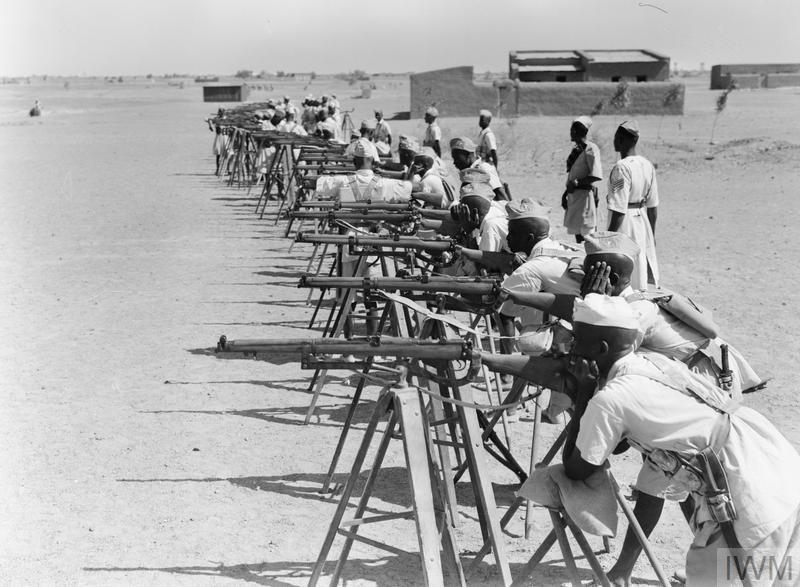
The sentence “having laughed at them, they all came back” is the most Gregson moment in the entire oral history. No fury, no punishment, no lecture on discipline. He laughed. They laughed. And then they learned to be artillerymen. Five months later, at Keren, they would prove that this apparently casual method of military training had produced something the official histories rarely credit: a troop of colonial gunners who could hold their ground under sustained air attack.
An Old Harami
Just before the advance on Keren, a native officer came to Guy with unwelcome news. The troops were talking. They did not want to go into battle. Their reasons were human rather than political — they were outside Sudan, they had not seen their women for months, and nobody had asked them to fight a European war in the Eritrean mountains. It was not, technically, a mutiny. But it was close enough.
Guy went down and spoke to them. He did not threaten. He did not appeal to duty or empire or the martial traditions of the Sudan Defence Force. He used a Sudanese proverb.
“Well, you no good kicking an old harami out of your house if you don’t shut the door after it.”
— Guy to his troops, quoting a Sudanese proverb. Harami: thiefThey saw the point. They went. He never had any trouble again. It is worth pausing on what this tells us about the man — not the military record, which speaks for itself, but the officer. He had spent three years living among Sudanese soldiers, learning their language, eating their food, sleeping under their sky. When the moment came that could have ended his command and his career, he reached not for the authority of the British Army but for a proverb in Arabic. And it worked, because it was the right argument delivered in the right language by a man who had earned the right to make it.
Keren
The Battle of Keren lasted from the third of February to the twenty-seventh of March 1941. The terrain was, as General Platt had promised, gruesome — narrow gorges, sheer escarpments, positions that could only be approached frontally. The Italian garrison, under Brigadier-General Carnimeo, fought with a determination that surprised the British. Colonel Orlando Lorenzini, one of Italy’s most capable colonial commanders, was killed directing the defence.
Guy’s gun troop was positioned alongside the Indian divisions and the regular British batteries. His four pack howitzers — crewed by men who had been horsemen less than a year earlier — fired in support of the assaults on the mountain positions. And then the Italian bombers came, and the scene that opens this chapter played itself out on a hillside in Eritrea.
There is a detail Guy mentioned only once, almost in passing. When he drew up his order of battle, the troop “came up with one spare one of their own” — an enormous man who had appointed himself, without being asked, as Guy’s personal bodyguard. The Arabic word is harris. This man followed Guy everywhere during the battle, into the hills and the observation posts, and never let him get into a dangerous position without being there first.
“That fellow … they detailed themselves to look after me personally, because I had to do all the shooting up in the hills and everything. And when we were fighting the Italians … this enormous man never let me get into a difficult spot. He had eyes like a gimlet, and he was a hell of a good shot too.”
— Guy on his self-appointed bodyguard at KerenA young Sudanese second lieutenant — a mulazim — won the Military Cross at Keren for holding his post against a night attack. Years later, he rose through the ranks of an independent Sudan to become His Excellency, the Director of Communications, and returned to England as a senior official. “Couldn’t be more friendly to the British.” It is the kind of detail that Guy offered without commentary, leaving the listener to make of it what they would.
Guy was awarded the Military Cross for the East Africa campaign. The citation — retrieved from the National Archives at WO 373/18/41 — reveals that the award was not for Keren itself, but for an action at Ed Duda, outside Tobruk, in December 1941, by which time Guy had already left the SDF and was commanding a battery of the 1st Royal Horse Artillery. The Keren action described here was real, and the composure his men showed under air attack was remarkable. But the formal gallantry citation came for what he did next — inside the besieged fortress, against twenty-four German tanks. That story belongs to the next chapter.
“Quite Wonderful”
At the end of the Sudan tapes — three reels, sixty minutes, recorded in 1979 when Guy was seventy-three — Conrad Wood asked him to assess the Sudanese soldiers he had served with. The answer came without hesitation.
“I thought they were marvellous. I’ve never felt more secure than I did with them. They were quite wonderful.”
— Guy on his Sudanese soldiersHe said it thirty-eight years after the events, and you can hear in the recording that he meant it as simply as he said it. No qualifications, no historical distance, no officers’-mess irony. They were marvellous. He had never felt more secure. They were quite wonderful.
Within a year, Guy would leave the Sudan Defence Force and join the 5th Royal Horse Artillery in the Western Desert. The world of mounted cavalry, mud bungalows, and camel messengers would give way to the armoured warfare of North Africa, the beaches of Italy, and the hedgerows of Normandy. The next four years would bring him a DSO at Tunis and a Bar to DSO at Villers-Bocage, and they would take his brother Mark at El Alamein. But the Sudan years made him. The man who laughed when his soldiers ran from the first bang, who defused a near-mutiny with a proverb, who told his troops to look like dervishes and found that they did it beautifully — that man was the one who would coordinate a hundred and sixty guns in Normandy and direct thirty-seven thousand shells onto the Hook in Korea. The skills were Woolwich’s. The temperament was Shendi’s.
Explore Further
- Listen to Guy’s voice — the IWM oral history, recorded at Bears Farm in 1979
- Sudan & East Africa map — Shendi, Nyala, Keren, and the route south
- The Source Library — all 28 verified research files
What We Don’t Know
The IWM oral history is the only first-person source for the Sudan years, and it was recorded thirty-eight years after the events it describes. Guy was seventy-three, and while his memory was sharp and his anecdotes vivid, there are silences. He does not mention his family. He does not say whether he was married or attached during these years. He says almost nothing about the eleven years between his 1926 commission and his 1937 arrival in Sudan, beyond “playing polo and racing.” The transition from the SDF to the 5th Royal Horse Artillery — how it happened, when exactly, who arranged it — is a gap the surviving records have not yet filled.
The MC citation has now been retrieved — and it held a surprise. The MC was not for Keren at all, but for Ed Duda, outside Tobruk, in December 1941. Guy had already left the SDF and was commanding a battery of the 1st Royal Horse Artillery inside the besieged fortress. The Keren action described in the oral history was real and significant, but the formal gallantry award came for what happened next.
Three reels of tape, approximately sixty minutes. Sudan, Keren, the Four Feathers, the near-mutiny, the leopard in the Red Sea Hills. The sole first-person source for Guy’s formative years.