Research in Progress
This chapter is built from confirmed primary sources — the DSO citation, 5 RHA unit history, and formation records — but several threads remain open. Additional research would fill the following gaps:
- 7th Armoured Division’s advance from El Alamein to Tunis (November 1942 – May 1943): the specific engagements of 22nd Armoured Brigade en route, and 5 RHA’s role in each.
- The Salerno landings (September 1943): 5 RHA’s actions during the Italian campaign and the fighting at the beachhead.
- Guy’s transition from the Sudan Defence Force to command of 5 RHA: how a colonial secondment officer came to lead a Desert Rats regiment.
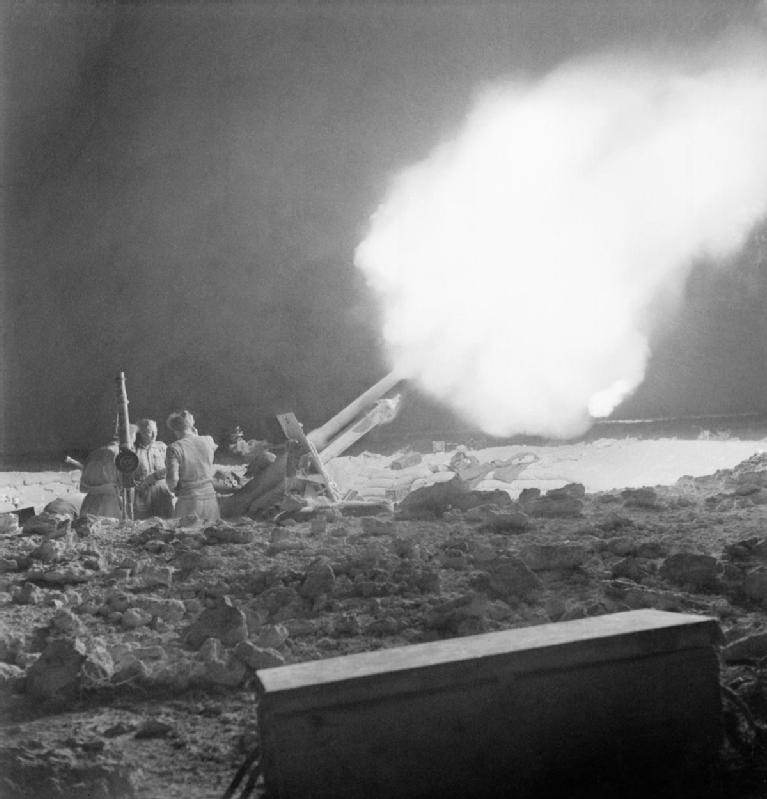
On the morning of 7 May 1943, the guns of 5th Royal Horse Artillery were firing in support of an armoured brigade that was about to end a war. Ahead of them, the road into Tunis lay open for the first time in six months. Behind them, stretching back across fifteen hundred miles of desert, lay the wreckage of two armies and two years of fighting. And somewhere in the middle of it — standing in an observation post close enough to the forward tanks that the brigade commander’s endorsement would later note his “total disregard for his own personal safety” — was a forty-year-old lieutenant-colonel named Guy Peter Gregson, directing the fire of three batteries of field guns onto the last Axis positions in North Africa.
He had been at it for three days. The citation that would earn him the Distinguished Service Order covers 6, 7, and 8 May with the economy of language that military prose demands and the precision that makes it, at its best, a kind of poetry. His regiment was in support of 22nd Armoured Brigade during “the final break through and capture of TUNIS.” The advance was steady. The operation was difficult. The fire was coordinated and directed by one man. That man was Guy.
But how did a cavalry officer from the Sudan Defence Force — a man who eighteen months earlier had been converting horsemen into artillerymen at a Nile outpost — come to command one of the most storied regiments in the Royal Horse Artillery, inside the most famous armoured division in the British Army? The answer, like so much of Guy Gregson’s war, sits in a gap in the record that no surviving document has yet filled.
The Regiment He Joined
The 5th Royal Horse Artillery was a regular regiment of the Royal Artillery — three batteries designated G, K, and CC — that had spent the first years of the war in England before embarking for the Middle East. The regiment sailed in March 1942 and arrived in Egypt on 18 July, having taken four months via the Cape route, the Suez Canal being rather too busy with other traffic. Three days before 5 RHA set foot on Egyptian soil, Mark Gregson was killed at Ruweisat Ridge. Whether Guy knew the regiment was coming, whether he had already been earmarked for command, whether someone in the Royal Artillery’s posting machinery had identified the SDF gunner with a Military Cross as the right man for a horse artillery regiment — all of this is speculation. The records are silent.
What we know is that 5 RHA was thrown into the fighting almost immediately. From July through October 1942, the regiment served with 23rd Armoured Brigade Group in the defence of the Alamein Line and at Alam el Halfa, where Rommel made his last attempt to break through to Alexandria and was stopped by Montgomery’s carefully prepared defensive battle. In October and November, 5 RHA transferred to 24th Armoured Brigade Group for the Second Battle of El Alamein — the set-piece offensive that cracked the Axis line and sent the Afrika Korps into a retreat that would not stop until Tunisia. Through all of this, the regiment was learning the brutal curriculum of desert gunnery: how to shoot and scoot before counter-battery fire found you, how to support armour across ground with no features, how to keep ammunition flowing across supply lines that stretched for hundreds of miles.
Guy’s name does not appear in the unit history until late 1942. His first Mention in Despatches covers the period to October 1942 and identifies him as a temporary lieutenant-colonel in the Middle East, but not with which unit. Somewhere between the summer and the winter, between the death of his brother and the advance that followed Alamein, he took command. By 1 December 1942, when 5 RHA formally joined the 7th Armoured Division within 22nd Armoured Brigade, Guy Gregson was commanding officer. He had arrived in the Desert Rats.
The Jerboa on the Sleeve
The 7th Armoured Division wore a red desert rat — a jerboa — on their sleeve, and the name had stuck since the earliest days of the North African campaign. They had fought at Sidi Barrani and Beda Fomm, at Tobruk and Gazala and Alamein. By the time Guy joined, the division had been in the desert longer than any other British formation. Its men were lean, sunburned, contemptuous of anything that smelled of base areas, and possessed of a unit pride that bordered on the religious. To command a regiment inside this division was not merely a posting; it was an admission to a tribe.
The 22nd Armoured Brigade, Guy’s immediate formation, was commanded by Brigadier “Looney” Hinde — a cavalryman of considerable dash whose nickname was said to derive not from his mental state but from his initials, though the former explanation was more widely believed. The division itself was taken over in January 1943 by Major-General Bobby Erskine, a Scots Guards officer who would lead it through the rest of North Africa and into Normandy. Both men would endorse Guy’s DSO recommendation. Both, in the clipped language of the endorsement chain, used the word “outstanding.”
The role of a Royal Horse Artillery regiment in an armoured brigade was precise and demanding. The guns — twenty-four 25-pounders, eight per battery — moved with the tanks, providing fire support that could be called down within minutes of a request from the leading armour. The commanding officer’s job was not to sit at regimental headquarters and move pins on a map. It was to be forward, with or ahead of the brigade commander, reading the battle as it developed and coordinating fire from his own batteries while calling in additional support from divisional or corps artillery when the situation demanded it. It required a particular kind of officer: one who could calculate fire plans under pressure, who understood the armoured battle from the inside, and who was willing to position himself close enough to the fighting to see what needed to be hit. Guy, trained at Woolwich, blooded at Keren, and temperamentally incapable of directing anything from the rear, was the type.
Fifteen Hundred Miles
The advance from Alamein to Tunis covered roughly fifteen hundred miles and took six months. It was not, despite the popular image, a single headlong dash across the desert. The Eighth Army pursued Rommel’s retreating forces through Libya — past Tobruk, Benghazi, and the port of Tripoli, which fell on 23 January 1943 — and then into southern Tunisia, where the terrain changed from open desert to hill country and the fighting took on a different character. The Afrika Korps, reinforced by fresh German and Italian divisions that had been pouring into Tunisia since the Allied landings in Morocco and Algeria the previous November, turned and fought a series of sharp defensive actions. The Kasserine Pass, where American forces took a severe mauling in February, was the most famous. But the 7th Armoured Division, pushing up from the south as part of the Eighth Army, fought its own battles — at the Mareth Line, at Wadi Akarit, at Enfidaville — in terrain that suited defenders and punished attackers.
For 5 RHA, the advance meant constant movement, constant fire missions, and the grinding logistics of keeping twenty-four guns supplied with ammunition across a supply chain that grew longer by the day. The batteries — G, K, and CC — leapfrogged forward in the standard pattern: one firing, one moving, one ready to take over. When the brigade halted, the guns dug in. When it moved, the guns limbered up and followed the tanks. It was a rhythm that required stamina more than heroism, though heroism was demanded often enough.
The specific engagements of 22nd Armoured Brigade during this advance — the firefights, the ambushes, the days when nothing happened and the days when everything did — are recorded in war diaries that have not yet been consulted. What we know is the outcome. By the first week of May 1943, the Eighth Army and the Allied forces from the west had compressed the remaining Axis forces into a pocket around Tunis and Bizerta. The end was coming. Everyone knew it. The question was which formation would get there first.
Three Days at Tunis
The final assault on Tunis began on 6 May 1943. The 7th Armoured Division, operating as part of 10 Corps, drove into the crumbling Axis perimeter from the south. The 22nd Armoured Brigade led the division’s advance, with Guy’s regiment providing the artillery support that allowed the tanks to push forward against positions that, even at this late stage, were defended with determination. The German and Italian troops in Tunisia knew what surrender meant; they had been told to fight to the last. Some did. Most, by now, were looking for a way out.
The difficulty, from a gunner’s perspective, was not simply the volume of fire required. It was the coordination. An armoured advance through defended country demands artillery support that shifts as fast as the tanks move — targets appearing and disappearing, friendly forces intermixed with enemy, the whole picture changing every few minutes. The commanding officer of the supporting regiment has to hold the entire battlefield in his head: where his own batteries are, where the tanks are, where the enemy guns are, and which additional fire he can pull in from the units on his flanks. He has to do this while moving, while under fire, and while maintaining communications on a radio net that, in 1943, was only marginally more reliable than shouting.
“It was due to his tireless work of co-ordinating and directing the fire of his Regt and arranging additional support when necessary, in a difficult operation that 22nd Armd Bde were able to make a steady advance in the face of the enemy.”
— DSO citation, 6–8 May 1943That phrase — “arranging additional support when necessary” — is the mark of a gunner who understood that his own regiment’s twenty-four guns were not always enough, and who had the authority, the contacts, and the nerve to reach beyond his own command for more firepower. It suggests a man who was on the radio to divisional artillery, to corps artillery, pulling in fire from regiments he did not command, concentrating it on targets that his own observation had identified. This is not what a cautious officer does. This is what a very good one does when he knows the battle depends on it.
Tunis fell on 7 May. The 7th Armoured Division was among the first British formations into the city, and the scenes that followed were extraordinary — crowds of Tunisians in the streets, French tricolours appearing from windows, German soldiers surrendering in their thousands. Within a week, all organised Axis resistance in North Africa had ended. A quarter of a million German and Italian troops went into captivity. The campaign that had begun at Sidi Barrani in December 1940 was over.
“Outstanding Throughout”
The recommendation for Guy’s DSO originated with the commander of 22nd Armoured Brigade — Looney Hinde, the man who had watched Guy direct fire from the forward positions for three days. From there it passed to the Commander Royal Artillery of the 7th Armoured Division, who added his own endorsement: “this officer has been outstanding throughout.” It went next to the General Officer Commanding the 7th Armoured Division — Bobby Erskine — and then upward through the commander of 10 Corps to the headquarters of the Eighth Army, where it crossed the desk of the army commander himself. Bernard Montgomery signed it off. From there it reached the Commander-in-Chief, Middle East Forces. Six levels of command, each adding a signature or an endorsement, each confirming what the man below had written.
The award was immediate. An immediate DSO is not given through the periodic honours system, the twice-yearly lists that reward sustained good service. It is given in the field, for a specific action, on the recommendation of the officers who saw it. It is, in the hierarchy of military recognition, the next thing below a Victoria Cross in weight, and it carries a different kind of meaning: not a single act of supreme valour, but a sustained performance of command under fire that made the difference between success and failure. The citation says it plainly. It was due to Guy’s work that the brigade was able to advance. Not that the advance was assisted by his work. That the advance was made possible by it.
The citation form records one further detail. His name is given as “Guy, Peter, GREGSON” — Peter, not Patrick. It is the military clerk writing down the name the officer actually used, the name his friends and colleagues knew, rather than the legal name on his commission. A small thing, but it catches something of the man: even on the most formal document of his war, the name that stuck was the one he had chosen for himself.
“His total disregard for his own personal safety and high example of courage is an inspiration to all those who serve with or under him.”
— DSO citation for Lt-Col G.P. Gregson, 5 RHA, May 1943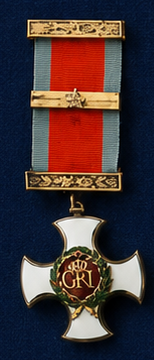
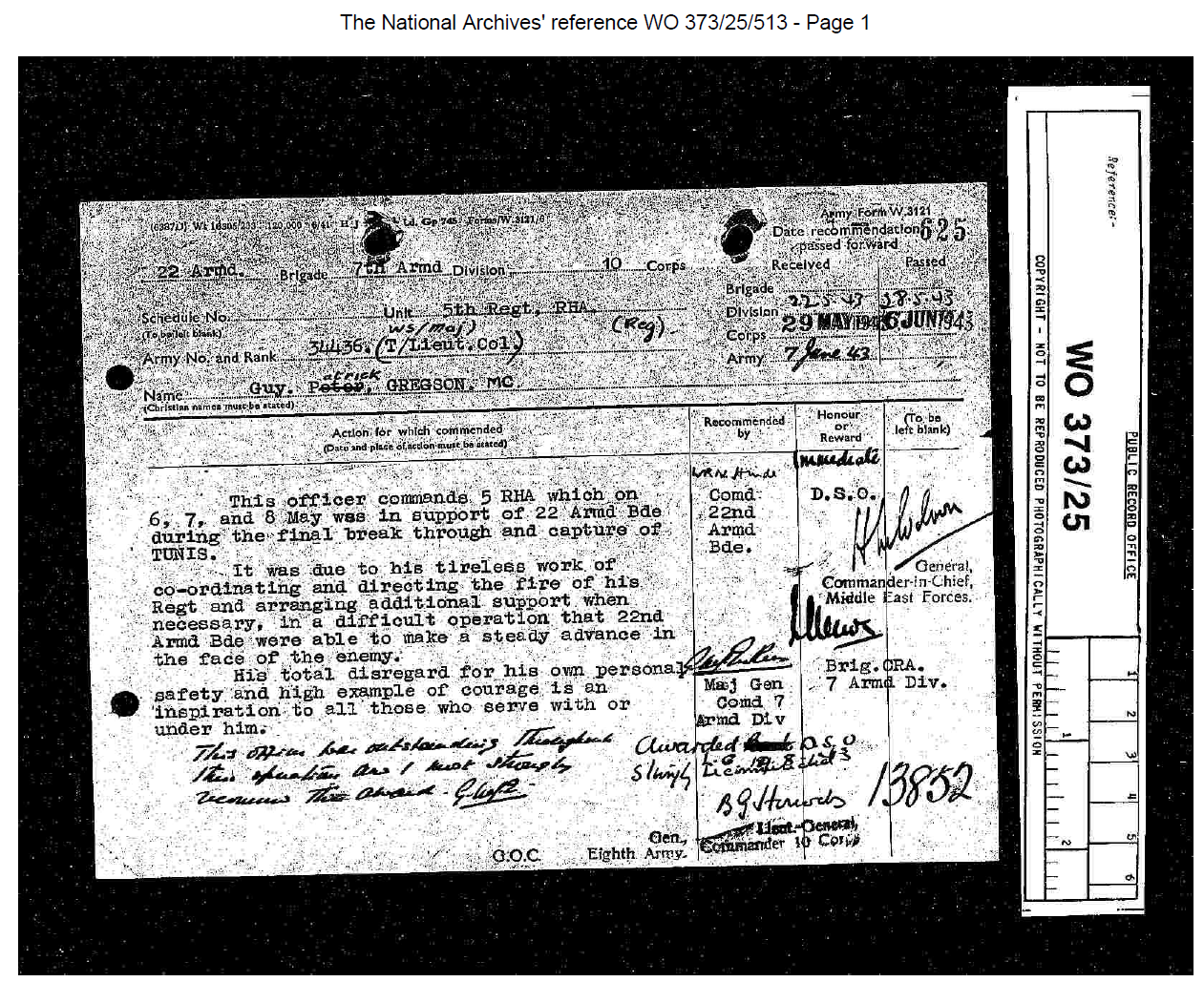
That final sentence of the citation is boilerplate in one sense — many DSO citations use similar language. But it was written by a brigadier who had spent three days watching Guy operate under fire, and endorsed by every officer in the chain above him. “All those who serve with or under him” is not a phrase a recommending officer uses lightly. It means the men of G, K, and CC Batteries saw their commanding officer forward, in danger, doing the work. It means they knew he was there.
The Italian Shore
The victory at Tunis did not lead to rest. Within four months, 5 RHA and the 7th Armoured Division were committed to the invasion of mainland Italy. Operation Avalanche — the amphibious landing at Salerno, south of Naples — began on 9 September 1943 and came perilously close to disaster. The initial landings met fierce German resistance, and for several days the beachhead was in genuine danger of being pushed back into the sea. The fighting was as intense as anything the division had experienced in North Africa, and the terrain — flat coastal plain backed by mountains, with every road and village a potential strongpoint — was a gunner’s nightmare and a gunner’s opportunity in equal measure.
The details of 5 RHA’s specific actions at Salerno are not yet documented in the sources consulted for this biography. What is known is that the regiment landed with the 7th Armoured Division, fought in the beachhead battles, and remained in Italy through October 1943 before the division was withdrawn. The 7th Armoured had been chosen for a greater task: it was to return to England to prepare for the invasion of France. By January 1944, Guy and his regiment were back in Britain, the North African campaign and the Italian interlude behind them, the hedgerows of Normandy ahead.
Between Alamein and England, 5 RHA had served under three different armoured brigade groups, fought across two continents, supported the final breakthrough at Tunis, and landed on a hostile shore at Salerno. Guy had commanded the regiment through at least the last six months of this odyssey, and probably longer. He had arrived in the Desert Rats as an outsider — a colonial secondment officer, a man whose recent experience was pack howitzers and camel patrols — and had earned a DSO endorsed by Montgomery. Whatever doubts the regular officers of the Royal Horse Artillery might have had about a man who had spent three years at Shendi and Nyala, the citation settled the matter.
The Making of a Commander
The Sudan chapter of Guy’s life made his temperament. North Africa made his reputation. The skills he would carry into Normandy — the ability to coordinate massed fire across a fast-moving armoured battle, the instinct for where to stand to see what needed seeing, the willingness to go forward when going forward was dangerous — were forged in the desert between Alamein and Tunis. He went in as an officer who had proved himself with four pack howitzers in the Eritrean mountains. He came out as a regimental commander who had been endorsed by the army commander as worthy of one of the highest decorations in the gift of the Crown.
There is a particular quality to the DSO that matters here. The Victoria Cross rewards an act. The DSO rewards a performance — days rather than minutes, sustained command rather than a single decision. What Guy did at Tunis was not one brave thing. It was three days of brave things, done continuously, under fire, while holding the fire plan of an entire armoured brigade in his head. The citation does not mention a single dramatic moment because there was no single dramatic moment. There was a man doing his job, superbly, for seventy-two hours, in conditions that would have exhausted most officers in twelve.
Within a year he would do it again, at Villers-Bocage, in circumstances even more desperate. But that story belongs to the next chapter, and to Normandy, and to the day when the most famous tank action of the Second World War descended on the regiment that Guy had led from the desert to the sea.
Explore Further
- Read the full DSO citation on the Awards page — the original language from WO 373/25/513
- North Africa campaign map — from Alamein to Tunis, fifteen hundred miles
- The Source Library — all 28 verified research files
What We Don’t Know
The gap between Guy’s SDF service and his command of 5 RHA remains the biography’s most significant silence. His service record — held by the Ministry of Defence and not routinely released for this period — would confirm when he assumed command and under what circumstances. Whether he served with another unit between the SDF and 5 RHA, or whether he joined 5 RHA directly upon its arrival in Egypt, is unknown.
The 5 RHA war diary, held at the National Archives, would provide a day-by-day account of the regiment’s actions from July 1942 through January 1944 — the engagements on the road to Tunis, the fighting at Salerno, and the texture of daily life under Guy’s command. The 22nd Armoured Brigade war diary would complement this with the broader tactical picture.
Research Plan
The following avenues would substantially enrich this chapter:
- 5 RHA War Diary (WO 171 series, National Archives): The regimental war diary for 1942–1944 would provide specific engagements, casualty figures, movements, and daily operational detail from Alamein through Italy.
- 22nd Armoured Brigade War Diary: The brigade diary would supply the tactical context for 5 RHA’s actions, including the breakthrough at Tunis and the Salerno landings.
- 7th Armoured Division history: Published unit histories of the Desert Rats (notably G.L. Verney’s The Desert Rats, 1954) would place Guy’s regiment within the division’s broader campaign narrative.
- Guy’s Army service record (MOD): Would confirm the date he assumed command of 5 RHA and any interim postings between the SDF and the regiment.
- Salerno operation records: 10 Corps and Fifth Army records for Operation Avalanche would clarify 5 RHA’s role in the beachhead fighting.
- Personal accounts: Any surviving letters, photographs, or family recollections from this period would add colour to a chapter currently built entirely from official sources.