Research in Progress
This chapter will be substantially revised when the following material arrives:
- Guy’s 20-page Hook battle account (letter to Colonel T.G. Brennan, 12 September 1953, with 23 pages of appendices) — held at IWM Documents.24854, currently in transit under request IWM250694. This will be the first time we hear Guy describe a battle in his own words since the Sudan tapes.
- Chinese PVA order of battle and tactics at the Third Battle of the Hook
- Commonwealth Division artillery organisation — the multinational coordination challenge
- The Jamestown Line geography and the Hook’s tactical significance
At half past three on the morning of 29 May 1953, the guns stopped. Not all at once — there is no clean ending to an artillery engagement — but in diminishing waves, the roar that had shaken the Korean hillside for hours fell away into scattered fire, then harassing shots, then silence. The Hook was held. The Chinese assault, launched against a single battalion at odds of five to one, had broken on a wall of steel that Guy Gregson had spent months designing and a single night executing. The shell count, when the quartermasters finished their tally, came to 37,818 rounds across all calibres. It remains one of the most concentrated defensive fire missions in the history of the Commonwealth Division.
Guy had come to Korea in 1952 as Brigadier, Commander Royal Artillery of the 1st Commonwealth Division — the only division-level multinational formation in the war, comprising British, Canadian, Australian, and New Zealand units, each with its own guns, its own ammunition stocks, its own tactical doctrines. Coordinating their fire was a job that required not only technical mastery but diplomatic skill. A British CRA directing Canadian guns onto a position held by Australians, using American ammunition delivered by Korean porters, needed to speak several professional languages at once. Guy had been doing exactly this kind of work since Sudan, where he had translated Woolwich gunnery into Arabic for cavalrymen who had never seen a gun. The scale had changed. The principle had not.
The Hook
The Hook was a ridgeline west of the Samichon River, named for its shape on the map, commanding the approach to the Jamestown Line — the main defensive position across the Korean peninsula. It had been fought over before. The First Battle of the Hook in October 1952 and the Second in November had both seen fierce Chinese attacks driven back by Commonwealth firepower. By the spring of 1953, with armistice negotiations grinding toward a conclusion at Panmunjom, both sides understood that the final line on the map would become the permanent border. Every hill held or lost in these last months would be a permanent fact. The Chinese wanted the Hook. The Commonwealth Division intended to keep it.
The position was held by the 1st Battalion, Duke of Wellington’s Regiment — the Dukes — under Brigadier Joseph Kendrew’s 29th British Infantry Brigade. They were good soldiers in a bad position. The Hook was overlooked from higher ground to the north, exposed to direct observation, and accessible to the Chinese through a network of approach trenches and tunnels. The infantry held the line. The artillery held the infantry.
Eleven Thousand Rounds
The Chinese did not arrive without warning. Between 19 and 29 May, over twenty thousand shells fell on the Hook and its approaches — a systematic bombardment designed to destroy the bunkers, cut the wire, collapse the communication trenches, and break the will of the defenders before the infantry assault began. On the single night of 28 May, approximately eleven thousand rounds struck the position. The Hook was a moonscape. Trenches that had been dug, reinforced, and reveted over months were blown open in hours. The men of the Dukes crouched in whatever cover remained and waited for the ground attack they knew was coming.
It came after dark. Chinese infantry of the People’s Volunteer Army advanced in strength, outnumbering the defenders by roughly five to one, following a pattern that Guy had studied and written about in a letter to Colonel Brennan two months earlier. The Chinese infantry methods were sophisticated: multiple echelons, rapid infiltration of gaps, a willingness to absorb casualties in the assault wave to get close enough to use grenades and submachine guns in the trenches. They were brave and well-led. What they could not overcome was the fire plan.
The Wall of Steel
Guy’s defensive fire plan was not improvised. It was the product of months of preparation — registered targets, pre-planned concentrations, timed programmes, and the meticulous coordination of every gun within range. When the Chinese attacked, the plan was activated and the mathematics of industrial killing took over.
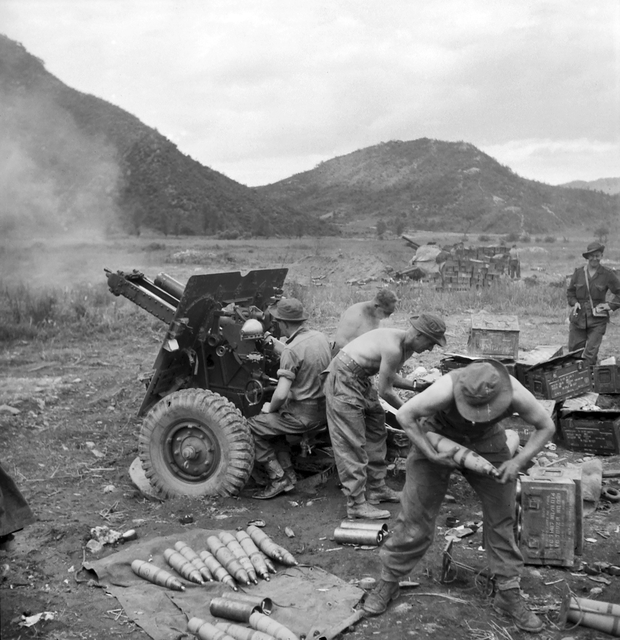
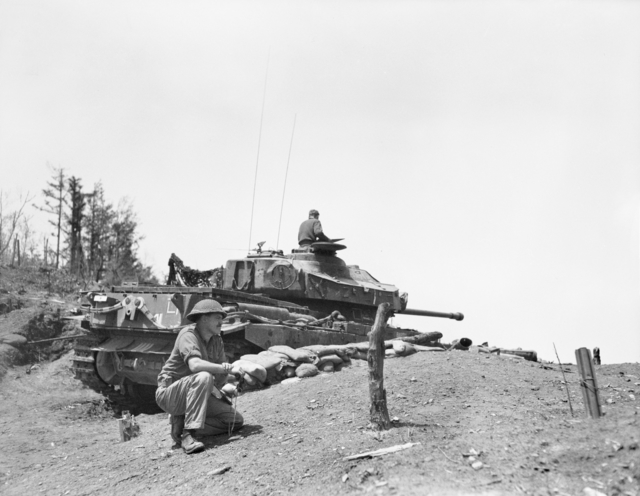
The combined fire came from every direction. British and Commonwealth 25-pounders — the workhorse of the divisional artillery — fired at a rate that turned their barrels white-hot. The Canadian 81st Field Regiment alone fired 5,800 rounds on the night of 28 May, a rate of sustained fire that pushed crews and weapons to their mechanical limits. American I Corps artillery added the heavier calibres: 155mm guns, 8-inch howitzers, and 240mm weapons whose shells could collapse a bunker in a single hit. A United States rocket battery contributed 325 rockets. Centurion tanks of C Squadron, 1st Royal Tank Regiment — not under Guy’s command, but firing on the same targets — added 504 rounds of 20-pounder and 22,500 rounds of machine-gun fire.
The total across all calibres: 37,818 shells. The Dukes’ own regimental account recorded the result with soldierly understatement: “The Chinese were caught by the well planned artillery, tank and machine gun Defensive Fire tasks.”
“The Chinese were caught by the well planned artillery, tank and machine gun Defensive Fire tasks.”
— Duke of Wellington’s Regiment Association, account of the Third Battle of the Hook“Well planned” does a great deal of work in that sentence. The plan was Guy’s. He had designed the interlocking fire tasks, calculated the ammunition expenditure, coordinated the multinational gun lines, and ensured that when the moment came, every battery knew its targets, its rates of fire, and its priorities. The CRA of a Commonwealth division did not fire the guns. He made certain that when four nations’ worth of guns fired simultaneously, they hit the right ground at the right time in the right sequence. At three-thirty in the morning, the Hook was still in Commonwealth hands.
The Last Battle Before the Silence
The armistice was signed at Panmunjom on 27 July 1953, less than two months after the Hook. The Third Battle of the Hook was one of the last major engagements of the war, fought in the full knowledge that the negotiators were nearing agreement and that every position held or lost would become permanent. There is a particular grimness to battles fought in the final weeks of a war — the men who die in them are no less dead for the peace that follows, and the commanders who order the fire plans know that the political settlement will be signed regardless of whether this hill or that ridge changes hands. Guy’s fire plan did not end the Korean War. It ensured that when the line was drawn, the Hook was on the right side of it.
Guy was awarded the CBE in the Korea Additional Honours of 4 December 1953: “Brigadier (temporary) Guy Patrick Gregson, D.S.O., M.C. (34436), late Royal Regiment of Artillery.” It was his fifth decoration for gallantry or distinguished service, and the last he would receive for combat. The next honour, five years later, would come from an old friend at a desk in Bulford, not from a hillside in Korea.

The Missing Voice
There is a gap at the centre of this chapter where Guy’s own words should be. The IWM oral history, recorded in 1979, covers only his Sudan years — Conrad Wood did not ask about Korea, or Guy chose not to speak of it. But on 12 September 1953, three months after the Hook, Guy sat down and wrote a letter to Colonel T.G. Brennan, his subordinate commanding the 20th Field Regiment RA. The letter ran to twenty pages, with twenty-three pages of appendices, maps, and photographs. It is the most detailed first-person account of any battle in Guy’s career — the only time he set down in writing, at length, what had happened and how.
That letter is held at the Imperial War Museum. It is in transit. When it arrives, this chapter will be rewritten around it. Until then, we have the statistics, the regimental accounts, and the single fact that at three-thirty in the morning on 29 May 1953, the position was held and 37,818 shells had been fired. The plan worked. The man who made it left a twenty-page explanation of how, and we are waiting to read it.
Explore Further
- The Hook on the map — the Jamestown Line, the Samichon valley, and the killing ground
- Read all citations on the Awards page — DSO, Bar to DSO, and CBE in the original language
- The Source Library — all 28 verified research files
What We Don’t Know
Guy’s voice is entirely absent from this chapter. The IWM oral history covers only Sudan. The Brennan papers, when they arrive, will be the first time we hear Guy describe a battle in his own words as a senior officer — not a captain in the desert but a brigadier directing the firepower of an entire division. The letter may also reveal how he felt about the Korean War, the Commonwealth Division’s multinational character, and the Chinese soldiers he fought against.
An earlier letter to Brennan (28 March 1953) covering Chinese infantry methods and attacks on the Royal Canadian Regiment and the Black Watch is also at the IWM. Together, the two letters may give us the closest thing to a Korean oral history that Guy ever produced.
Research Plan
The following would substantially enrich this chapter:
- IWM Documents.24854 — Guy’s 20-page Hook battle account + 23 pages of appendices (in transit, request IWM250694). Priority one.
- IWM Documents.24854 — Guy’s 28 March 1953 letter on Chinese infantry methods. Same collection.
- Published histories — Barclay (1954) The First Commonwealth Division; Farrar-Hockley (1995) The British Part in the Korean War Vol. II; Selway (2025) Centurions on the Hook
- 81st Field Regiment RCA war diary — Library and Archives Canada. The Canadian perspective on the fire plan.
- 1 DWR war diary — TNA WO 281 series. The infantry’s experience of the fire plan from below.
- Chinese PVA accounts — translated sources on the Third Battle of the Hook would provide the other side of Guy’s fire plan.