Research Flags
This chapter is built almost entirely from contextual and public-record sources. No personal papers, letters, or interviews survive for the period 1960–1988. The following lines of inquiry would substantially strengthen the account:
- The Regional Seats of Government programme and the Cambridge RSG specifically — TNA series HO 322 may contain Eastern Region files
- Eastern Region’s strategic significance: the nuclear-capable airfields at Lakenheath, Mildenhall, Honington, and Wattisham, and the civil defence infrastructure built around them
- The 1967–68 political debate about civil defence abolition — Hansard, Cabinet papers, Home Office records
- Family interviews with Marcus — partially addressed: StoryWorth memoirs (2022–23) now provide extensive detail on Bears Farm, Guy’s character, and daily life at Hundon. Further interview could explore his war memories and relationship with Iris
On the thirty-first of March 1968, at a quarter to midnight, the Civil Defence Corps of the United Kingdom ceased to exist. There was no ceremony. No medals were struck, no last parade called, no flag lowered to a bugle call. A Treasury memorandum had concluded that the country could not afford to plan for nuclear war and devalue the pound at the same time, and the pound had won. Across England, Regional Directors of Civil Defence — most of them retired senior officers who had spent years planning for the unthinkable — received letters informing them that their services were no longer required. In Cambridge, one of those letters was addressed to a sixty-one-year-old major-general named Guy Gregson, who had given forty-three years of continuous service to the Crown, from his commission at Woolwich in 1926 to this moment, and who now found himself, for the first time in his adult life, without a role.
It was not retirement. It was redundancy. The distinction matters.
The Nuclear Planner
Guy had left the regular Army in 1959, having served as Director of the Royal Artillery and overseen the reorganisation of Britain’s gunner force for the nuclear age. He was fifty-three, a Companion of the Bath, a Commander of the Order of the British Empire, holder of the DSO and Bar, the Military Cross, and enough campaign medals to fill a display tray. He had commanded guns from Keren to Korea. A lesser man might have called it enough. Guy took a job planning for Armageddon.
The appointment was Regional Director, Civil Defence, Eastern Region, with headquarters in Cambridge. The title was bureaucratic. The responsibility was not. Civil Defence in Britain by 1960 was no longer about wardens with stirrup pumps and buckets of sand. It was about hydrogen bombs. The Soviet Union had tested a fifty-megaton weapon. NATO war planning assumed that any European conflict would go nuclear within days. And the Eastern Region of England — the six flat counties stretching from Cambridgeshire to the Norfolk coast — was, by a grim accident of geography, one of the most strategically sensitive pieces of real estate in the Western alliance.
The reason was the airfields. RAF Lakenheath and RAF Mildenhall, both in Suffolk, were American bases — USAF facilities operating under the NATO umbrella, home to nuclear-capable aircraft that would, in a crisis, be among the first assets the Soviet Union would try to destroy. RAF Honington and RAF Wattisham added to the concentration. East Anglia was, in effect, a forward operating base for American nuclear power, ringed by quiet market towns and sugar beet fields, and any Soviet strike plan would have placed multiple warheads on the region before most of its inhabitants had finished their breakfast.
Guy’s job was to plan for what happened after the warheads landed.
Government After the Bomb
The machinery he administered was part of a programme that the government preferred not to discuss. The Regional Seats of Government — RSGs — were hardened bunkers designed to serve as emergency administrative centres in the event of nuclear attack. Each of the twelve civil defence regions in England and Wales had one. The theory was grimly rational: if central government in London was destroyed or rendered inoperable, regional directors and their staffs would assume authority over their areas, coordinating rescue, managing population movement, maintaining essential services, and — the phrase that appeared in the planning documents with quiet frequency — disposing of the dead.
The Cambridge headquarters was part of this infrastructure. Whether Guy worked from the RSG itself or from a conventional office that would relocate to the bunker in a crisis is not recorded. What is recorded, in the broad outline of the civil defence system, is the scale of what a Regional Director was expected to manage: population dispersal plans for millions of people, the identification and stocking of fallout shelters, the training of thousands of Civil Defence Corps volunteers, liaison with military commanders, police, fire services, and the Regional Commissioner who would, in theory, become the civilian authority if the government in London fell silent.
It was, in other words, exactly the kind of work Guy had spent his career doing — planning the movement of large numbers of people and resources under conditions of extreme violence, with inadequate information, against a timetable set by the enemy. The difference was that the enemy was now thermonuclear, the timetable was measured in minutes rather than hours, and the odds of any plan surviving first contact with reality were, as every officer in the system privately understood, essentially nil.
Guy had coordinated a hundred and sixty guns at Villers-Bocage and directed thirty-seven thousand shells onto the Chinese at the Hook. He had built an artillery troop from horsemen who ran from the first bang. He was not, temperamentally, a man who believed that impossible odds excused poor planning. So he planned. For eight years, in a university city that went about its business of medieval architecture and molecular biology, a retired major-general sat in an office and worked out what to do when the bombs fell on Lakenheath.
“All Their Staffs Are Being Sacked”
The crisis that ended Guy’s career came not from Moscow but from the Treasury. On 18 November 1967, Harold Wilson’s government devalued the pound sterling from $2.80 to $2.40 — a humiliation that Wilson attempted to frame as a technical adjustment with his infamous assurance that “the pound in your pocket” had not been devalued. It had, of course. And the spending cuts that followed were savage.
Civil Defence was an obvious target. It had always been politically awkward — a programme that existed to acknowledge the possibility of nuclear war, which was precisely the possibility that deterrence theory was supposed to make unthinkable. The annual cost was modest by Whitehall standards, but the symbolism of abolition was useful: it signalled fiscal seriousness without touching any constituency that could fight back. The Civil Defence Corps had no trade union, no parliamentary lobby, no newspaper that would campaign on its behalf. It had retired officers and volunteer wardens, and neither group possessed the political weight to prevent what happened next.
Home Secretary Roy Jenkins announced the abolition in early 1968. The debate in the House of Lords on 27 March captured the mood of men who understood what was being lost. The words in Hansard are blunt: “All the Regional Directors of Civil Defence, all their staffs, are being sacked.” The effective date was 31 March 1968. Approximately one hundred million pounds in savings were claimed. The entire national civil defence infrastructure — the volunteer corps, the regional headquarters, the warning systems, the planning staffs — was dismantled in a single administrative stroke.
Guy was sixty-one. He had served the Crown in one capacity or another since 1926 — forty-two years, if you counted from his commission; thirty years of active soldiering from Shendi to Seoul; eight years of civil defence work that he had presumably taken on because he believed it mattered. Whether he was angry, philosophical, or merely resigned, we do not know. He is not named in any Hansard debate. He left no letter, no diary entry, no recorded observation about the abolition. The IWM oral history, recorded eleven years later, covers only his Sudan years and stops. The silence is total.
What we can say is this: Guy Gregson’s career of service ended not with a dining-out night at the mess, not with a presentation sword or a letter from a grateful minister, but with a Treasury cut. The man who had won a DSO at Tunis and a Bar at Villers-Bocage, who had directed the guns at the Hook and reorganised the Royal Artillery for the nuclear age, was made redundant to save money. It was not the ending that forty-three years of service had earned. But it was the ending the country gave him.
Bears Farm
He tried civilian life first. After leaving the army in 1959, Guy moved to Anstey Grange near Dorking and took a job with Letheby and Christopher, the racecourse caterers. He hated it. “He found the lack of discipline in Civvy Street was really off-putting,” Marcus recalled. The experiment did not last long.
In June 1960, Guy married Iris Patricia Slade-Powell — she was rising thirty-seven, he was fifty-four — and together they bought Bears Farm, Hundon, for six thousand pounds. Hundon is a small village five miles north of Sudbury in the Suffolk countryside, deep in the kind of quiet, hedge-bound, church-towered England that the civil defence plans had been designed to protect. If Guy had wanted to be at the centre of things — a London club, a regimental association, the cocktail circuit of retired generals — he could not have chosen a less convenient address. That he chose Hundon suggests he did not want to be at the centre of things.
Thanks to Marcus, we know what life there looked like. Guy and Iris ran a small stud farm, breeding racehorses. A faithful employee named Jack Willett worked for them for twenty-eight years — “My father was a retired Major-General so had plenty of experience as a leader; he needed it.” Guy kept his forensic relationship with money: he drove forty miles to the NAAFI at Swaffham for marginally cheaper whisky, “spending a shilling to save sixpence.” He did the farm accounts at the dining room table, glasses pushed up onto the top of his forehead, and when Marcus gave him a calculator he rejected it and went back to mental arithmetic.
“The main cultural events were TV programmes, particularly Westerns. Dad loved ‘Laramie.’”
— Marcus Gregson, StoryWorthHe was a keen shot and had a way with dogs — patient, expert, able to train retrievers to a high standard. The evening routine was unvarying: let the dogs out last thing, wait in the doorway while they attended to business (“piddle, damn you”), then lock up for the night. He was active in the local church — bequests would go to All Saints Hundon and All Saints Little Thurlow, the next parish along. He formed friendships strong enough to be remembered in his will: Mick Cutts and Brenda Mayes, local neighbours, each received a specific bequest.
Three Reels of Tape
On 21 May 1979, a researcher named Conrad Wood arrived at Bears Farm with a tape recorder. Wood was working for the Imperial War Museum’s Sound Archive, collecting oral histories from men who had served in the Sudan Defence Force. Guy was seventy-three. He had been living at Hundon for eleven years. Whatever he had done in those years — gardened, read, attended church, walked the lanes — he had also kept his memories sharp, because when Wood switched on the recorder, Guy talked for three reels, approximately sixty minutes, and produced the most vivid first-person account of the SDF in the archive’s collection.
He spoke about Shendi and the punkah boy. About the four Europeans at Nyala. About the dervish extras for Korda. About the first frightful bang of the pack howitzers and the men who ran like rabbits and came back laughing. About the near-mutiny and the old harami. About Keren, the bombers, the self-appointed bodyguard with eyes like a gimlet. He spoke with the precision of a man who had told these stories before — to dinner guests, perhaps, or to his son Marcus — and with the warmth of a man who had loved every moment of his time in Sudan.
What he did not speak about was everything that came after.
The recording covers the Sudan years and stops. There is nothing about the Western Desert, nothing about Mark, nothing about Tunis or Villers-Bocage or Korea or the Cold War or the abolition of civil defence. Whether Wood asked only about Sudan, or whether Guy deflected questions about the later years, the tape does not reveal. The three reels are the only known recording of Guy’s voice, and they capture him entirely in the past — a seventy-three-year-old man sitting in a farmhouse in Suffolk, talking about a thirty-one-year-old captain sleeping on a roof beside the Nile.
The Last Post
Guy had a long history of heart trouble. Angina, Marcus recalled, “went on for years … painful and rather debilitating. In his day there wasn’t the option of a bypass operation so he just had to luck it out.” In late 1987, he suffered a serious stroke and was, in Marcus’s words, “hardly there.” But even after the stroke, something remained. When Marcus brought his infant son Max to visit — Max was about three — Guy, whose handshake was famously vice-like, was extraordinarily gentle. “He must have been able to recognise Max’s youth.”
“I once told him I loved him, and he virtually curled up in embarrassment. I’m very glad that I did, though.”
— Marcus Gregson, StoryWorthGuy Patrick Gregson died on 10 December 1988, at Sudbury, Suffolk. He was eighty-two. Marcus was forty-two — his mother had died when he was forty. The probate record, granted on 14 April 1989, names Marcus as sole executor. The estate was modest — seventy thousand pounds gross, ten thousand net — the accounts of a man who had lived within his means in a farmhouse, not of a retired major-general with a London address.
At the funeral, Marcus walked up to the gates of the church and spotted Jack Willett — the faithful employee of twenty-eight years, the man nobody else could manage — standing among the mourners. It was, in its quiet way, a last testament to Guy’s gift for earning loyalty.
He was cremated. His ashes were placed at All Saints Churchyard, Barnardiston, near Sudbury.
Fifteen Medals
What Guy left behind, besides the farm and the modest estate and the ashes at Barnardiston, was a medal tray. Fifteen decorations, mounted in the order of precedence that the military establishes for such things: the CB and CBE first, as appointments to orders of chivalry; then the DSO and Bar, the Military Cross; then the campaign medals, from the 1939–45 Star through to the UN Korea Medal; then the Coronation Medal and the General Service Medal with its Malaya clasp. The collection spans the entire arc of his career — from the Western Desert to the Cold War, from the pack howitzers at Keren to the nuclear reorganisation at Woolwich.
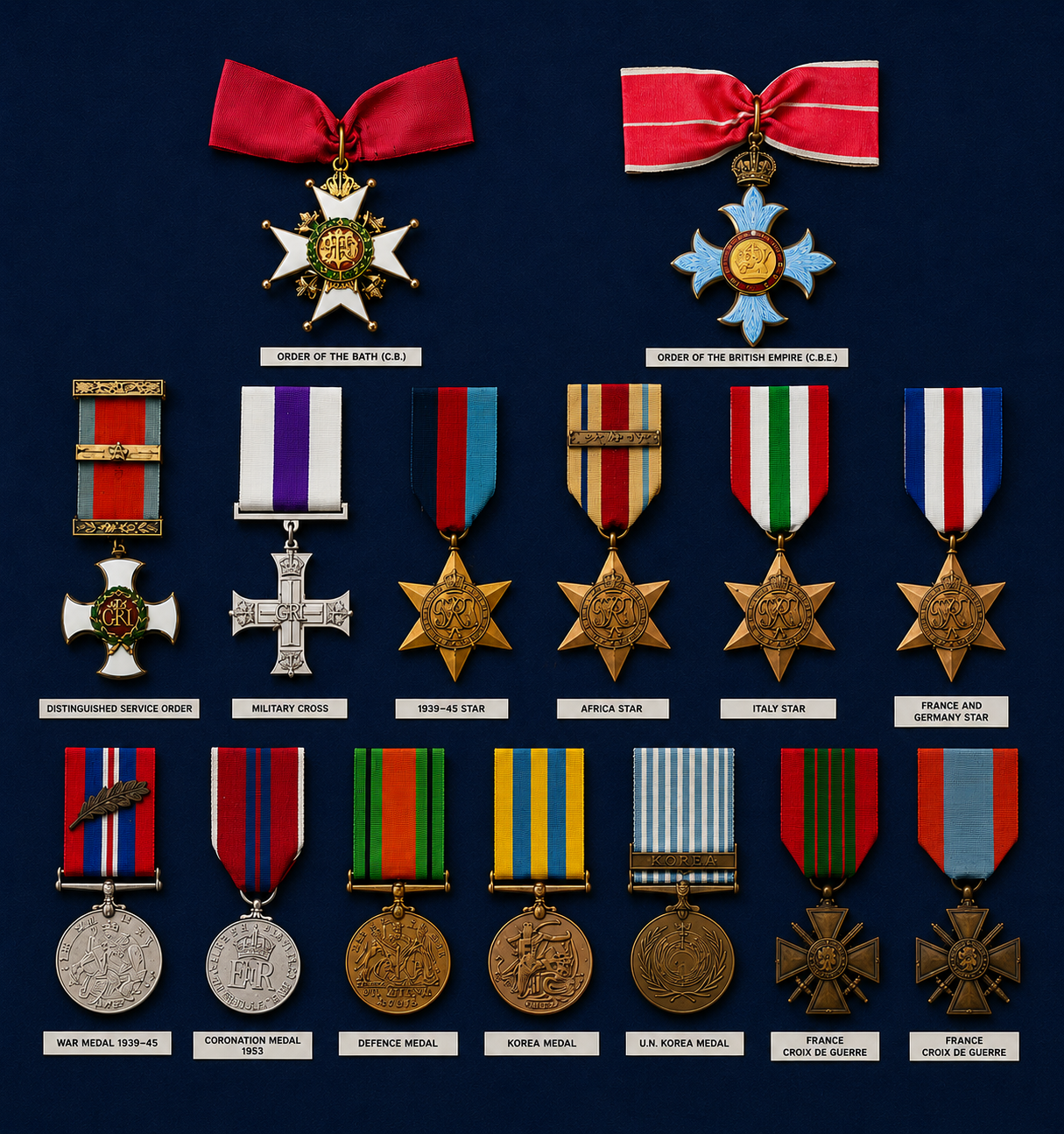
The tray remains in the family. Marcus inherited it, along with the signet ring bearing the family crest — the link to the Knight Gregson line that the genealogical research has traced but not yet proven. The medals are the material evidence of a life that the documentary record covers only in fragments: a citation here, a Gazette entry there, three reels of tape, a probate form, a headstone that does not exist because the ashes were scattered or interred without one.
There is a question that biographies of military men rarely ask, because the answer is usually too depressing to contemplate: what does a man built for service do when there is no more service to give? Guy Gregson answered it in the most English way imaginable. He bought a farm. He went to church. He made friends with his neighbours. He sat in his farmhouse and told stories about Sudan to a man with a tape recorder. And when he died, he left behind a tray of fifteen medals, a son who would keep them, and a silence about everything that had happened between the first bang of the howitzers and the last afternoon at Bears Farm.
The silence, in the end, is the most Gregson thing of all. He had coordinated the guns at the greatest tank battle in British history. He had fired thirty-seven thousand shells in a single night. He had planned for nuclear annihilation across six counties. And he never said a word about any of it.
Explore Further
- Ch 8: The Man Behind the Medals — Marcus’s memories of his father
- The Gregson family tree — Guy, Marcus, and the wider family
- Listen to Guy’s voice — three reels of tape, recorded at Bears Farm in 1979
- Mark Gregson memorial — the brother who did not come home
- Kentchurch & Castleshane — the Lucas-Scudamore line, Marcus’s maternal heritage
- All service locations — from Shendi to Seoul, every place Guy served
What We Don’t Know
Almost everything specific about the Civil Defence years is unknown. Guy is never named in Hansard. There are no personal sources for the period 1960–1988 beyond the will, the probate record, and the IWM recording — which covers only the Sudan years. His role within the Eastern Region’s civil defence structure, his relationship to the Regional Seat of Government programme, and his response to the 1968 abolition are entirely undocumented at the personal level.
The Bears Farm years are now substantially illuminated by Marcus’s StoryWorth memoirs. We know about the stud farm, the dogs, Jack Willett, the NAAFI runs, and the television Westerns. What remains unknown: whether Guy ever spoke of Mark. Whether he kept in touch with old comrades from the SDF, 5 RHA, or Korea. What he thought of his forced redundancy. The deeper texture of his second marriage to Iris — whether it was happy or companionable or complicated — and the emotional interior of a man who curled up in embarrassment when told he was loved.
The IWM oral history was recorded at Bears Farm on 21 May 1979. Conrad Wood spent three reels — approximately sixty minutes — on the Sudan years alone. Whether further recordings were planned, whether Guy declined to discuss later periods, or whether the scope was always limited to the SDF is not known. The archive holds only the three Sudan reels.
Research Plan
The following sources and avenues could fill the gaps in this chapter:
- TNA series HO 322 — Home Office civil defence files, which may contain Eastern Region records, staffing lists, and correspondence from the Regional Directors
- Regional Seats of Government files — the Cambridge RSG specifically; some RSG records have been released under the thirty-year rule
- Hansard, 1967–68 — the full parliamentary debate on civil defence abolition, including the Lords debate of 27 March 1968, for political context and any references to the Eastern Region
- IWM Sound Archive — confirm whether further recordings of Guy were made or planned beyond the three Sudan reels
- Family interviews — Marcus Gregson is the essential source for the Bears Farm years. His memories of his father in retirement, of Iris, of the farmhouse, of the medal tray on the mantelpiece (or wherever it was kept) would transform this chapter from informed speculation into biography
- All Saints Barnardiston — parish records may confirm the interment of ashes and any memorial
- Suffolk Record Office, Bury St Edmunds — local records for Hundon and Barnardiston, including any planning or property records for Bears Farm