Research Flags
- The 5 RHA unit history records a landing date of 8 July 1944 (D+32), but the Bar to DSO citation places Guy at Villers-Bocage on 14 June — twenty-four days earlier. The citation is a primary document signed by four senior officers; the landing date may refer to a different echelon, or the unit history may be wrong. This discrepancy is unresolved.
- The wider 7th Armoured Division controversy at Villers-Bocage: Erskine was eventually removed from command; Bucknall (XXX Corps) was sacked in August 1944 and replaced by Horrocks. The battle’s reputation shifted from triumph to cautionary tale.
- The American artillery: 33rd Field Artillery Battalion, 1st US Infantry Division, firing 155mm guns from the Caumont heights. Their war diary would confirm the fire mission.
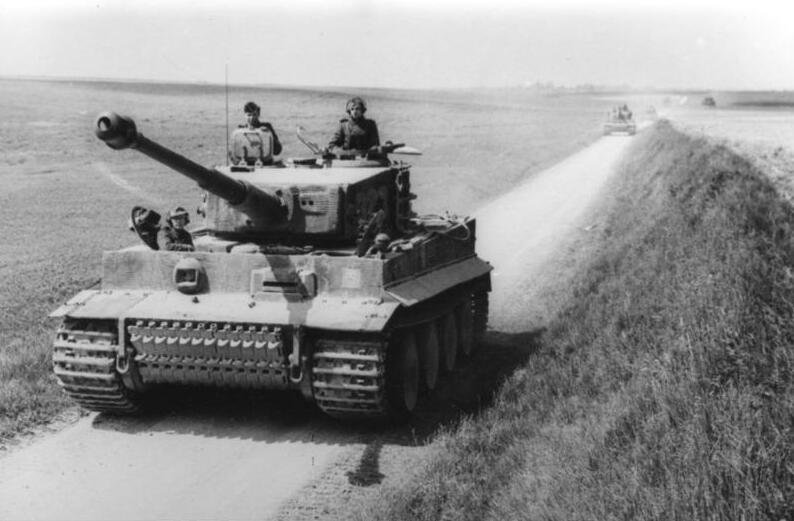
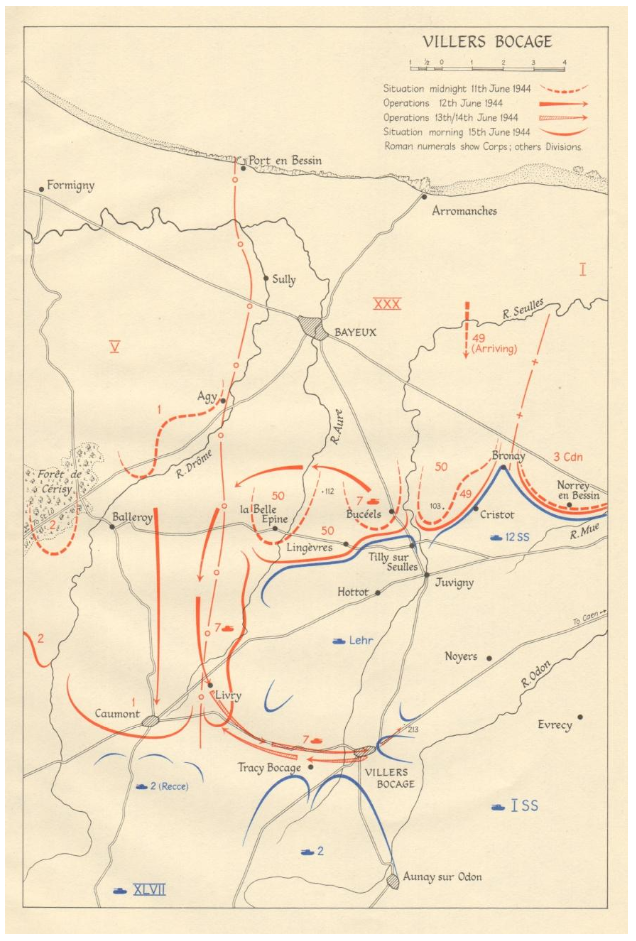
At half past eight on the morning of the thirteenth of June 1944, a column of Cromwell tanks, half-tracks, and scout cars belonging to the 4th County of London Yeomanry was strung out along the road east of Villers-Bocage, a small Norman market town of stone houses and shuttered windows thirteen miles south of Bayeux, when a single Tiger tank emerged from the tree line to the north and began killing them.
The Tiger belonged to SS-Hauptsturmführer Michael Wittmann, commander of the 2nd Company, schwere Panzer-Abteilung 101 — the heavy tank battalion of I SS Panzer Corps. What followed in the next fifteen minutes became one of the most famous small-unit actions of the Second World War, a story retold so often and with such relish by the German side that it would take decades for British historians to unpick the propaganda from the fact. The bare facts were bad enough. Wittmann’s Tigers, joined by elements of the Panzer-Lehr Division already positioned around the town, caught the leading elements of the 22nd Armoured Brigade in column of march — the most vulnerable formation imaginable — and destroyed them in detail. Cromwells and Shermans brewed up along the road. The half-tracks burned. Men died in their vehicles or were cut down as they scrambled into the hedgerows. By mid-morning, the 4th CLY had effectively ceased to exist as a fighting unit.
The ambush at Villers-Bocage was a catastrophe, and it was one week old when the full scale of it became clear to the men who had to live with its consequences. Among those men, standing on a ridge called Point 174 a mile and a half west of the burning town, was Lieutenant-Colonel Guy Gregson, commanding the 5th Royal Horse Artillery.
He had not been present for the ambush itself. His task began afterwards, when the remnants of the 22nd Armoured Brigade pulled back from the town to a defensive position around the hamlet of Tracy-Bocage and the high ground of Point 174, and the question ceased to be whether the brigade could advance and became whether it could survive. The answer, as it turned out, depended almost entirely on the guns.
The Bocage
To understand what happened at Villers-Bocage, you have to understand the ground. The bocage — the ancient hedgerow country of Normandy — was the worst terrain in western Europe for armoured warfare. Small fields enclosed by earthen banks topped with dense hedgerows, each one a natural anti-tank obstacle. Sunken lanes so narrow that a tank could not traverse its turret without snagging the branches on either side. Orchards, stone farmhouses, church towers — every one a potential observation post, every one invisible from fifty yards away. The desert, where Guy had won his DSO, had been a place of vast horizons and long-range gunnery. The bocage was its opposite: a claustrophobic, deadly, close-quarters killing ground where you could not see the enemy until he was close enough to throw a grenade.
The 7th Armoured Division had been sent inland from the beaches on the twelfth of June with orders to exploit a gap between the British and American sectors, swing east through Villers-Bocage, and seize the high ground of Point 213 on the road to Caen. It was an ambitious flanking manoeuvre, the kind of thing the Desert Rats had done a dozen times in North Africa. But North Africa had been flat and open, and the bocage was neither. The division that had raced across the desert to take Tunis found itself threading through lanes that a carthorse would have found constricting.
The plan called for speed. Speed was exactly what the bocage denied.
Wittmann’s Morning
Michael Wittmann was twenty-nine years old, a veteran of the Eastern Front who had destroyed over a hundred Allied tanks, and he possessed the quality that every tank commander prayed for: an instinct for ground. On the morning of 13 June, positioned with a handful of Tigers in an orchard north-east of Villers-Bocage, he saw the British column pass below him on the road to Point 213 and recognised what he was looking at — an armoured brigade in column of march, strung out along a single road, with no infantry screen and no flank protection. It was the kind of target that might present itself once in a war.
He attacked with what he had. The precise number of Tigers involved — five, or six, or possibly only four — has been debated for eighty years. What is not debated is the result. The 4th County of London Yeomanry lost its commanding officer, most of its tanks, and its capacity to fight. A Squadron was destroyed almost entirely. The Rifle Brigade company travelling with the column was caught in its half-tracks and badly mauled. In the town itself, a confused close-quarters battle between Tigers, anti-tank guns, and dismounted infantry raged through the afternoon. By evening, the British had been forced out.
Wittmann would be dead within two months, killed in his Tiger near Cintheaux during Operation Totalize. But on the morning of the thirteenth of June, he had stopped the 7th Armoured Division cold and inflicted on the 22nd Armoured Brigade the worst single day in its history. The brigade was not destroyed — it still had two battlegroups intact — but it was badly shaken, and it now occupied a position that was, by any conventional reckoning, untenable.
The man who had to make it tenable was Brigadier W.R.N. Hinde — known throughout the army as “Looney” Hinde, a nickname that reflected his appetite for risk rather than any deficiency of intellect. Hinde pulled the brigade back to Point 174 and the hamlet of Tracy-Bocage, organised what he had into a defensive box, and called for guns.
The guns were Guy Gregson’s department.
The Box at Point 174
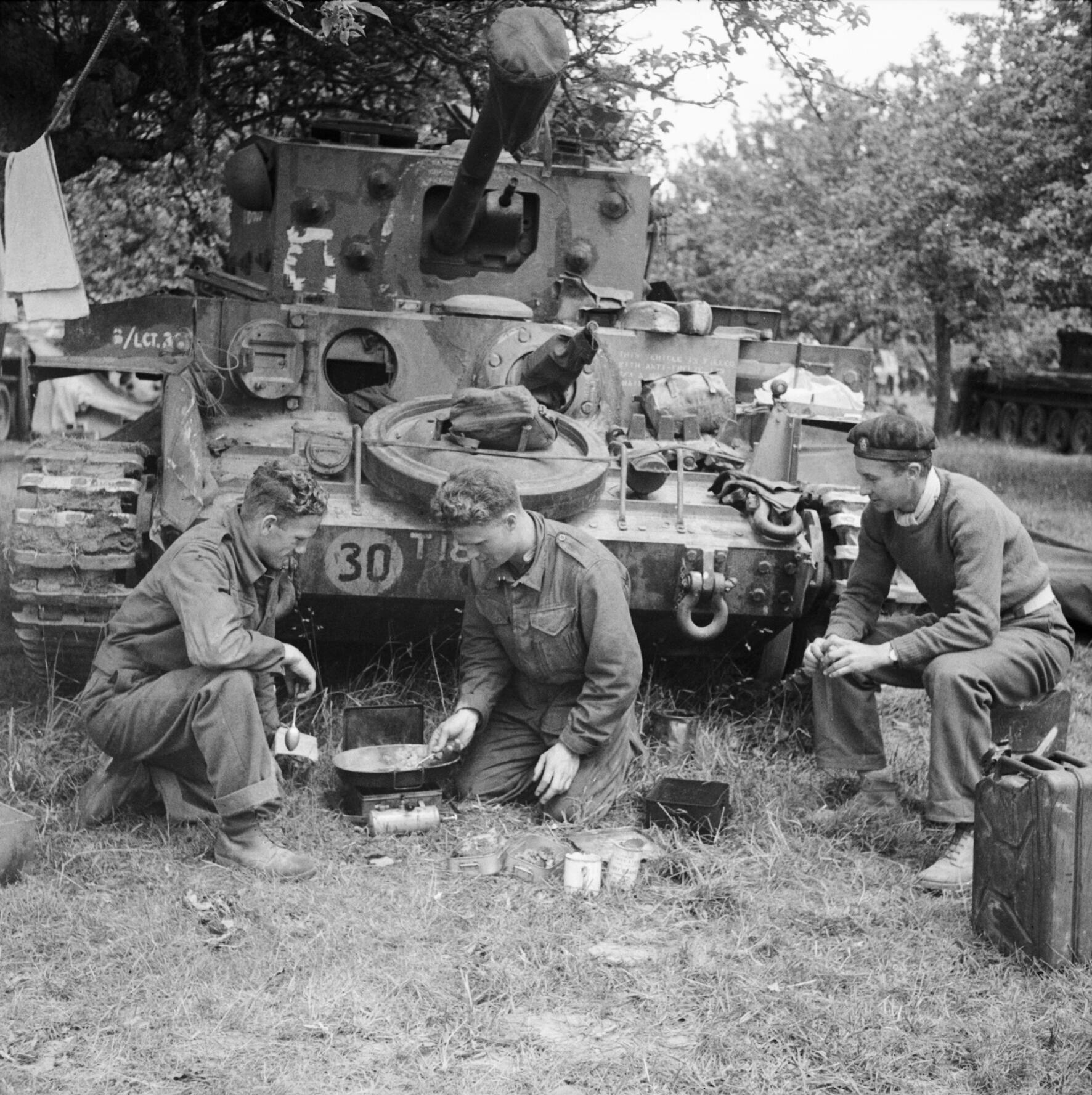
A defensive box was a formation the Desert Rats knew intimately from North Africa — a tight perimeter of armour, infantry, and artillery, all-round defence, guns inside the position rather than behind it. In the desert it had been the standard response to an armoured threat when you could not advance and could not retreat. In the bocage it was something different: a box surrounded not by open sand but by hedgerows and orchards that concealed an enemy who was gathering in strength by the hour.
The brigade occupied the high ground around map reference 817578 — Point 174, a modest ridge that offered observation to the west towards the American sector and, critically, fields of fire to the east towards Villers-Bocage itself. Guy placed his observation posts on the ridge and set about the task that would earn him the Bar to his DSO: coordinating the fire of every gun he could reach.
The resources at his disposal were formidable, if he could knit them together. His own regiment, the 5th Royal Horse Artillery, gave him twenty-four 25-pounder gun-howitzers — the workhorse of British field artillery, firing an 87.6-millimetre shell to thirteen thousand yards. Beyond that, he had been given control of an Army Group Royal Artillery formation, almost certainly 4 or 5 AGRA attached to XXX Corps, which added medium and heavy guns to his plan. And then, from the Caumont heights to the south-west where the American sector began, came the most unexpected reinforcement of all: the 33rd Field Artillery Battalion of the 1st US Infantry Division — the Big Red One — with their 155-millimetre howitzers, each shell weighing ninety-five pounds and capable of reaching fifteen miles.
In total, Guy controlled approximately a hundred and sixty guns. Eighty-four British — his own twenty-four 25-pounders plus the AGRA’s mediums and heavies — and seventy-six American 155s firing from the flank. The fire plan required him to coordinate three separate national and organisational systems, different calibres, different rates of fire, different radio nets, different procedures. British twenty-five-pounders could sustain five rounds a minute at maximum effort. American 155s fired about one round every two minutes but hit with the force of a small earthquake. The art was in the orchestration — bringing them all down on the same target at the same time, or walking them across an axis of advance to create a wall of steel that no infantry or armour could cross.
This was what Guy Gregson had trained for his entire career. From the 3.7-inch pack howitzers at Shendi to the combined-arms gunnery of the Western Desert, every posting had been a rehearsal for this moment: a single officer, on a ridge in Normandy, conducting an orchestra of destruction.
The Evening of 14 June
The Germans did not leave them waiting long. On the evening of 14 June, Panzer-Lehr Division under Generalleutnant Fritz Bayerlein — one of the most capable armoured commanders in the Wehrmacht, a veteran of Rommel’s staff in Africa — launched a coordinated counter-attack against the brigade box with infantry and tanks. Elements of the 2nd Panzer Division joined the assault. The surviving Tigers of schwere Panzer-Abteilung 101, Wittmann’s battalion, were in the mix. It was a heavy, deliberate attack by first-class troops against a position they had every reason to believe was vulnerable.
They were wrong. Not because the position was strong — it was not — but because the guns were.
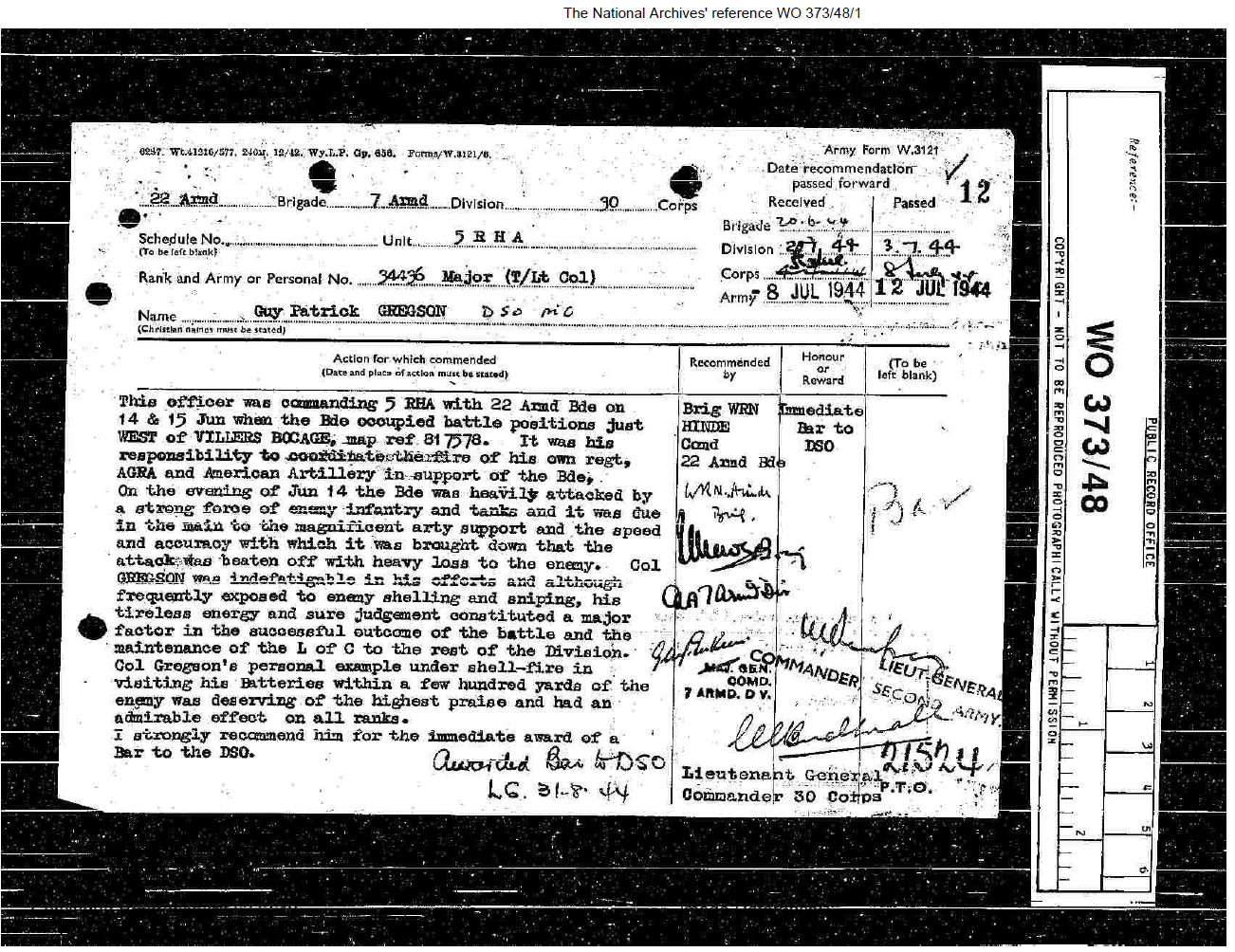
“It was due in the main to the magnificent artillery support and the speed and accuracy with which it was brought down that the attack was beaten off with heavy loss to the enemy.”
— Bar to DSO citation, WO 373/48/1The word magnificent appears in the citation and it was not casually chosen. British military citations of this period were written in a deliberately understated register — “gallant,” “determined,” “creditable” — and when a brigadier reached for magnificent, he was saying that what he had witnessed was extraordinary. The fire that Guy brought down on the Panzer-Lehr attack was not merely adequate. It was the kind of concentrated, precision-timed barrage that breaks an assault before it reaches the wire.
A hundred and sixty guns firing on pre-registered targets, the fall of shot adjusted in real time by forward observation officers lying in hedgerows within rifle range of the German infantry. Twenty-five-pounders at sustained fire, their barrels hot enough to cook on, the crews stripped to the waist in the Norman summer. AGRA mediums dropping their heavier shells onto the forming-up points where Bayerlein’s Panzergrenadiers were assembling. And from the Caumont heights, five miles to the south-west, the American 155s delivering their ninety-five-pound shells in a deep arc that cleared the bocage hedgerows and fell with a sound that survivors compared to an express train passing overhead.
The attack was beaten off with heavy loss. The citation does not specify how heavy, but the evidence of the ground, recovered by later historians, suggests that Panzer-Lehr took serious casualties in men and vehicles. Bayerlein, who had survived the North African campaign and would survive the rest of the Normandy fighting only to surrender his division to the Americans in the Ruhr, knew what concentrated artillery felt like. He had been on the receiving end of it at El Alamein. Now he was on the receiving end of it again, and the man directing it was the same kind of officer he had faced in the desert — a Royal Horse Artillery colonel who understood that in the bocage, where you could not see the enemy until he was on top of you, the guns were the only thing that could stop him before he arrived.
Over Open Sights
While Guy coordinated the fire plan from his command post on Point 174, one of his batteries was fighting at a range where fire plans ceased to matter and only the speed of the gun layer’s hands made the difference between living and dying. CC Battery, 5th Royal Horse Artillery, engaged German armour and infantry over open sights — direct fire, the gun pointing at the target, the crew able to see what they were shooting at. In the Royal Artillery, open sights meant close range. It meant the enemy was within a few hundred yards. It meant the gun was essentially a large-calibre rifle, and if you missed, the tank you were aiming at would not.
The twenty-five-pounder was not designed as an anti-tank weapon, although it could function as one at short range with its armour-piercing shot. CC Battery’s engagement was the kind of action that artillery units remember for generations — the moment when the gunners stopped being technicians and became something closer to infantry, firing at targets they could see with their own eyes, taking casualties from weapons they could hear being loaded. It was exactly the kind of fighting Guy had first encountered at Keren, three years earlier, when his Sudanese gun troop had been strafed by Italian bombers and his soldiers had asked him whether the British battery’s calmness was the correct way to behave.
The difference was that at Keren he had been a troop commander with four guns and a handful of men. At Villers-Bocage he commanded a regiment and controlled an artillery group, and his batteries were fighting simultaneously at ranges that varied from fifteen thousand yards to a few hundred. The span of that responsibility — the man on the ridge who must think in both miles and metres, who must keep the American 155s falling in the right place while one of his own batteries fights for its life at point-blank range — is what the citation means when it calls his energy tireless and his judgement sure.
“Within a Few Hundred Yards of the Enemy”
Brigadier Hinde’s recommendation, endorsed up the chain by Major-General Erskine at 7th Armoured Division, Lieutenant-General Bucknall at XXX Corps, and finally by the army commander, made a point of Guy’s personal conduct under fire.
“Col Gregson’s personal example under shell-fire in visiting his Batteries within a few hundred yards of the enemy was deserving of the highest praise and had an admirable effect on all ranks.”
— Bar to DSO citation, recommended by Brigadier “Looney” Hinde, 22 Armd BdeTo visit his batteries, Guy had to leave the relative safety of the command post on Point 174, move forward through the bocage under shell-fire and sniper fire, and present himself at gun positions that were already under direct observation and engagement by the enemy. A commanding officer who stays at his command post and directs the battle by radio is doing his job. A commanding officer who goes forward to his batteries under fire is doing something more — he is showing the men who are doing the dying that he is willing to be where they are, to share the risk that he is asking them to take. The citation calls this personal example. It is the oldest and most effective form of leadership in the British Army, and it was the quality that ran through every one of Guy Gregson’s commands, from the Sudanese cavalry troop that ran from the first bang to the gun lines in the bocage.
The phrase within a few hundred yards of the enemy is precise. In the bocage, a few hundred yards was very close indeed — close enough to hear German voices, close enough for a sniper to pick off an officer who showed himself above a hedgerow. Guy was thirty-eight years old, a lieutenant-colonel who had already won the DSO and the MC, and he chose to walk into that.
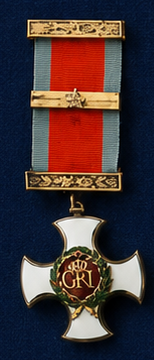
Hinde called it deserving of the highest praise. Four officers in the chain of command agreed. The Bar to the DSO was awarded as an immediate decoration — given in the field, not through the periodic honours list, because the action that earned it was considered too significant to wait.
The Line of Communication
There is a phrase in the citation that is easy to miss but which tells you something crucial about the scale of what Guy achieved: the maintenance of the line of communication to the rest of the Division. The 22nd Armoured Brigade was not fighting in isolation. It was the forward element of the 7th Armoured Division, and behind it — to the west, along the narrow Norman lanes — ran the supply route that connected the brigade to the rest of the division and, beyond that, to the beachhead. If that line of communication was cut, the brigade box at Point 174 would become not a defensive position but a pocket. And pockets, in Normandy in June 1944, did not last long.
Guy’s artillery did not merely beat off the counter-attack. It kept the road open. The guns, by breaking the German assault before it could envelop the position, preserved the line of retreat that the brigade would need when the order came — as it did, on the night of 14–15 June — to withdraw. The withdrawal from Villers-Bocage was conducted under fire, through the bocage, at night, and it succeeded because the route had not been cut. The reason the route had not been cut was that a hundred and sixty guns, directed by one man on a ridge, had made it impossible for Bayerlein’s Panzer-Lehr to close the trap.
The Chain of Endorsement
The Bar to DSO recommendation was written by Brigadier Hinde, who had watched the battle from the same ridge and who knew, because he was a professional soldier of considerable experience, what the artillery had done. It was endorsed by Major-General Erskine, the GOC of the 7th Armoured Division — the same Erskine who had commanded the division at Tunis, where Guy had won his first DSO. Erskine knew Gregson’s quality because he had seen it before. Above Erskine, Lieutenant-General Gerard Bucknall at XXX Corps added his endorsement, and above Bucknall the army commander signed off.
The fates of the endorsers are themselves a footnote to the Villers-Bocage story. Erskine was removed from command of the 7th Armoured Division in August 1944, amid controversy over the division’s performance in Normandy — a controversy in which the failure to hold Villers-Bocage featured prominently. Bucknall was sacked from XXX Corps the same month, replaced by Brian Horrocks, one of Montgomery’s most trusted lieutenants. The battle that earned Guy Gregson the Bar to his DSO was, for the officers above him, the beginning of the end. They were removed not because they had lost a battle — the box at Point 174 had held — but because the opportunity that Villers-Bocage represented had been squandered, and Montgomery wanted men who would not squander the next one.
Guy, the man who had actually held the position, was decorated. The men who had sent him there were fired. It is the kind of irony the British Army specialises in.
After the Bocage
The 5th Royal Horse Artillery continued with the 7th Armoured Division through the rest of the Normandy campaign and into the breakout, across France, through Belgium, and into Germany. The bocage fighting gave way to the open country that the Desert Rats understood — the long pursuits, the river crossings, the armoured thrusts that carried the division to the German frontier.
Guy received a second Mention in Despatches on 22 March 1945, covering the campaign from Normandy through north-west Europe. After the war, the French government awarded him the Croix de Guerre, gazetted on 24 June 1947 — a recognition, three years after the fact, that what he had done at Villers-Bocage and in the subsequent fighting had been done in their country and for their liberation.
But it is the Bar to the DSO that defines the chapter. Two DSOs for two battles, Tunis and Villers-Bocage, twelve months apart, both won with the same regiment in the same brigade in the same division. In both cases the citation was written by the brigade commander. In both cases it was endorsed by Erskine. In both cases the decisive factor was the same: Guy Gregson’s ability to coordinate devastating artillery fire while personally exposing himself to enemy action at the forward edge of the battle.
At Tunis, the language had been total disregard for his own personal safety. At Villers-Bocage, it was indefatigable and tireless energy and sure judgement. The portrait that emerges from the two citations, read side by side, is of an officer who was not merely brave — bravery in 1944 was common enough to be unremarkable — but effective under fire in a way that changed the outcome of battles. He could think while being shot at. He could plan while his batteries fought at point-blank range. He could walk forward into the bocage, visit a gun line under sniper fire, adjust the fall of shot, and walk back to his command post to direct the American 155s onto a different target entirely.
The man who had laughed when his Sudanese cavalry troop ran from the first bang had become, by June 1944, one of the most effective artillery commanders in the British Second Army. The skills were Woolwich’s. The nerve was Keren’s. The judgement was thirteen years of shooting, from pack howitzers on the Nile to a hundred and sixty guns in the Norman hedgerows.
Explore Further
- Read the DSO citations on the Awards page — Tunis and Villers-Bocage in the original language
- Villers-Bocage on the map — Point 174, the bocage, and the line of retreat
- Listen to Guy’s voice — the Sudan years, recorded at Bears Farm in 1979
What We Don’t Know
The most significant unresolved question is the landing date. The 5 RHA unit history records the regiment landing in Normandy on 8 July 1944 — D+32 — which is twenty-four days after the date on the Bar to DSO citation. The citation, signed by four senior officers including the divisional and corps commanders, places Guy at Villers-Bocage on 14 June. Either the unit history’s landing date is wrong, refers to a rear echelon, or Guy was attached to a different formation for the initial phase. The citation is a primary document and takes precedence, but the discrepancy needs resolution.
The 5 RHA war diary, if it survives at the National Archives (likely under WO 171), would settle the question and provide the operational detail that the citation only summarises. It would name the batteries, the ammunition expenditure, the casualties, the map coordinates of the gun lines. It would tell us exactly where CC Battery fought over open sights, and at what range.
Guy’s IWM oral history, recorded in 1979, covers only his Sudan years. He does not speak of Villers-Bocage, Tunis, or the Western Desert. Whether additional recordings exist, or whether family letters survive from the Normandy period, is unknown.
Research Plan
- 5 RHA War Diary (WO 171) — National Archives. Would resolve the landing date discrepancy and provide the operational narrative of 13–15 June 1944.
- 22 Armd Bde War Diary (WO 171) — The brigade-level perspective. Would show how Hinde organised the box at Point 174 and how Guy’s fire plan was integrated.
- 33rd Field Artillery Battalion records — US National Archives (NARA). The American guns at Caumont. Their fire missions on 14–15 June would confirm the combined British-American artillery coordination.
- Panzer-Lehr Division records — Bundesarchiv-Militärarchiv, Freiburg. Bayerlein’s after-action report would give the German view of the artillery barrage.
- 4 or 5 AGRA War Diary (WO 171) — Identifying which AGRA supported the 22nd Armoured Brigade at Villers-Bocage and how many guns it contributed.
- Henri Marie’s Villers-Bocage Through the Lens — The definitive photographic and tactical account; may contain 5 RHA references.